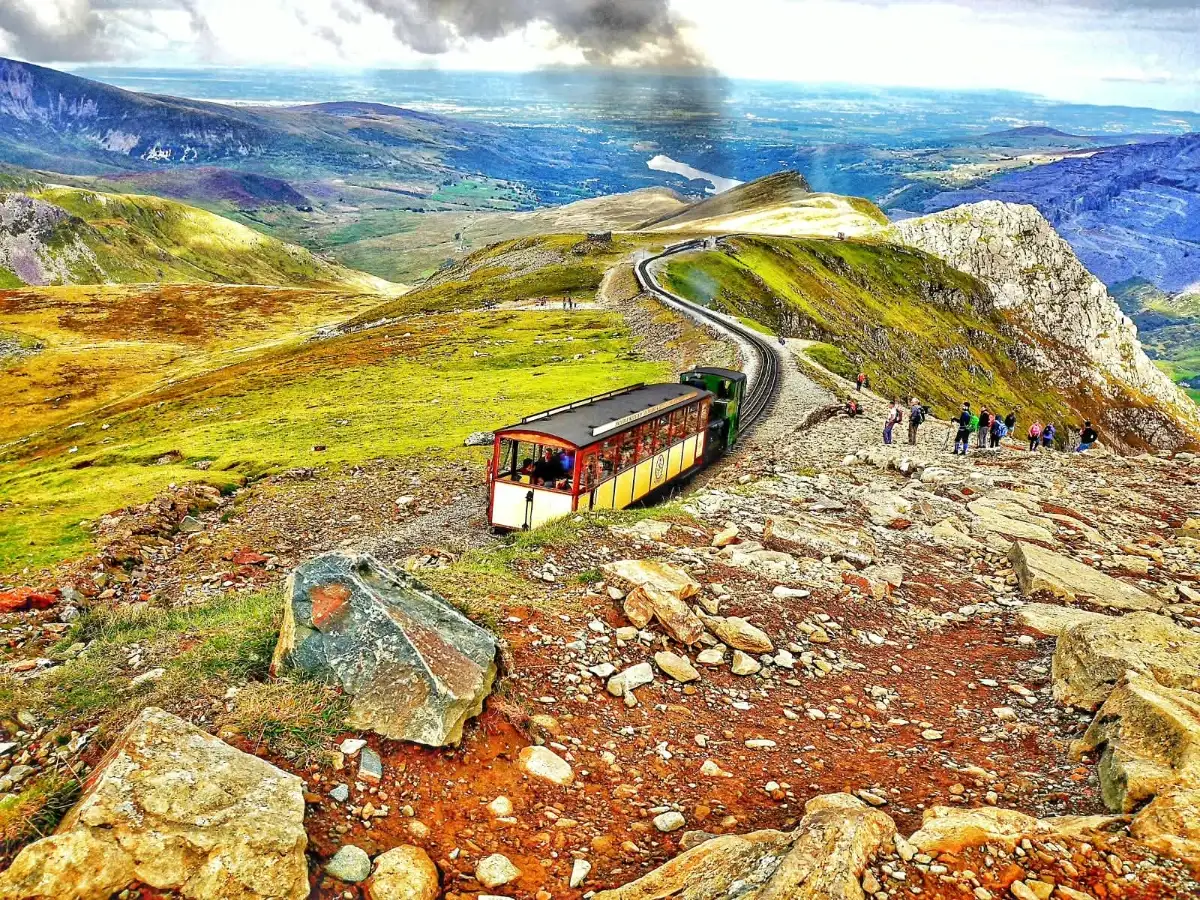
On April 6, 1896, a new steam train was making its second round-trip journey down Britain’s highest mountain in Wales, having transported its first set of passengers successfully. Suddenly, the rack failed, the locomotive ran down the hillside, and one traveler fell off and died from his injuries. Meanwhile, a second train, oblivious of the crash ahead in the fog, collided with the wreckage. Such a disaster might have put an end to further development of the transport system connecting the region with Snowdon’s peak, but instead, the Snowdon Mountain Railway was rebuilt and re-opened a year later.
To this day, the facility has been serving tourists, being in commercial operation for over a century. According to the official record of a UK Parliament inquiry into the incident, the engineers concluded that the locomotive had climbed on the rack because the newly laid track had sunk under the weight of the vehicle. Probably, the combination of snow melting and the load on the rails affected the instability of the locomotive, which was too heavy for the road.

The solution turned out to be incredibly simple
Perhaps it is the simplicity, as well as the ordinariness of the technical intervention, that seems surprising to a modern reader. The mountain was not changed; instead, the train was lightened and slowed down. The new regulation reduced the maximum train weight by fifty percent, while the new carriages were much lighter. In addition, a mechanical “gripper” was attached to the locomotive to hold it back on the rack in case of similar accidents in the future. The line reopened at the lower station in September 1896, and at the summit in 1897. Since then, it has run almost without serious incident, the main exceptions being two wartime closures and a minor 1906 mishap, when a loose wagon rolled into a train and injured one passenger, nothing close to the scale of the 1896 crash. This solution appears almost old-fashioned in its simplicity and robustness.
The mountain is now the problem, not the train
It is noteworthy that Snowdon, or, as it is called in Welsh, Yr Wyddfa, is now faced with the reverse problem of carrying too many visitors. The railway transports passengers along a 4.7-mile route from Llanberis (353 ft above sea level) to the summit station, which is located at an elevation of 3,493 ft (close to the peak of 3,560 ft). However, this tourist infrastructure is only one of the ways to reach the top of Wales. Despite the national park authorities' efforts to establish a coordinated system for tourist management, the entire mountain is overwhelmed with visitors.