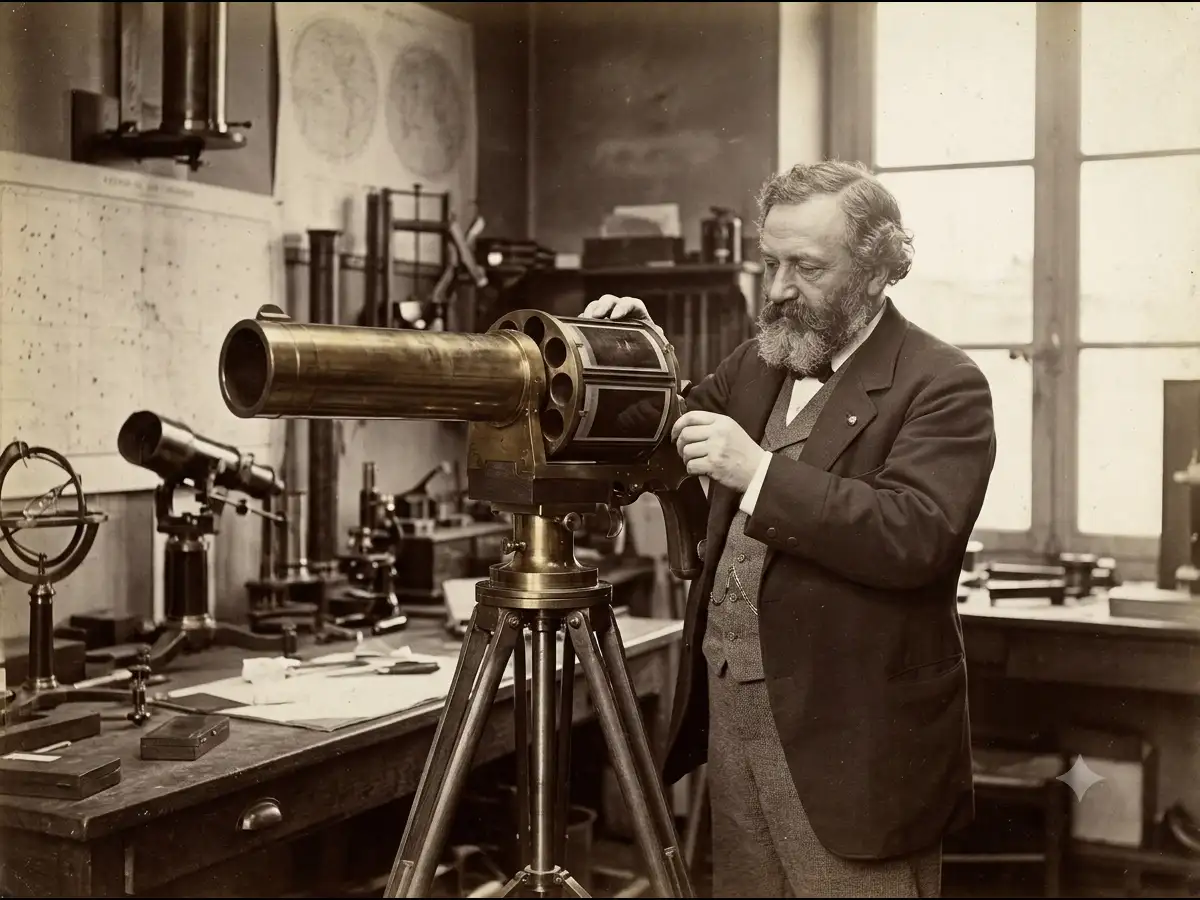
In 1873, a French astronomer invented a unique device 'photographic revolver' which could automatically capture a sequential series of photographs. The device was created by French astronomer Pierre Jules César Janssen. It was designed for astronomical observations and was later used during the 1874 transit of Venus. The instrument allowed Janssen to record a sequence of images without manually taking each photograph. The device became known as the photographic revolver because its mechanism used a rotating cylinder. Its design was inspired by the revolving cylinder of Samuel Colt's firearm. However, the purpose of Janssen's instrument was scientific observation and photographic recording.
The invention is connected to the development of chronophotography, a method in which several photographs are taken one after another to record movement or changes over time. The approach later became important in the development of motion-picture technology.