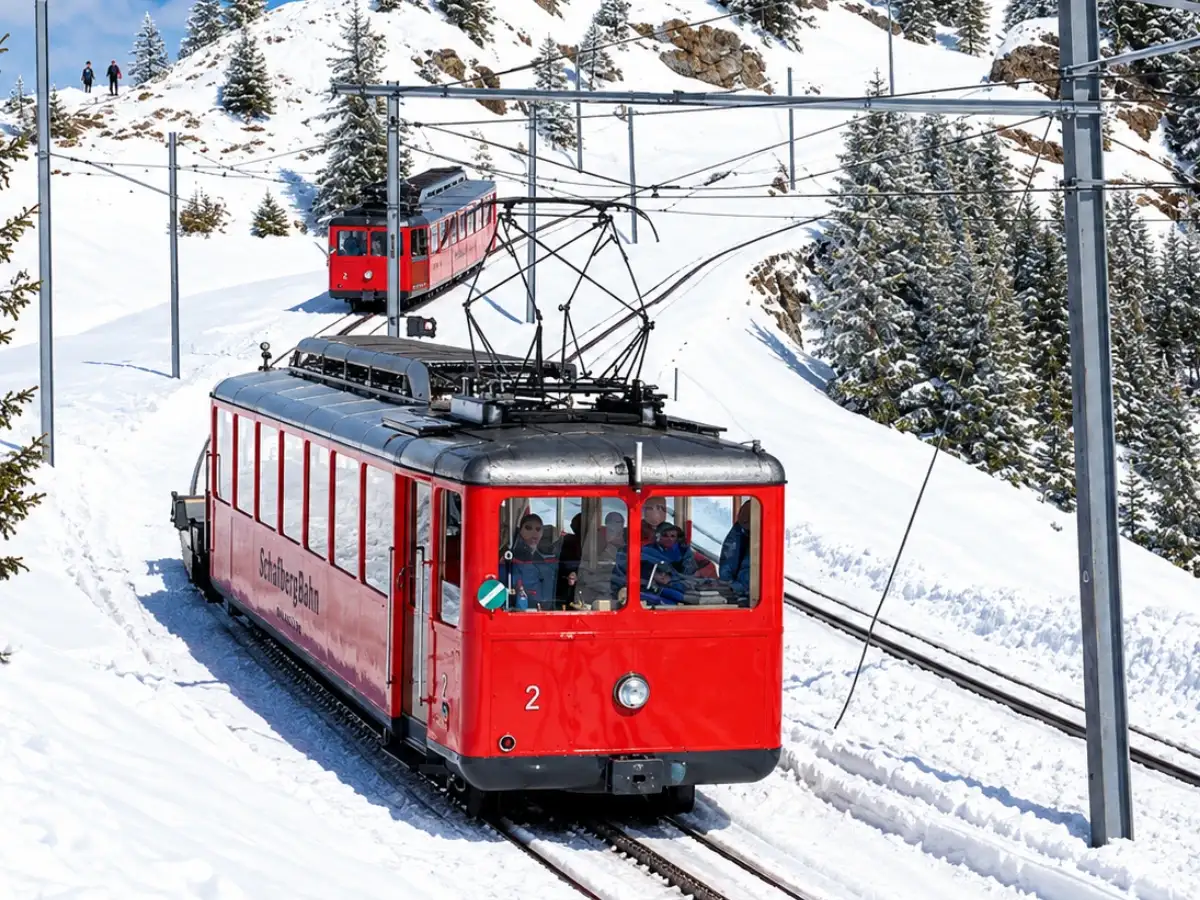
Somewhere in Switzerland runs a train track with a third rail down the center, cut with teeth like the rungs of a ladder. Under the train is bolted a matching gear that locks into the teeth, so that the wheels cannot slip even on a steep slope. The first system of this type in Europe was built by Switzerland in 1871 on Mount Rigi. The same rack-and-pinion grip system is still carrying passengers up the mountain today, 155 years later, according to a retrospective published by House of Switzerland, the outreach arm of the country's Federal Department of Foreign Affairs.
Why regular trains couldn’t climb high mountains
A standard train wheel grips the rail by plain friction, just like a shoe grips a sidewalk. This works well on level ground. But when a slope gets much steeper than about 4 percent, the wheels begin to slip, especially in rain or snow. Rigi is 1,797 meters high, and before the 1870s visitors could only reach the top on foot, on horseback, or by carriage. The mountain was already a tourist attraction, but the hike was slow and hard, and it ruled out anyone who wasn't fit enough for a long walk.
An engineer solves the grip problem
The solution was found by a Swiss locomotive builder, Niklaus Riggenbach, who lived in Olten. Riggenbach had patented his rack-and-pinion system in France in 1863. The Historical Dictionary of Switzerland states that in 1867, the engineer Carl Culmann, of ETH Zurich, reviewed and publicly endorsed Riggenbach's design, developed as a flat rack in the shape of a ladder between the two normal rails, lending it the institutional credibility that helped secure the Swiss construction concession. Underneath the locomotive, a toothed wheel engaged the rungs of that ladder, giving the train enough grip to climb without slipping, and enough control to brake safely on the way down. Riggenbach tried the idea on Rigi. Work began on the line from the lakeside town of Vitznau in 1869, and it opened to the public on 21 May 1871, the first such mountain railroad in Europe.