Get all your news in one place.
100's of premium titles.
One app.
Start reading
Fit & Well
Fit & Well
Health
Lou Mudge

If you struggle to sit cross-legged, a Pilates instructor suggests opening your hips with these four exercises

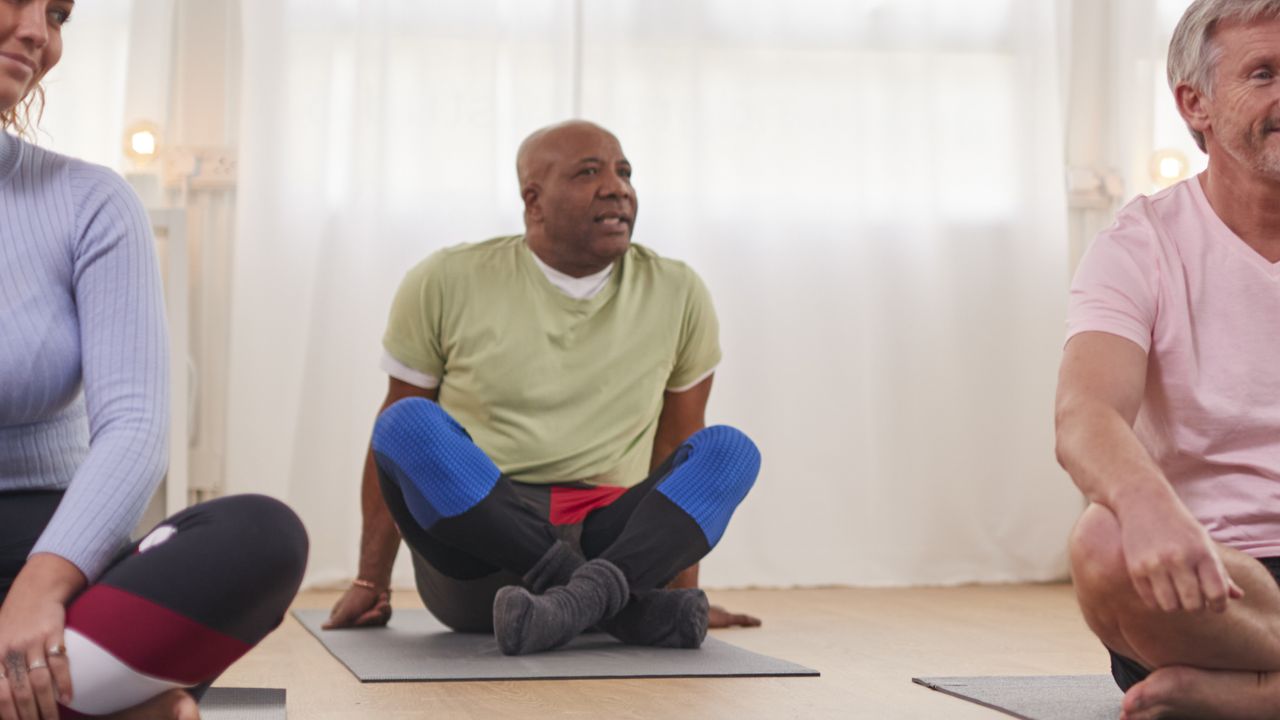
Man in yoga class sitting with his legs crossed looking less comfortable than other students.

If you ever look wistfully back on the days you had the hip mobility to sit cheerfully for long periods cross-legged, you are not alone.

Most adults rarely sit in that position and some have lost the range of motion to even try.

Jill Drummond, a NASM-certified personal trainer and vice president of fitness at BODYBAR Pilates, explains that a cross-legged position requires a combination of hip joint mobility, and muscle flexibility and strength.

“If any of these qualities are compromised, an individual may experience tight hips and difficulty sitting cross-legged,” she says.

“To combat this, we must address tightness and strength in the glutes, hip flexors, inner thighs, hamstrings and surrounding connective tissue.”

She notes that if the natural shape of your hip joint also contributes to immobility, rather than your muscles, then a cross-legged position may never be the most comfortable position for you.

That said, you can still benefit from hip strengthening and stretching and can still gain some additional range of motion.

Drummond recommends trying the following movements to create more space and ease in your hips.

1. Elevated glute bridge

Reps: 15-20

How to do it:

  • Lie on your back with your knees bent and your feet on a yoga block or step, hip-width apart.
  • Squeeze your glutes and raise your hips, feeling your inner thighs activate too.
  • Pause at the top of the movement, squeezing your glutes but without arching your lower back.
  • Lower your hips to the floor with control.

Drummond says: “The glute bridge strengthens the posterior chain, with a primary focus on the glutes and hamstrings while also engaging the calves and core.

“It challenges stability and coordination as it promotes hip extension and opens the front of the hips, creating a powerful combination of strength, stability and mobility that supports healthy, resilient hips.”

2. Supine butterfly stretch

Time: 30-60sec

How to do it:

  • Lie on your back with your arms by your sides, your knees bent and your feet flat on the floor.
  • Bring the soles of your feet together, letting your knees drop out to the sides.
  • Relax your lower back and breathe deeply, holding the stretch for time.

Drummond says: “The supine butterfly stretch gently opens the hips and inner thighs while helping release tension through the adductors and hip flexors.

“The body is fully supported on the floor, so it encourages relaxation, deeper breathing and improved mobility without placing stress on the spine.”

3. Hip-strengthening series

Drummond says: “This series strengthens and mobilizes the muscles that support healthy hip function, including the gluteus maximus, the hip abductors (such as the gluteus medius), and the hip adductors (including the adductor magnus).

“Find a stable hands-and-knees position, then work through the following movements, performing 10 repetitions of each movement, then repeating on the opposite leg.”

3A. Donkey kick

Reps: 10 each side

  • Start on your hands and knees, with your shoulders over your hands and your hips over your knees.
  • Squeeze your glutes and engage your core .
  • Raise and extend your left leg behind you to hip height.
  • Bend your knee to return to the starting position.

3B. Wide sweep

Reps: 10 each side

  • Lift and extend your left leg behind you to hip height, pointing your toes—this is your starting position.
  • Sweep your leg out the side, rotating from your hip.
  • Return to the starting position.

3C. Lift and lower

Reps: 10 each side

  • Lift and extend your left leg behind you to hip height, pointing your toes—this is your starting position.
  • Raise your left leg without arching your back.
  • Lower your left leg to tap your left foot on the floor.
  • Continue, alternating between these two positions.

3D. Hamstring curl

Reps: 10 each side

  • Raise your left leg behind you to hip height, keeping a 90° bend in your knee and your foot flexed—this is your starting position.
  • Bend your left knee to move left heel toward your left glute.
  • Extend your left knee to straighten your left leg.
  • Continue, alternating between these two positions, keeping your thigh horizontal throughout.

4. Runner’s lunge

How to do it:

Reps: 8-10 each side

  • Begin in a high-plank position with your shoulders over your hands and your legs extended behind you, balanced on your toes.
  • Move your left foot forward to the outside of your left hand and place it flat on the floor.
  • Let your hips gently sink toward the floor.
  • Step your foot back to a plank position and repeat on the other side.
  • Alternate sides, moving with your breath.

Modification: For less intensity, lower your back knee to the floor when in the lunge position.

Drummond says: “The runner’s lunge stretch lengthens the hip flexors, quadriceps and calves while improving mobility through the hips and ankles.

“It also helps counteract the effects of prolonged sitting by promoting greater range of motion and reducing tension in the front of the hips.”

Sign up to read this article
Read news from 100's of titles, curated specifically for you.
Already a member? Sign in here
Related Stories
Top stories on inkl right now
One subscription that gives you access to news from hundreds of sites
Already a member? Sign in here
Our Picks
Fourteen days free
Download the app
One app. One membership.
100+ trusted global sources.