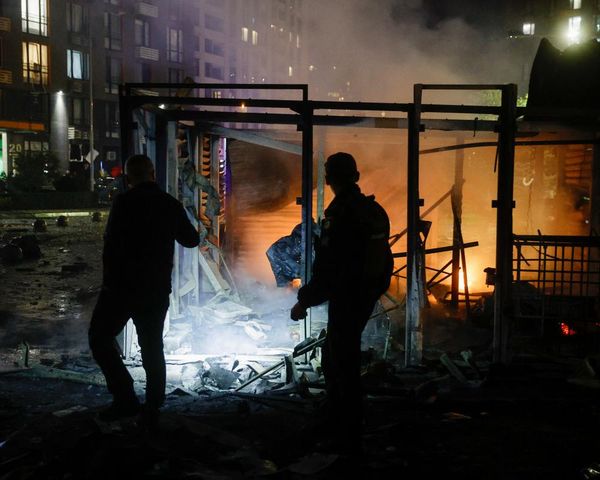
An Immigration and Customs Enforcement (ICE) officer fatally shot a motorist on Monday in Biddeford, a coastal town in Maine about 24 kilometres from Portland. It is the second time in a week that ICE has resorted to lethal force, and the ninth death recorded since President Donald Trump launched his crackdown on irregular immigration.
Migrant rights groups identified the dead man as a 26-year-old Colombian; the Colombian embassy confirmed it is in contact with the US authorities and is providing consular support to the family.

Conflicting accounts of what happened
The Department of Homeland Security said in a post on X that its officers had been monitoring the home of a person with a final deportation order and that, when they tried to stop a vehicle leaving that address, the driver attempted to flee; fearing for public safety, one of the officers opened fire.
However, Maine senator Angus King gave a different account after speaking to Homeland Security Secretary Markwayne Mullin: according to his version, the officer fired because the man had allegedly tried to use his car as a weapon against the agents in Biddeford, who were not wearing body cameras.
Mullin also told King that officers had gone to the scene to execute an arrest warrant that did not correspond to the person who was ultimately shot, correcting an earlier statement. Asked about these conflicting versions, King was cautious in an interview with the US network CNN.
"Did this young man really try to run down an ICE officer, or was he at risk of running over other people in the street? Was there a reasonable expectation of bodily harm or lethal force that would justify this shooting?".
Republican senator Susan Collins said Mullin had informed her that the case is being jointly investigated by the Department of Homeland Security’s Office of Inspector General and the FBI. Maine’s attorney general, who is also investigating, has said that initial statements indicate the driver was trying to flee towards the officer, who has already been suspended from duty.
"I tried to stop"
Daniel Boucher, who lives in the area, said he heard several shots and saw a small car turned 90 degrees towards the pavement with an SUV behind it; the wounded man’s vehicle kept moving down the street until the other car rammed it. "I clearly heard the victim say, 'I tried to stop'," Boucher recounted, his voice breaking.
Boucher also said that after he challenged the officer who fired, the latter replied that the man had tried to run him over. Security-camera footage from a nearby building, obtained by the Associated Press, shows a white vehicle approaching a junction at moderate speed and circling several times before a police pickup blocks its path and two officers pull a limp body from the driver’s seat; the footage does not capture the precise moment when the shots were fired.
A shattered family and a shaken neighbourhood
Two migrant advocacy organisations, the Maine Immigrants’ Rights Coalition and Presente!, confirmed that the man was authorised to work in the United States. His family contacted the Coalition after the shooting, although they did not yet feel ready to speak publicly, according to its executive director, Mufalo Chitam.
A neighbour, Mary Hayes, said the man lived nearby with his wife and daughter: "I saw a woman fall to her knees when she saw her husband’s lifeless body on the ground. I saw a little girl crying with a small pink backpack because she would never see her father again." Another resident, Sadie Dilboy, remembered him as a regular customer at her launderette, where he brought his daughter and gave her coins for the sweets machine: "He was such a good person. He was always so neat".
Protests in Biddeford and an escalating migration crackdown
Several hundred protesters gathered in Biddeford on Monday night to demand the abolition of ICE, facing a smaller group of supporters of the agency and of Trump. "We will always be a city of immigrants," declared the speaker of the Maine House of Representatives, Democrat Ryan Fecteau. The episode comes on top of another deadly ICE shooting on 7 July in Houston, when plainclothes agents in unmarked vehicles pursued and killed 52-year-old Lorenzo Salgado Araujo.
Both incidents are part of a mass deportation campaign that, in just five days at the end of June, led to more than 10,000 arrests. According to data from the Deportation Data Project at the University of Berkeley, ICE detained 546 people in Maine between the start of Trump’s second term and 11 March 2026, of whom only 45% had criminal records, compared with 69% in a similar period before Trump first took office.