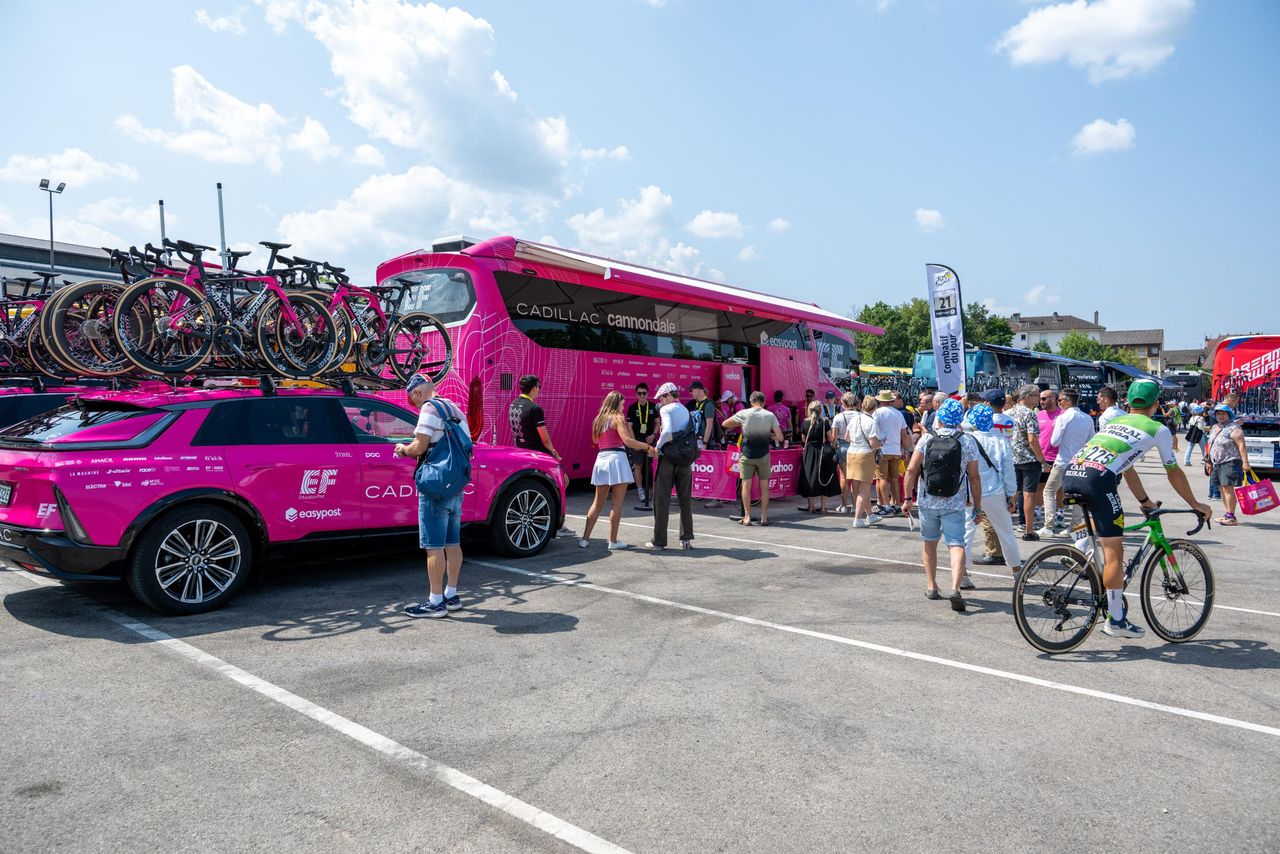
EF Education-EasyPost team manager Jonathan Vaughters has defended night-time anti-doping tests at the Tour de France.
He suggested that if such tests had been carried out when he was racing 25 years ago, it could have exposed more cases of doping and "saved the sport 25 years of drama."

Vaughters posted his initial thoughts on social media and then spoke further to Cyclingnews and other media before the stage 16 time trial in Évian on Tuesday morning.
He said that limited night-time testing is a good thing and openly apologised to the current generation of riders who he suggests are still facing the consequences of the doping of his own generation.
Vaughters was a teammate of Lance Armstrong at the U.S. Postal Service team and later testified in the U.S. Anti-Doping Agency's investigation that led to Armstrong losing his seven Tour de France victories.
Current Tour de France race leader Tadej Pogačar (UAE Team Emirates-XRG) and Jonas Vingegaard (Visma-Lease a Bike) revealed that they were awoken during the night before stage 15 for night-time anti-doping tests. Cyclingnews understands that other teams have been visited for testing outside of the usual 6:00 a.m. to 11:00 p.m. window, which is not typical but which is provided for within the UCI's rules.
Being selected for a test, including out-of-hours, is a standard part of anti-doping controls and does not imply any suspicion of, or wrongdoing by, the riders concerned. Pogačar, Vingegaard and any other riders in the Tour peloton have not been accused of any anti-doping violation.
Vaughters reiterated his thoughts and spoke at length at the start of the Tour de France stage 16 time trial on July 21, 2026.
We have published the interview in a Q&A format, with slight edits in parts for clarity.
Jonathan Vaughters Q&A
Jonathan Vaughters: I don't love it for the riders, I don't like that their sleep is being disturbed. However, when it comes down to it, it is very difficult to detect hormones and peptides such as EPO, human growth hormone, et cetera. The clearance time on a lot of these can be quite quickly [the time it takes for a substance to leave your body]. So one of the very few weapons anti-doping agencies have to make sure that there's not a microdosing effort going on is to basically be able to test whenever they can.
My opinion is, although I don't like that they lost sleep, and I don't love that, but I would rather lose sleep than lose credibility.
My guess is that those tests are going to turn out to be fine and that then you've established more credibility for the sport than we had before, and we're showing that we're doing something that no other sport is even coming close to doing in terms of anti-doping testing
So, I get the concerns over it, but I think from a very big picture standpoint, it helps the sport, and it helps those riders show what they're doing transparently.
Question: But there are a lot of insinuations now because they have to have a clear reason to do those tests at midnight. It's not standard protocol. That creates, of course, an atmosphere that is not positive for cycling.
JV: We don't know when [the International Testing Authority sought authorisation from a French judge to conduct out-of-hours testing]. Unfortunately, the history of cycling, which I was part of the problem, to be blunt. Because of that history, you're going to be able to find a French judge that is going to give you a favourable warrant to exercise that sort of extreme protocol.
My guess is that they're not basing that warrant on any specific suspicion that they were able to get the warrant based on performance, based on the history of the sport and who knows what else.
I don't think we should read too much into that because I think it would be very easy to find a French judge that would be favourable to issuing that sort of thing because of the history of the sport, and that's unfortunate, but here we are.
[Editor's note: French publications L'Equipe and AFP reported on Monday that the ITA sought permission for overnight testing from a French judge, under French sports code article L232-14-4, which requires additional permission for tests between 11 p.m. and 6 a.m. Additional permission was granted per specific test, Cyclingnews understands. It is unclear when the permissions were sought, or the reasons for the request. The ITA states: "The timing of a control is determined through a risk-based assessment that takes into account a range of relevant factors and information. It is therefore not arbitrary, but nor should it be interpreted as evidence that a rider has committed an anti-doping rule violation.]
Q: Should this kind of testing already have been done in your time when you were racing?
JV: 100%. I said this yesterday on Twitter, but I'll say it again now, that if we had had 2 a.m., 4 a.m. testing in 2000, 2001 when the EPO test was first introduced, we would have had a huge number of riders immediately banned from the sport then, including me, and we would have saved the sport 25 years of drama.
[Editor's note: The World Anti-Doping Agency (WADA) first introduced provisions for overnight testing in January 2015. It was allowed in France later that year. The UCI follows the WADA code, with the ITA administering testing on its behalf.]
We wouldn't have had to go through the whole Lance Armstrong and this and that, blah blah blah. No, it wouldn't have happened because the problem would have been solved immediately in the race in 2000. Would you trade 25 years of drama for a few wake-up calls? I think the answer would be yes.
Q: Is the current generation paying for the mistakes of the previous generation?
JV: In my opinion, yes, I think definitely that this current generation is paying for the reputation of the sport previously.
My guess is, again, I don't know this, but it would be much more difficult to go to a French judge and get this sort of warrant executed for a football team. Whereas with the cycling team, the previous generation probably facilitated that. For sure they are, and so for that part I feel very sorry for. We should have been doing this years and years ago. And maybe if we had been doing it years ago, we wouldn't have to be doing it right now.
Q: You tweeted that maybe your generation should apologise to the current generation for what's happened.
JV: Yes, 100%. I'm willing to say that directly to the camera that I do think that we should apologise to the current generation for the atmosphere that they have to function under nowadays with regards to anti-doping.
Q: Have there been tests last night at EF? There were a lot more tests, not in the middle of the night but later in the evening.
JV: Yeah, we were tested at about 10 p.m. last night. So, not 2 a.m., but late in the evening.
Q: Have you been tested at all before last night out of hours, any sort of outside of the window testing out of this?
JV: No.
Q: And what about previous Tours? Maybe since you've been a manager.
JV: I've never heard of a 2 a.m. test before. That doesn't mean it hasn't happened. I'm not sure, but I don't think that those two, Vingegaard and Pogačar, were the only people tested. There were others, but I don't know who they were.
I can tell you they weren't on our team, but I think there were others. Which probably should have remained private, but it's only because the riders started talking about it that it's a controversy.
Q: Do you believe that there's a tangible difference between a 2 a.m. test, a 10 p.m. test, and say a breakfast test, 6 a.m.?
JV: Yes, absolutely. If you are introducing a low enough dose of sort of a peptide hormone, you know, the clearance time can be four hours. So if you were to take that at 11 p.m., that means it's cleared out of your system at 3 a.m. So yes, there is a difference.
Now, of course, testing technology is evolving very quickly. Maybe it won't be necessary in a few years, but I do understand why they're doing it now.
Q: There's a lot of controversy, a lot of riders complaining. You're obviously taking a slightly different view to most. Is that something you communicate to the team, and how do the riders feel about this whole topic?
JV: I explained it to my riders exactly how I'm explaining it to you. I said, 'Listen, here's the background', and I said if we'd done this in 2001, 25 years ago, you would have never had all these scandals, and it would have been 'You're not racing, see you later, see you two years from now'.
I explained to them that if they had implemented this earlier, the sport would be in a better place, a more credible place. There probably wouldn't have been nearly as many scandals like Operation Puerto. A lot of those were based on this ability to microdose, in addition to the blood doping.
I could get into the technicalities of all that, but it would take forever. That it didn't happen in our generation means basically they're sort of paying the price for it. But it's good that it's happening now.
And I just said: 'Guys, just be thankful that like it's, this is cycling re-earning its credibility and that you guys are getting to race in a cleaner environment and that you're getting to prove that you're racing in a cleaner environment by this stuff happening.'
I apologised to them. I said, 'Listen, I'm sorry that I'm sort of the cause of this, but this is good'. But at the same time I would never tell them to speak to the media and say you have to say it's good too. I said: 'Your opinion is your opinion on this. You're free. I'm just giving you the scientific background of how this works and why they're doing it and then the history as to why it's happening.'
Q: Have you noticed an uptick in general in this Tour in terms of the amount of testing that's been done in hotels, not necessarily out of hours
JV: Not for our team, no. But I don't know what the overall numbers are.
Q: Are you confident that fans at home can believe what they're seeing in this Tour de France? Because obviously the headlines are going to say one thing but the reality can be much different.
JV: Let's be clear. I think getting French judicial permission was probably fairly easy for a bike race, so I don't actually think you should read into that. I think that the fact that the tests are going on at 2 a.m, that's a step that no other sport is even coming close to making. So if you want to trust a sport, you should trust cycling because [in] most other sports, bluntly put, the testing is a complete joke.
So if you're going to watch other sports, pretty much any other professional sport, understand that you're watching sports that the testing is essentially a joke compared to this. If you want to watch a clean sport, watch cycling.
Now, why is cycling so hyper-focused on this? Well, it's the history, but also this is human Formula 1 car racing. This is the edge of human performance. Boundaries are always going to be pushed. If we want to keep that in the confines of the rules, you're always going to have to push back. This isn't like kicking a ball around or whatever.
This is human motors. Is doping a risk factor? It's always going to be a risk factor, but that means you also have to take equally extreme measures to keep it within the bounds of the rules. So I'm supportive of that.
Q: Do you believe that the riders can push the boundaries of the sport if their sleep is so massively interrupted?
JV: It sucks, and if it happened all the time, I would probably be a little bit more circumspect than I am with this. But the fact of the matter is it's happening once or twice a year, is a great deterrent. I mean: lose a little sleep, gain a lot of credibility.
Q: What percentage would you say of the testing protocols going on right now is sending a message, and what percentage is now looking for something?
JV: I couldn't answer that because it's just that's inside ITA. I don't know what they're doing. They're not going to tell me.
The world’s biggest bike race deserves world-class coverage. Subscribe to Cyclingnews for unlimited access to our unrivalled reporting of the 2026 Tour de France. From Barcelona through to Paris, our experienced team will bring you breaking news, expert insight, and in-depth coverage from every stage as the battle for the yellow jersey plays out. Plus, access the Cyclingnews app to follow the action on the go! Find out more.