Get all your news in one place.
100's of premium titles.
One app.
Start reading
Tom’s Guide
Tom’s Guide
Technology
Dan Bracaglia

I went to Sweden to watch bike helmets get smashed into anvils — 3 things I learned at the MIPS test lab

Behind the scenes at the MIPS helmet test lab in stockholm, Sweden.

I flew all the way from Seattle, Washington, to Stockholm, Sweden, to watch bike helmets get smashed into heavy metal anvils over and over again, all for science.

I was invited on behalf of MIPS, which stands for Multi-Directional Impact Protection System. MIPS isn’t a helmet manufacturer, but there’s a good chance your bike, ski, snowboard, motorcycle, or equine helmet contains MIPS technology.

(Image credit: Dan Bracaglia/Tom's Guide)

MIPS-equipped helmets — which all carry a small yellow circular logo near the rear — are widely regarded as the safest and the best helmets in the biz. As an avid outdoor enthusiast and gear tester, nearly all of the helmets I own carry the yellow dot. But why exactly makes MIPS helmets so superior to the competition? I had to find out. So, I packed my bags and split for Scandinavia.

There, I got a behind-the-scenes tour of the MIPS helmet test lab, where I saw helmet testing first hand (it’s more violent than I expected!). I also got to ask tons of questions and document the whole process.

With no shortage of cranium-defending insights to share with you, below are the three biggest things I learned from my time with MIPS.

1. MIPS helmet tech mimics how your skull protects your brain

(Image credit: Dan Bracaglia/Tom's Guide)

MIPS helmets reduce the risk of brain injury by minimizing rotational force when you hit your noggin. Researchers have known that rotational force is bad for the brain since the 1940s, but it wasn’t until MIPS debuted over a decade ago that the helmet industry seriously attempted to reduce it.

Similar to how your skull protects your brain, upon impact, MIPS creates relative motion between the inside of the helmet and your head by 10 to 15mm on average. The result is a notable reduction in the severity of brain-related injuries compared to non-MIPS helmets. More simply put, MIPS lets your helmet slide slightly when you fall, and that absorbs quite a lot of energy.

It’s worth noting that MIPS is an “ingredient” brand with 12 versions of the system for all sorts of different helmet styles and types. MIPS also works with over 150 different helmet brands, licensing their technology and performing testing to ensure the addition of MIPS measurably improves the performance of each and every helmet by a repeatable margin.

2. They smash a whole lot of helmets into anvils at the MIPS test lab

(Image credit: Dan Bracaglia/Tom's Guide)

A lot of helmets get smashed in the MIPS test lab on a daily basis. As noted above, every single helmet that carries the MIPS yellow dot is extensively tested in the lab against an identical model without MIPS. Not only that, MIPS tests every size variation as well.

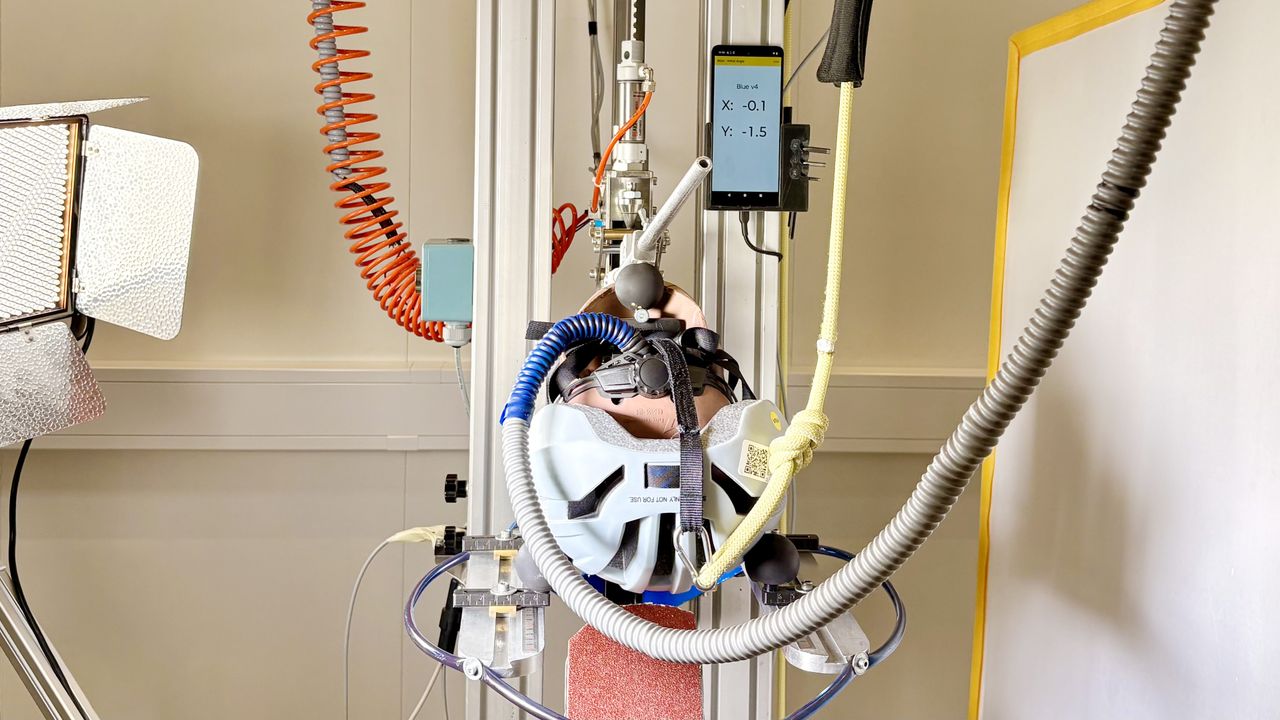
To test a helmet, it gets attached to a size and weight-accurate dummy head with nine accelerometers inside. That head then gets lifted in the air on a rig to a predetermined height before it’s dropped onto an angled 45-degree metal anvil, simulating a fall.

Each helmet receives four impact tests, including the front and rear, as well as a lateral and pitched impact. Between the accelerometers and several super-high-speed video cameras recording the commotion, the MIPS team learns a lot about how a helmet performs from these tests.

According to Marcus Seyffarth, the head of MIPS testing, the lab assesses roughly 1,000 helmets a month for performance. In my time there, I saw no fewer than three helmets get smashed. They even have a giant numeric tally board to keep track of the total helmets tested since MIPS founding.

3. Helmet testing also involves advanced digital models and even cadavers

(Image credit: Dan Bracaglia/Tom's Guide)

Lab testing isn’t the only way MIPS assesses helmet performance. The MIPS Virtual Test Lab seeks to bring computerized helmet testing up to speed with the car industry, which has largely moved on from traditional crash tests.

Using the Finite Element Method, the virtual lab breaks down the different parts of a helmet into a matrix of components based on their material-specific properties. They then test and record how each component performs under stress. Those results get added to a database, which is referenced during virtual testing. This lets researchers simulate how a MIPS-equipped helmet will perform, without ever smashing a thing, with impressive accuracy.

(Image credit: Dan Bracaglia/Tom's Guide)

Other forms of helmet testing involve reviewing real-world crashes where a MIPS helmet was involved. This includes analyzing camera footage of the crash from different angles, if available, as well as medical images of any resulting injuries, and of course, the helmet itself. Once all the data is collected, MIPS generates a computer model to mirror the accident.

I’d never given much thought to all the testing and technology involved in designing a solid-performing helmet. However, now that I’ve seen it first-hand, I'll never look at the humble brain bucket the same again.

Finally, a portion of the helmet testing performed by MIPS involves dropping actual cadavers. Researchers insert small markers into various areas of the brain tissue to monitor the severity of an impact. It’s worth noting that this testing doesn’t occur at the MIPS facility, but rather at the Technical University of Stockholm in conjunction with MIPS.

Ultimately, I’d never given much thought to all the testing and technology involved in designing a solid-performing helmet. However, now that I’ve seen it first-hand, I'll never look at the humble brain bucket the same again.

More from Tom's Guide

Sign up to read this article
Read news from 100's of titles, curated specifically for you.
Already a member? Sign in here
Related Stories
Top stories on inkl right now
One subscription that gives you access to news from hundreds of sites
Already a member? Sign in here
Our Picks
Fourteen days free
Download the app
One app. One membership.
100+ trusted global sources.