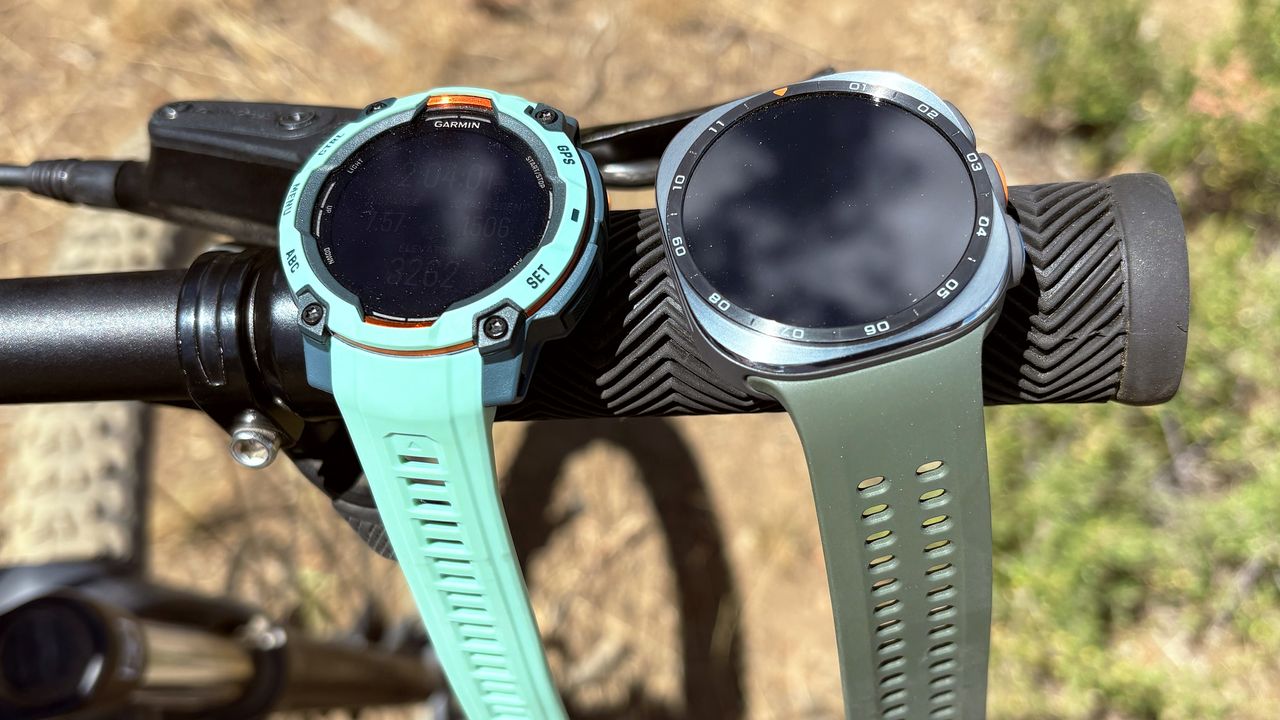
If you’re headed into cougar country to go e-mountain biking and you're tempted to watch videos of real-world cougar encounters beforehand, I encourage you to reconsider. Otherwise, what should be a lovely day in nature might feel a bit more, well, intense.
Fortunately, I encountered no cougars while researching this story.

With that out of the way, I just got back from electric mountain biking in Northern Washington State’s Cascade range — aka, cougar country — while wearing the new Samsung Galaxy Watch Ultra 2 on my left wrist and my go-to outdoor adventure watch, the Garmin Instinct 3 on my right wrist.
After several excellent hours spent ripping it up on a vast network of trails, followed by a quick check of the results, it was clear as day which smartwatch I’d choose to wear next time I go e-mountain biking.
I went e-mountain biking with the Galaxy Watch Ultra 2 vs Garmin Instinct 3
Garmin Instinct 3 |
Samsung Galaxy Watch Ultra 2 |
Strava |
|
|---|---|---|---|
Distance |
11 miles |
11.11 miles |
10.8 miles |
Elevation gain |
1,885 feet |
2,088 feet |
1,744 feet |
Average speed |
4.1 mph |
4.1 mph |
7.7 mph |
Max speed |
24 mph |
24.2 mph |
26.6 mph |
Samsung lacks a dedicated e-bike mode
I had a hunch that the Garmin Instinct 3 would be more up to the task of accurately logging a mountain e-bike adventure than the Samsung Galaxy Watch Ultra 2. Even before my helmet reached my head, I noticed a shortcoming of the latter: it not only lacks a mountain e-bike tracking mode but also doesn’t even have an e-bike mode.
So, I settled for Samsung’s standard mountain bike tracking mode. Meanwhile, the outdoor-oriented Instinct 3, of course, had a dedicated mode for the day’s activity.
Garmin’s elevation data appears more accurate
Assuming our control, the Strava app running on my iPhone 16 Plus is correct, then the Instinct 3 overcounted my climb by 141 feet, while the Galaxy Watch Ultra 2 inflated it by as much as 344 feet, a notable difference. This also isn’t the first time the Ultra 2 reported an inflated climb in my testing.
With elevation gain being one of the primary metrics I focus on post-ride, along with top speed and distance, the Garmin is an easy choice over the Samsung. It's also worth noting that the Galaxy Watch Ultra 2 failed to report my total ascent in the post-workout stats. Fortunately, I documented the stat before ending the session (something I've made a habit of doing for these exact moments).
The Instinct 3 is more comfortable than the Galaxy Watch Ultra 2
Finally, the Garmin Instinct 3 feels much comfier on my 6.5-inch wrist than the Samsung Galaxy Watch Ultra 2, especially while working up a sweat. The Samsung case isn’t only taller and wider than that of the 45mm Instinct 3; it’s also much heavier, weighing 86 g versus 54 g for the Garmin.
After a few hours of riding, I must admit, I was eager to remove the Galaxy Watch Ultra 2 from my wrist.
But the Galaxy Watch Ultra 2 was easier to read in direct sunlight
There was one aspect of the Galaxy Watch Ultra 2 I preferred: Its ultrabright display. Even in direct sunlight with shades on, I was able to read the Samsung watch’s display at a glance. That wasn’t the case for the Garmin Instinct 3.
Of course, the Galaxy Watch Ultra 2 display maxes out at a seriously impressive 5,000 nits. Garmin doesn’t generally provide screen brightness metrics for its wearables, but I highly suspect that the Instinct 3 screen maxes out at around 1,000 nits.
Which of these smartwatches would you choose to track your next outdoor adventure? Let me know in the poll below.
More from Tom's Guide
- Can the $99 Fitbit Air beat the $799 Apple Watch Ultra 3 at fitness tracking? I manually counted 4,500 steps to find out
- I walked 4,000 steps with the Apple Watch Ultra 3 vs Samsung Galaxy Watch Ultra 2 — and the winning margin was razor-thin
- I trekked the Cascade Mountains with the Apple Watch Ultra 3 vs Garmin Instinct 3 vs Samsung Galaxy Watch Ultra 2 — this is the one I'd take on my next hike