Get all your news in one place.
100's of premium titles.
One app.
Start reading
Guitar World
Guitar World
Entertainment
Ryan Reed

“I was watching a Brad Paisley video and saw this contraption attached to his strap: ‘What is going on here?’ I heard of this thing called the B-bender…” How John Osborne fell down the B-bender rabbit hole and came out with a signature Fender Tele

Fender John Osborne Telecaster B-Bender .

“My dad's a plumber, and I did plumbing with him as a kid,” says John Osborne, guitarist and co-songwriter behind acclaimed country-rock duo the Brothers Osborne.

“I wanted to not be a plumber so bad that I practiced guitar every damn day. Then, the older I get, the more I realize, ‘I’m just a plumber with a guitar!’ [Laughs] I’m just showing up to do a job, hoping I do it well.”
If you’ve ever heard this man play, it’s clear that obsession paid off. Across their four LPs, he and singer/sibling T.J. pair classy Nashville twang with pop hooks, elevated by the kind of blazing musicianship suited for an arena stage flanked by pyrotechnics.

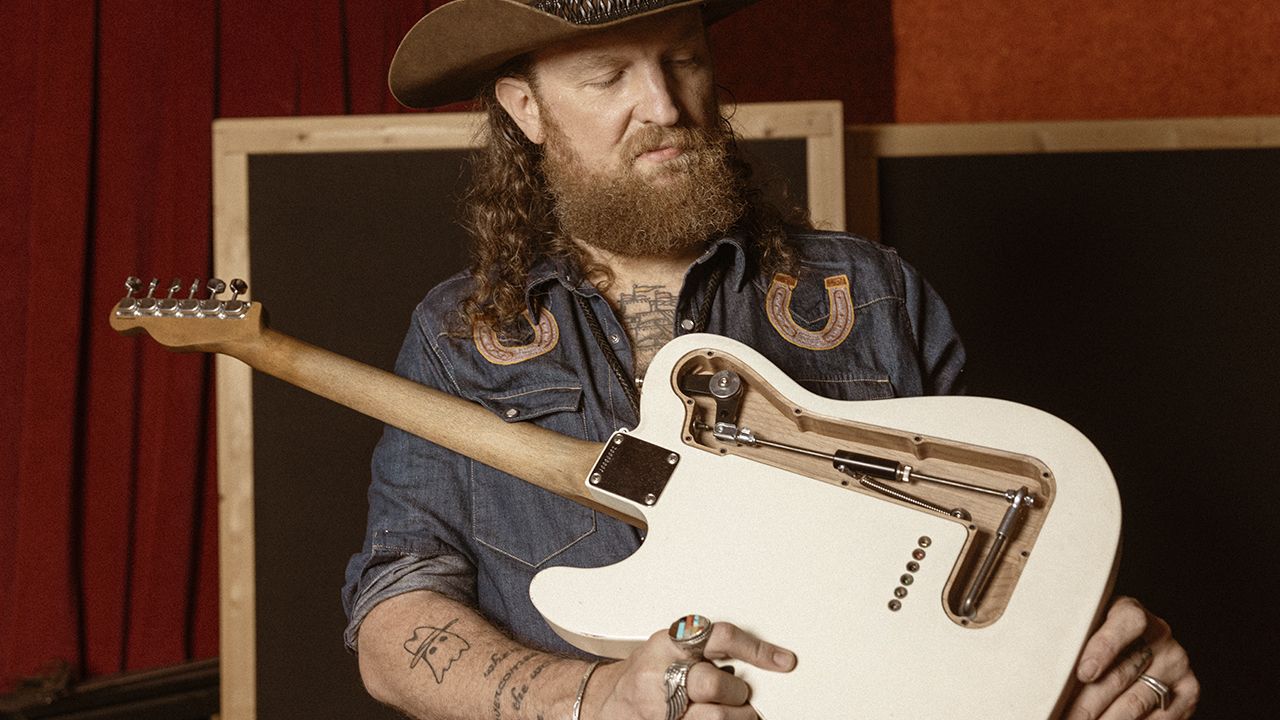
It’s no surprise Fender tapped him for this year’s signature John Osborne Telecaster, inspired by his own modded-out ’68 – B-bender and all.

The design draws on many years of his own tweaking, experimentation and “aha” moments. There’s the maple neck, the “lifeblood” of the instrument. The quirky pickguard, which “lends itself to the almost outlaw era of Teles.”

The custom pickups, which nail that sweet spot of “spank.” Then there’s that B-bender, which channels classic pedal-steel sweetness by raising the B string’s pitch a whole step to C#.

(Image credit: Future/Lucy Robinson)

“You’re trying to make it an emotional thing,” he tells us of the device. “When you get it, it’s so much fun. You get to create a sound you’ve never made before. Once you get through the honeymoon period, you realize, “Now I have this other tool to use when it’s necessary – emphasis on when it’s necessary.”

Osborne gave us an overview of his signature Tele, shared his history with the B-bender and mused about finding the perfect balance of craftsmanship and technique.

(Image credit: Future/Lucy Robinson)

You’ve talked about how you constructed your current guitar, making modifications over the years to the ’68 Tele you bought at age 21. Was the idea with this signature model to recreate that precisely?

The idea was to replicate it as precisely as possible, with all of the slight – and maybe large – modifications I made over time. This is where the guitar has ended up over 20 years of experimenting. I wanted to recreate that because it really is a unique Tele in so many ways. I wanted whoever picks it up to realize, “This is very classic but also very different.”

Tell us about your history with the B-bender.

When I was in late high school, I became obsessed with Brent Mason. That’s after I did my long stints of wanting to be a rock player and a blues player and all the different genres I’ve encountered.

I heard a solo on the radio on an Alan Jackson song, and I thought, “Who is bending that note so perfectly?”

The song is called Who’s Cheatin’ Who? It has these bends that are so snappy, and I couldn’t figure out what was going on. I learned how to do it with my fingers, but could never quite get the sound right.

(Image credit: Fender)

I remember watching a Brad Paisley video and seeing this contraption attached to his strap: “What is going on here?” Through that and a little investigating – the Internet was still in its infancy and you really had to dig – I heard of this thing called the B-bender.

I never had enough money to put one on my guitar. For the longest time, I just had one guitar, the ’68 Tele. I remember opening up for Brad Paisley in his early career, and his tech was joking with me, “Don’t do the B-bender thing. That’s Brad’s thing.”

Then he looked at my guitar and was like, ‘Wait, you don’t have one!” I was like, “Yeah, I had to learn how to do it like this.” But I was always obsessed with that sound.

(Image credit: Future/Lucy Robinson)

When we recorded our second record, [2018’s] Port Saint Joe, a phenomenal Tele player/artist/songwriter/producer named Keith Gattis – a dear friend of mine who passed away [in 2023] – let me borrow his B-bender.

At the time, he was playing it on a lot of Dwight Yoakam’s stuff. His B-bender playing is otherworldly – it’s got so much stank on it. And when I played that on the record, I realized, “This is so much fun.”

I finally could get all of the sounds I heard, and it came very naturally because I learned how to do a lot of those things with my hands. After that, I became obsessed with B-benders. I don’t know if I know how to bend a B string in tune anymore because I have a contraption that does it for me. [Laughs]

(Image credit: Future/Lucy Robinson)

Dead Man’s Curve is considered a modern-guitar classic. Does it feel like a signature moment for you?

It does, and it doesn’t. At the end of the day, I love that moment. I love the song Muskrat Greene that goes into Dead Man’s Curve. It’s a time to show off and step out there as a player, but first and foremost I consider myself a songwriter, and the song is paramount to anything else. If the song lends itself to more or less guitar, that’s what’s needed.

(Image credit: Future/Lucy Robinson)

The older I get, the more I believe that. I grew up listening to Jimi Hendrix, Jimmy Page, Eric Clapton, Stevie Ray Vaughan – the kings.

But as you grow up, you realize there has to be a reason for that guitar, and it’s the song. We have songs with zero solos because I didn’t think it was necessary. I thought it would be too much icing on the cake. I just play rhythm and make it a textural thing.

At the end of the day, the guitar is just a tool for the song – even though, when you’re young, you think the song is just the tool for the guitar. [Laughs]

(Image credit: Future/Lucy Robinson)

The reason the Stairway to Heaven solo is so great is that it’s a tension release.

Yeah! I love jamming and jam bands, listening to the Allmans and anything Derek Trucks is involved in. I love bands that solo, and I’m hanging on to every note.

The format we’re in, you have three to four minutes to have a song and maybe a moment like that. I’ve always treated the solo as its own mini-song, something you can sing along to.

I’m just trying to service the song. But we do have a few moments in the set where we unwind and let our fingers go. We need those as players. It’s so much fun to stretch out.

(Image credit: Future/Lucy Robinson)

I know the original Tele neck was the heart and soul of your guitar. What makes it so special?

The first thing you notice when you pick up a guitar is what the neck feels like. The back of your hand touching the back of the neck, it immediately informs what is about to happen with you and the guitar.

It’s this subconscious thing. Every time I picked up my guitar, it felt like putting on your favorite pair of jeans. It’s like, “Damn, these things fit like a glove.” It has a lot to do with how smooth the neck is. We did our best to get there.

(Image credit: Future/Lucy Robinson)

You can’t beat 60 years of playing on the back of a neck, but it’s very, very close. But also the rounded edges of the fingerboard indicate there’s a lot of natural hand wear on it. It becomes a little more contoured and ergonomic on your hand.

The last thing you want is to feel like you’re fighting your guitar to get sound out. That can be fine, but you want to enjoy it and have it be really comfortable. You can talk body woods all day, but you’re not touching the body – you’re holding on to that neck; that’s where the expression comes from.

It’s got the maple cap, and I’ve always found ’68-era Teles to have an interesting spank because of that. I found out that Brad Paisley’s original is a ’68. There’s something special about that year.

Sign up to read this article
Read news from 100's of titles, curated specifically for you.
Already a member? Sign in here
Related Stories
Top stories on inkl right now
One subscription that gives you access to news from hundreds of sites
Already a member? Sign in here
Our Picks
Fourteen days free
Download the app
One app. One membership.
100+ trusted global sources.