Get all your news in one place.
100's of premium titles.
One app.
Start reading
Guitar World
Guitar World
Entertainment
Phil Weller

“I wanted to know how he got the top note on Cause We’ve Ended As Lovers”: How Jeff Beck and Brian Robertson swapped guitars – and brought guitar synths to Motörhead

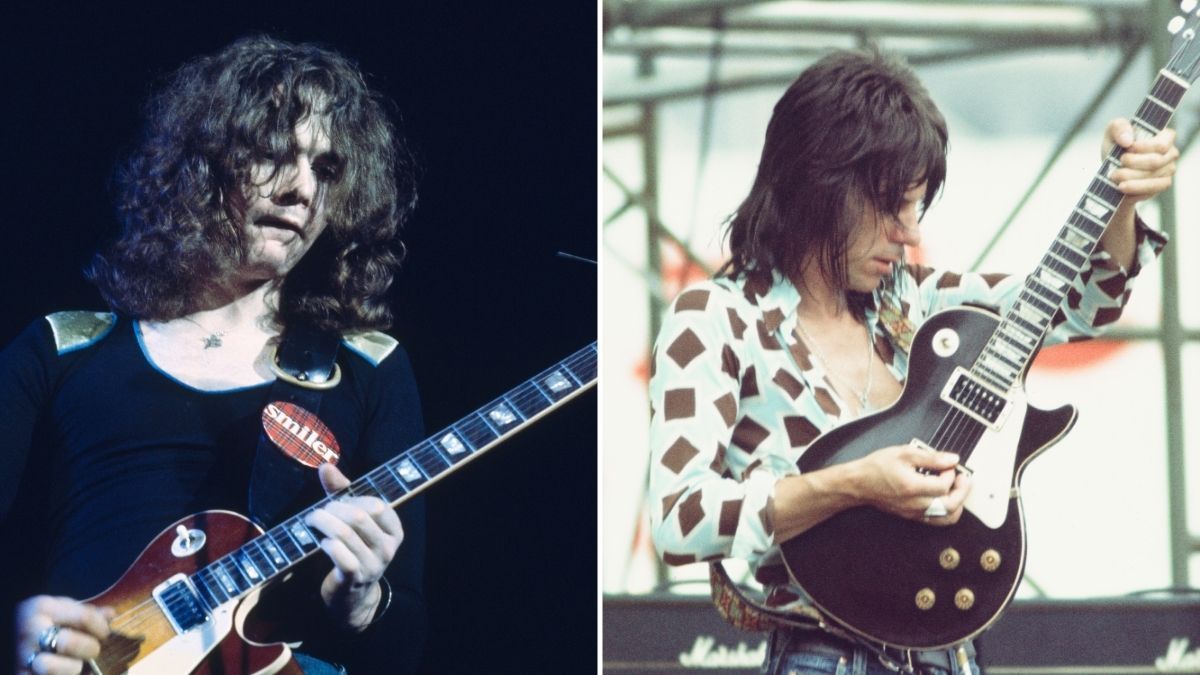
Brian Robertson and Jeff Beck comp.

Brian Robertson’s time in Motörhead is one of the most intriguing chapters in the band’s history, and while his brightly-colored hotpants proved contentious, he was able to sneak guitar synths into his one album with the band, and he has a guitar legend to thank for that.

When “Fast” Eddie Clarke left the band in the middle of the Iron Fist tour, they turned to the former Thin Lizzy guitarist for assistance. After filling in on tour, he ultimately earned a permanent place in the band, featuring on 1983’s Another Perfect Day, which would be their last record as a power trio until 1996’s Overnight Sensation.
Naturally, Robertson’s ultra-rare hollow-bodied 1953 Les Paul came along for the ride. The guitar was customized by Les Paul himself for his wife, Mary Ford, who found the usual design too heavy. Robertson had purchased it upon joining Lizzy in 1974, and it became the center of an important guitar swap.

“I used it on two gigs [with Lizzy],” he tells Guitarist, having bought it off Mott the Hoople/Bad Company riffer, Mick Ralphs.

“It was dreadful because it fed back,” he reveals. “But it looked great, Burgundy red-ish. I had to have it, even though it had a Bigsby. My contention was that we needed a spare, which is bollocks because you couldn’t use it live. Plus, with the Bigsby, if you broke a string, it’d take you an hour and a half to change it.”

The guitar featured on Lizzy’s classic, Jailbreak, and, he says, anything that needed slide guitar, but Jeff Beck soon had it in his crosshairs.

“We were rehearsing together in [London rehearsal/recording studio] Nomis Studios,” Robertson explains. “I was rehearsing with Motörhead. I wanted to know how he got that top note on Cause We’ve Ended As Lovers, and he said, ‘It’s a guitar synth.’ I started joking, ‘You can have that if you give me your Roland guitar synth.’”

(Image credit: Getty Images/Billy Tompkins)

If you don’t ask in life, you don’t get. Fortunately for Robertson, Beck was game.

“He let me use the guitar synth while he had the Les Paul,” he smiles. “That’s how I got into using the guitar synths with Motörhead.”

In Joel McIver’s book Overkill: The Untold Story of Motörhead, Lemmy is quoted as saying that Robertson helped make the band “more musical,” but despite helping turn over a new leaf for the band, in the wake of their adrenalized heavy blues rock with Clarke, he left after just one year.

That paved the way for the late Phil Campbell and Michael “Würzel” Burston to form a fiery guitar tandem that lasted for around a decade, producing some of the densest-sounding Motörhead records in their exhaustive discography.

Robertson, in truth, knew his stint in the band was doomed, and he also knew what Lizzy lost when he stepped aside in 1978, yet he played a pivotal role in the histories of both hugely celebrated rock bands. And he did so with some rarified six-strings for company.

For the interview with Robertson, and to read about the unearthing of a classic Cream-era Eric Clapton guitar, pick up issue 539 of Guitarist from Magazines Direct.

Sign up to read this article
Read news from 100's of titles, curated specifically for you.
Already a member? Sign in here
Related Stories
Top stories on inkl right now
One subscription that gives you access to news from hundreds of sites
Already a member? Sign in here
Our Picks
Fourteen days free
Download the app
One app. One membership.
100+ trusted global sources.