
We would all love to achieve a centred strike with irons more consistently, eradicating those painful hand-stingers and the clunky contact that plagues many amateur golfers.
Similarly to ensuring a centred strike with driver, finding the middle of the face is crucial in maximising distance, finding more fairways and generally improving your ball striking.
This is a huge subject to cover, but, to hone in on a few of the main priorities for better ball-striking, you need to focus on three key elements: rotation/body turn, wrist hinge and spine angle.
Considering clubface is king, I'd go as far as saying this could be one of the most important ball striking lessons amateurs can learn, especially as strike location plays such a significant role in the outcome of every shot.
With a topic so important, we decided to reach out to an expert with more than 30 years of golf coaching experience. In this article, Top 50 Coach Keith Wood shares his top tips on how to ensure a centred strike with your irons...
The Simple Way To Ensure A Centred Strike With Your Irons
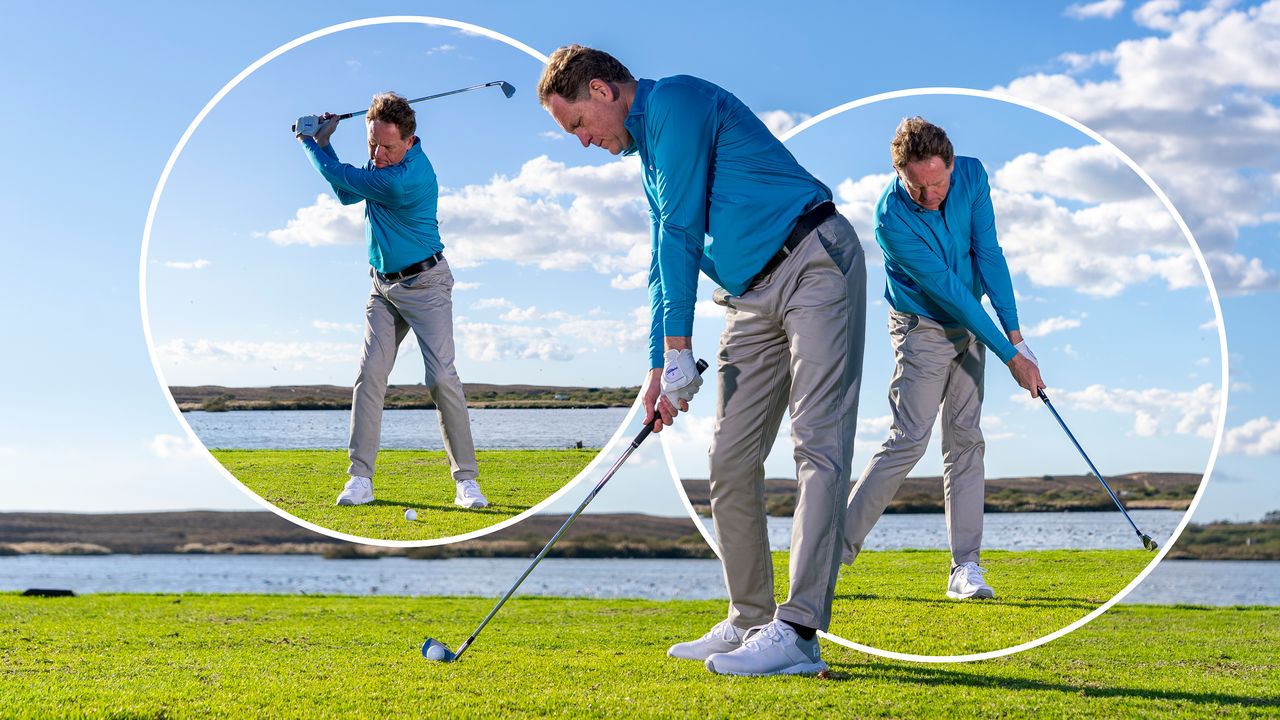
In the image below, we can see a full rotation of the torso and shoulders around my posture angle and against the resistance and support of my legs.
This is crucial for stability, power and balance to help you get the club back to the ball reliably and efficiently.
However, rotation is also fundamental to returning the club back to the ball for a centred strike.
Most toe and heel strikes come from you moving out of position and swaying in the golf swing (or tilting), with the spine angle changing up and down.

Therefore, your ability to simply turn your upper body back and through around your posture tilt helps enormously when it comes to striking the ball effectively.
Creating wrist hinge and retaining this angle before releasing it through impact is vital for better striking.
As you take the club back, feel your wrists levering the clubhead up, especially your gloved hand.
There will be a natural maximum angle, which you can store through the backswing and into the downswing to be used through impact, in the same way as when throwing a ball.

Just as we talked about the importance of the rotation of the torso back and through, maintaining spine angle throughout your swing is crucial to a centred strike.
In the image below, we see how the spine angle is still intact as the body clears through impact before moving into the follow-through.
Make sure you have enough spine tilt from your hips at address, balanced out with some knee flex to start with to help give you a spine angle to rotate around through the swing.

How Do I Increase Clubhead Speed In Golf?
To boost your clubhead speed in golf, you need to focus on a number of factors. One of the most important elements is the one that has been expertly outlined by PGA Pro Keith Wood in the article above - achieving a centred strike.
Investing some time on the best golf exercises is never a bad move, as they seemed to work for Golf Monthly's instruction lead Baz Plummer who is now hitting his driver over 240 yards as a 22-handicapper.
Your golf swing also needs to be sequenced correctly, with an effective weight transfer and an action that efficiently releases energy at the right time.
How Can I Ensure A Centred Strike With Driver?
According to Top 50 Coach Alex Elliott, there is something all amateurs can do when addressing the golf ball to help to ensure a centred strike with driver.
When placing the clubhead on the ground behind the ball, address the ball slightly more out of the toe of the club.
This is because as you raise the club to the height of the ball (on the tee) the position of the ball will naturally shift towards the centre of the face.
If you addressed it out of the middle while the club was resting on the ground, the ball would be dangerously close to the heel when the clubhead is raised up towards the ball.
This simple hack is just one component towards improving your ball striking with driver, but it's also something every amateur golfer can try straight away.