Kudos to Capcom. The iconic Japanese video game developer/publisher is currently enjoying what’s been dubbed a “golden age” thanks to its consistent habit of releasing excellent video games. And that era isn’t ending in 2026. The company already dropped Resident Evil: Requiem in February and is following it up with Pragmata this month.
Before getting my hands on Pragmata, a new sci-fi action game that emphasizes hacking, I wasn’t entirely sure what to make of it. I thought the concept of having to weaken enemies with a mini-game before unloading your weapons into their weak spots seemed promising, but could lead to tedium and frustration. After blasting through the 10-12 hour campaign on PS5 Pro, and playing a further couple of hours on Nintendo Switch 2, I’m a total convert.

Pragmata is one of the most refreshing and well-paced games I’ve played in months, and I echo my colleague Tony Polanco’s sentiment that it’s a real “GOTY contender” (see his review). Whatever system you own, you need to give this game a shot, because in the gaming world of 2026, Pragmata is the type of experience I want players to support.
Pragmata is the type of game I want more often
The blockbuster video game space feels increasingly homogenized in 2026. While the indie space is still a bastion of creativity, when it comes to AAA titles, I’m starting to feel like games fall into two buckets. Online-focused games (so-called “live service” games) that want you to play them forever, and massive single-player experiences that boast so much content, you’ll need to dedicate whole months of your life to them if you want to see everything they have to offer.
Don’t get me wrong, I love games that fall into both camps, and I absolutely will continue to play new live service releases and gigantic single-player games. But I do miss the era of blockbuster games being a little more manageable. That’s what’s so great about Pragmata. It packs a high-quality campaign that can be enjoyed without feeling like a second job.

Even with taking on optional extras, like hunting for hidden upgrade materials, and blasting through the suite of increasingly challenging “training rooms,” you can roll credits within a dozen hours, maybe up to 20 hours if you really must see everything. Far from a drawback, this more streamlined length is a real strength for me.
I completed Pragmata over a week, playing a couple of hours a night, and was always making tangible progress in each play session. Whereas in Crimson Desert, I’ve played 25 hours, and I’ve not even left the intro.
Pragmata’s other real strength comes in its core combat loop. Risk-averse is a term often used to describe tentpole video games in the 2020s, but Pragmata isn’t afraid to try something new. Yes, its slick lunar base setting, and surrogate father-daughter story (some will crudely label it “The Last of Us in space”, I’m sure), aren’t exactly original, but actually playing Pragmata is a breath of fresh air.

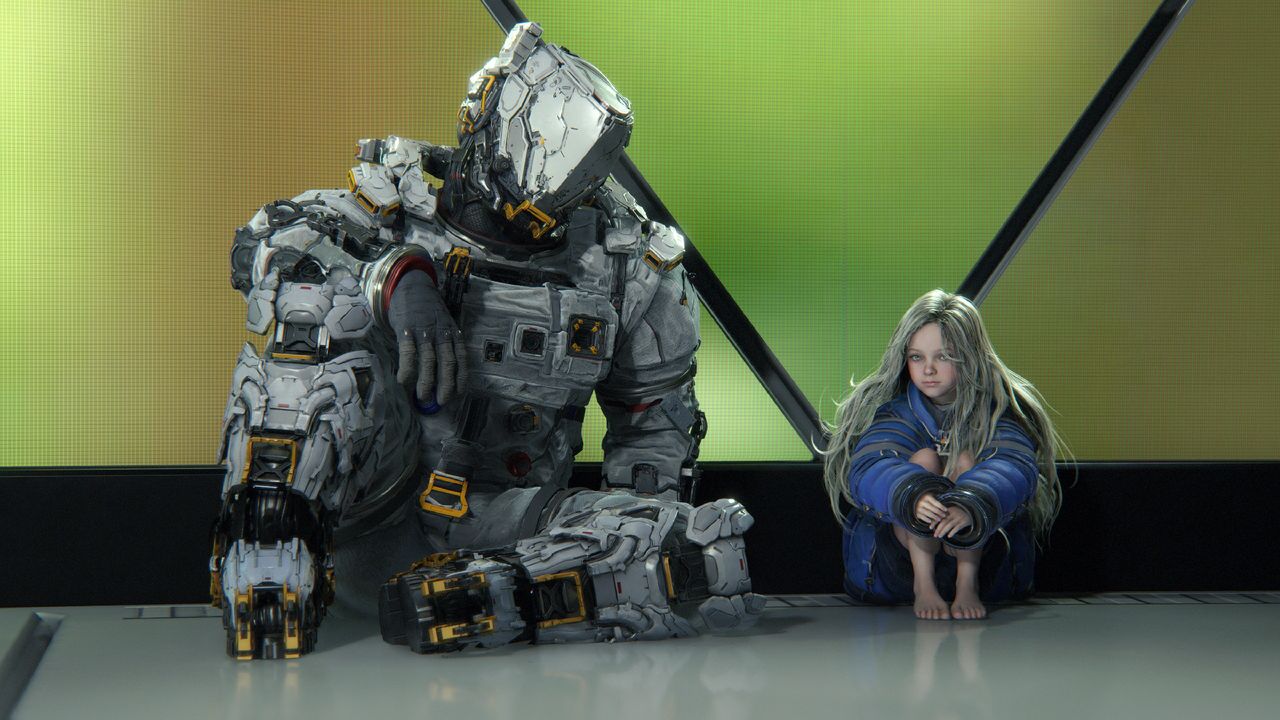
The crux of combat in Pragmata comes from protagonist Hugh’s companion, Diana, an android that resembles a young girl. Diana can hack enemies to weaken their defenses and allow you to unload your firearms into them. Hacking is performed via a real-time mini-game that starts simple but is augmented throughout the campaign.
This hacking mini-game is genius, perhaps because of its simplicity. In isolation, each hack is a breeze. But even a simple task becomes a lot more challenging when you’re trying to move nodes across a grid while also dodging enemy attacks and environmental hazards. Across the full experience, I never got tired of this loop, and it was so effective that I found Pragmata’s later enemy encounters even more tense than those in the most recent Resident Evil. And Resident Evil is a survival horror!
Pragmata is essential on PS5 Pro and still great on Switch 2

Pragmata is available across all major systems, PS5, Xbox Series X/S, PC, and Nintendo Switch 2. So, wherever you personally choose to play, you should have access to the game.
As mentioned, I completed a full run on PS5 Pro, where the game looks gorgeous. Unlike many releases in this generation, Pragmata doesn’t offer the choice of “Performance” or “Fidelity” modes; instead, it locks you into a single default setup that delivers impressive visuals alongside a very stable 60 fps. Which can be boosted to 120 fps if your setup supports it.
It speaks to the game’s impressive graphical quality that I got a little frustrated by the lack of a dedicated “Photo Mode,” as I wanted to take a few snaps for my PS5 home screen.
Meanwhile, on Nintendo Switch 2, there is no question that several sacrifices have been made to bring this cinematic experience to a hybrid console. The image and texture quality drops quite severely (Diana’s hair is very noticeably downgraded), and signs in the background become a pixelated blur, whereas on PS5, they’re readable from afar.
Capcom hasn’t slashed and locked the framerate on Switch 2, either. It technically targets 60 fps, but, at least to my eyes, it seldom hits this benchmark. Instead, it hovers around 40 fps, dropping much closer to 30 fps in the more hectic firefights. While I’m very much a “60 fps is best” player, I can still tolerate 30 fps, and I wish Pragmata would let you cap the framerate. Even a stable 30 fps would be preferable to one that consistently fluctuates.
But this isn’t to suggest that Pragmata is close to unplayable, or unenjoyable on Switch 2. It’s still an impressive port overall, and you have to factor in the power difference between Nintendo’s hybrid and Sony’s $899 beast of a console. Expecting performance parity would be foolish.
Capcom seems committed to supporting the Switch 2 (it dropped three Resident Evil games on the console this year, including the newly released Requiem), and that’s commendable. If you have access to a PS5 (or Xbox/gaming PC), I would recommend you play Pragmata there, but if Switch 2 is your only option, there’s really no reason to skip this game.