Get all your news in one place.
100’s of premium titles.
One app.
Start reading
The Independent UK
The Independent UK
Matt Ng

I’ve found the best portable power stations for home and outdoor adventures

I monitored each station’s watt-hour (Wh) capacity while running appliances large and small - (Matt Ng/The Independent)

Portable power stations have become hugely popular with outdoor enthusiasts, campers, remote workers, and those living off-grid. They also offer reassurance to homeowners who regularly experience power outages or blackouts. But which one should you buy? As a tech expert with more than 15 years of experience, I’ve tried, tested and chosen my top picks.

While power stations can be expensive, they’re useful in so many different scenarios. Imagine being able to use the hedge trimmer to the home projector outside without long extension leads, or to work and charge all your gear in your car off-site. You can also enjoy safer, cleaner and quieter camping trips without the noise and fumes from a heavier generator.

Better yet, you can pair a portable power station with solar panels for cleaner and cheaper off-grid living. And in the event of a power cut in your home, you can keep the household going by charging phones, boiling kettles, keeping the lights on and ensuring frozen food stays frozen.

However, choosing the right model requires some consideration of your power needs and balancing that against cost and weight. To get a head start in your search, keep reading for the portable power stations that passed my tests.

The best portable power stations for 2026 are:

  • Best overall – EcoFlow delta 3 plus: £599, Amazon.co.uk
  • Best budget buy – EcoFlow river 3 plus: £219, Amazon.co.uk
  • Best for camper vans – Jackery explorer 2000 V2: £899, Amazon.co.uk
  • Best for off-grid living – DJI power 2000: £959, Amazon.co.uk
  • Best for home backup – Anker solix F3000: £1,799, Amazon.co.uk

Read more: 7 best power banks tested on iPhone, Android and more

How I tested

I tested each power station with a range of appliances (Matt Ng/The Independent)

For this review, I tested each model by plugging in a range of everyday devices, including smartphone chargers and laptops, to see how they performed and how long they lasted on a full charge. I also ran high-power appliances such as hairdryers and tower fans to stress-test the units, paying close attention to fan noise and any signs of overheating. You can find my full testing criteria at the end of this article.

Read more: Best phones, reviewed by a tech expert

EcoFlow delta 3 plus

Rating: 5/5

Best: portable power station overall

Capacity: 1024Wh

Outputs: Four x 1800W AC, two x 140W USB-C, two x 36W USB-A, one x 126W 12V

Recharge time: 56 minutes

Dimensions: 15.6x7.8x11.1in

Weight: 12.5kg

Why we love it

  • Ideal capacity for most people
  • Good selection of ports

Take note

  • Socket arrangement can lead to messy wiring

The delta 3 plus is a top-notch performer, being reasonably portable and offering plenty of power and versatility. It also features lots of ports, including fast-charging USB-C ports, and will charge completely in under an hour. Plus, its 10ms uninterruptible power supply (UPS) feature helps ensure a constant and reliable power supply when you need it, whether for computers, fridges or security systems.

From fridges to laptops and phones, it has you covered (Matt Ng/The Independent)

I plugged in my laptop, monitor, phone charger and hair dryer simultaneously, and it maintained its composure without overheating, though the wiring isn’t super neat as the sockets are arranged perpendicularly to fit its tall frame better. I could get around 18 to 20 hours with my laptop and monitor plugged in, which is what I’d expect for a station like this. The fan only kicks in beyond heavy loads of around 1,500W, and I found it fairly quiet and non-intrusive.

There’s very little difference between this and the Solix C1000 as far as performance and stats go, and while the latter has slightly better portability and design, the delta 3 plus beats it for its expandable batteries and quieter fan. It’s still not enough for proper home backups, but for pretty much everything else, this is a solid power station at a reasonable price.

Buy now £699, Amazon.co.uk

EcoFlow river 3 plus

Rating: 4/5

Best: budget portable power station

Capacity: 286Wh

Outputs: Three x 300W AC, Two x 12W USB-A, One x 100W USB-C

Recharge time: One hour

Dimensions: 9.21in x 9.13in x 5.75in

Weight: 4.7kg

Why we love it

  • Super compact
  • Decent light

Take note

  • Not for high usage appliances
  • Socket placement not ideal

If you need power quickly at your fingertips, the dinky river 3 plus is for you. It impressively packs in three AC sockets, three USB ports, and even a light to use should you find yourself by the roadside in the dark. Its battery is expandable if you need to bulk out the capacity without buying another power station.

This is a neat power station that’s handy in emergencies (Matt Ng/The Independent)

It displayed around two and a half hours of runtime with my laptop and phone on fast charge (when not in the trickle charge mode). So while it’s not suited for long trips away from an electrical outlet or for high-wattage appliances, it’s good for less demanding jobs such as powering a cooler for a garden party or a TV for a few hours. And like most power stations, there’s a digital display showing your output, battery level and remaining runtime.

I’m also really impressed with its portability and compact form. You can easily carry it around, courtesy of its large handle, and it can even slip into a backpack without much fuss. It’s handy for keeping in the car or shed when you need power outdoors in a pinch. The low price adds to its charms, too. I’d advise getting the plus model, as the standard version only carries one AC output.

Buy now £219, Amazon.co.uk

Jackery explorer 2000 V2

Rating: 4.5/5

Best: portable power station for camper vans

Capacity: 2042Wh

Outputs: One x 2200W AC, one x 100W USB-C, one x 30W USB-C, one x 18W USB-A, one x 126W 12V

Recharge time: 102 minutes

Dimensions: 13.2in x 10.4 x 11.5in

Weight: 17.5kg

Why we love it

  • Lots of power for its size
  • Great value

Take note

  • Limited mains sockets
  • Small light

I recommend the Jackery explorer for camping enthusiasts in vans or estates with limited space to work with, as I’m astounded that a 2,000Wh power station is the size of a small cooler box. And, with a lightweight rubberised handle, most people will be able to shift it around a short distance unassisted.

This is a small but mighty power station (Matt Ng/The Independent)

The longest runtime was around 26 hours when fast-charging a laptop and phone, which is fairly impressive. And when I plugged in a hairdryer at maximum power and heat, that swiftly went down to one hour (assuming continuous use), which is par for the course, considering the load.

The fan tends to turn on even with lighter loads, but it’s nearly silent, so it’s fine to work around. Its display is a little small and simplistic, but it provides a clear picture of your use, runtime and charge status. My only gripe is that there are only two mains outlets, when rivals offer three or even four.

Still, the explorer 2000 V2 is great to bring camping, in trucks and when you need to power energy-sapping appliances such as kettles and stoves, particularly where space is at a premium.

Buy now £1399, Amazon.co.uk

DJI power 2000

Rating: 4.5/5

Best: portable power station for off-grid living

Capacity: 2,048Wh

Outputs: Four x mains AC, two x 140W USB-C, two x 65W USB-C, two x 24W USB-A, two x SDC

Recharge time: 45 minutes from zero to 80 per cent, 75 minutes for a full recharge

Dimensions: 17.64in x 8.86in x 12.76in

Weight: 22kg

Why we love it

  • Plenty of ports
  • Fast-charge for drones
  • Quiet fan

Take note

  • Strange charger port placement

It makes total sense for a company heavily focused on drones and action cameras to get involved in the portable power station game, so here comes DJI with the power 2000.

It features SDC ports for fast charging drones (Matt Ng/The Independent)

This 2,048Wh station comes with a massive number of ports, including four mains, four USB-Cs, four USB-As and two of DJI’s proprietary SDC ports for fast charging drones. It displayed 15 hours of runtime while fast-charging a laptop and phone, and with trickle charge the runtime extended to around 33 hours, though the number did sporadically fluctuate. I then plugged in a hairdryer on max power and heat, and it had just over an hour of runtime.

It’s got lots of power to run almost any appliance, and you can combine it with a DJI solar panel for living independently off the grid, provided you get enough sunshine. Plus, its generous ports ensure everyone’s power-hungry devices get charged.

It’s also excellent for videographers and photographers who want to charge multiple devices such as laptops, drones, cameras and phones simultaneously while on the go. However, the placement of the main charging port at the front of the unit is a questionable choice. It kind of spoils the neatness of the machine, and restricts the reach and practicality of the station.

Buy now £959, Amazon.co.uk

Anker solix C1000 gen 2

Rating: 5/5

Best: portable power station for remote work

Capacity: 1,024Wh

Outputs: Four x 2,000W, two x140W USB-C, one x15W USB-C, one x12W USB-A, one x120W 12v

Recharge time: 49 minutes

Dimensions: 15.1in x 8.2in x 9.6in

Weight: 11.3kg

Why we love it

  • Rapid charging
  • Lots of outputs

Take note

  • No battery expansion

Well designed and both modern and robust in look and feel, the second-gen C1000 boasts the 2025 Guinness World Record for the fastest recharging portable power station, able to fully charge its 1,024Wh battery in just 49 minutes.

Recharging speed is Guinness World Record-worthy (Matt Ng/The Independent)

I tested it with my laptop and mobile, which it could comfortably keep powered for more than 16 hours. When they both reached more than 90 per cent capacity and reverted to a slow charge, that time further extended to more than 20 hours. I also tested the fan by running my laptop, second monitor, mobile charger, tower fan and hairdryer simultaneously – this vastly cut down its battery longevity to about 30 to 40 minutes – and while it wasn’t too loud, it’s definitely audible.

It’s fairly weighty to carry, and it lacks the capacity to keep multiple household appliances running for long periods during a power outage, so it’s best to look elsewhere if you need that high-capacity backup. But this is a great little unit for weekend work or overnight remote use, with plenty of plug outlets and USB ports to charge your camera, phone and laptop with no hassle.

Buy now £699, Amazon.co.uk

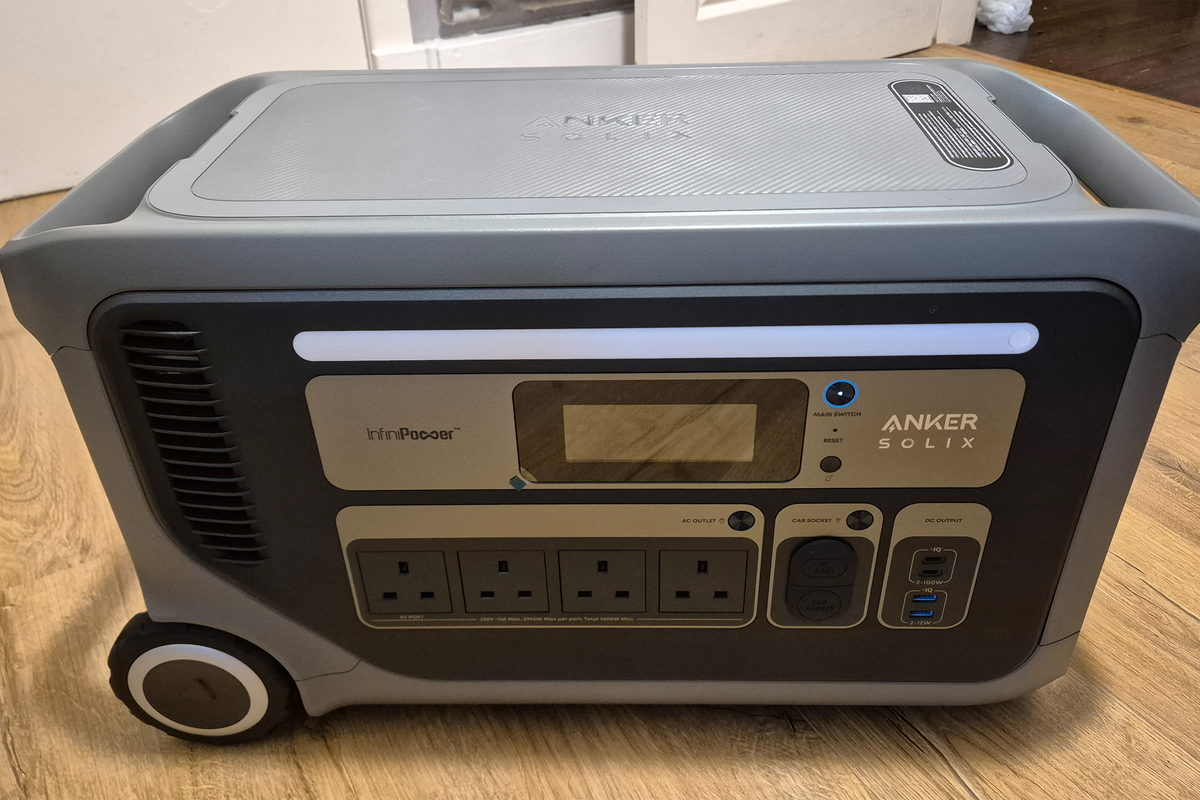
Anker solix F3000

Rating: 4.5/5

Best: Portable power station for home backup

Capacity: 3,072Wh

Outputs: Four x 2,400W, two x 100W USB-C, two x 12W USB-A, one x120W 12v, one x Anderson DC output

Recharge time: 120 minutes

Dimensions: 25.6in x 11.8in x 14.8in

Weight: 41.5kg

Why we love it

  • Wheeled design is great
  • Huge capacity

Take note

  • Pricey
  • Not many USB-C ports

This absolute beast of a power station can keep a home running in the event of a blackout. I could run my standing fridge-freezer for more than four days – so no more melted peas. It could fast-charge my phone and laptop for 23 hours, extending to more than 42 hours once it hit trickle charge mode, and with a fully cranked hairdryer added into the mix, you get one and a half hours of runtime. Still, with only two USB-C ports, if the power goes down, you might have a fight on your hands deciding who gets to charge their phones.

It could be worth the splurge for campervans or blackout cover (Matt Ng/The Independent)

The F3000 is also super heavy, so I’ve never been more thankful for Anker incorporating a retractable long handle and a pair of wheels into the design, making shifting it about far more doable. However, clearing high thresholds and stairs is often a two-person job.

The inflated price tag of £3,000 makes it a tough sell, but with a discount, it becomes more tempting, particularly for off-grid users, campervan owners or those who need high-capacity and reliable power backup at home. However, note that its 20ms UPS switch time (how long it takes for the battery to take over once the mains fails) is on the slow side, meaning you may need to look elsewhere if you have critical appliances.

Buy now £1999, Amazon.co.uk

Bluetti elite 200 V2

Rating: 4/5

Best: portable power station budget home backup

Capacity: 2,073Wh

Outputs: Two x 2,600W AC, two x 100W USB-C, two x 15W USB-A, two x126W 12V

Recharge time: 66 minutes for up to 80 per cent, two hours 24 minutes for a full charge

Dimensions: 13.78in x 9.84in x 12.74in

Weight: 24.2kg

Why we love it

  • Quick charging
  • Quiet operation
  • Compact for a 2000Wh station

Take note

  • Could do with more mains sockets
  • Uncomfortable to carry

The elite 200 V2 is as compact as the Jackery explorer 2000, another 2,000Wh station mentioned above. In my test, I got 22 and a half hours of runtime while fast-charging a laptop and mobile, and one hour of concurrent use with a hairdryer. Once fast-charging was complete (and without the hairdryer), that extended to more than 37 hours in trickle charge mode.

This can handle large and everyday appliances (Matt Ng/The Independent)

I also plugged my fridge into the elite 200, which yielded very efficient results, with barely any power draw when idle and a reported runtime of at least 75 hours (as there’s no days option on the display readout).

However, its 24kg weight and the angle of its handles make it uncomfortable and awkward to carry. Some wheels and a retractable handle would have made this a great choice for mobile use, as moving it from a car or camper can be hard work. Still, it’s a solid home backup option, but I’d have liked to see one or two more mains sockets added to the existing two alongside the four USB ports.

Buy now £999, Amazon.co.uk

Your questions on portable power stations answered

What is the best portable power station?

While I prefer the modern stylings of the Anker solix C1000, the EcoFlow delta 3 plus pips it. Stats and performance-wise, there’s very little separating them, though the latter features expandable batteries, a quieter fan and a slightly cheaper price tag. Still, both have great portability, affordability and versatility and should do fine for most users.

What kind of power station do I need?

It really comes down to what you need it for. If you need it for the odd night or weekend away, consider a 500Wh station for easy portability. If you’re on the road a lot and have lots of devices hungry for power, plump for a 1,000Wh device for more power and versatility. And if you love to live off-grid or need solid, reliable home power back-up, a 2,000Wh or even 3,000Wh station is your best bet.

How the best portable power stations were tested in full

I tested these devices according to the following criteria:

Why you can trust IndyBest reviews

At IndyBest, our experts analyse the latest products on the market to see if they stand up to scrutiny. Matt Ng is a tech writer with years of experience critiquing all things consumer tech, including gaming, audio players, dash cams, projectors, laptops, VR headsets and much more. When it comes to his review of the best portable power stations, Matt is interested in how helpful they are to the modern tech consumer who needs ample power for various devices and appliances.

Looking to charge your devices on the go? These are the best power banks, tested on iPhone, Android and more

Sign up to read this article
Read news from 100’s of titles, curated specifically for you.
Already a member? Sign in here
Related Stories
Top stories on inkl right now
One subscription that gives you access to news from hundreds of sites
Already a member? Sign in here
Our Picks
Fourteen days free
Download the app
One app. One membership.
100+ trusted global sources.