Get all your news in one place.
100’s of premium titles.
One app.
Start reading
Digital Camera World
Hillary K. Grigonis

I tried Photoshop’s new AI Assistant. The new Photoshop chatbot feels like an overly enthusiastic intern, but it’s not all bad

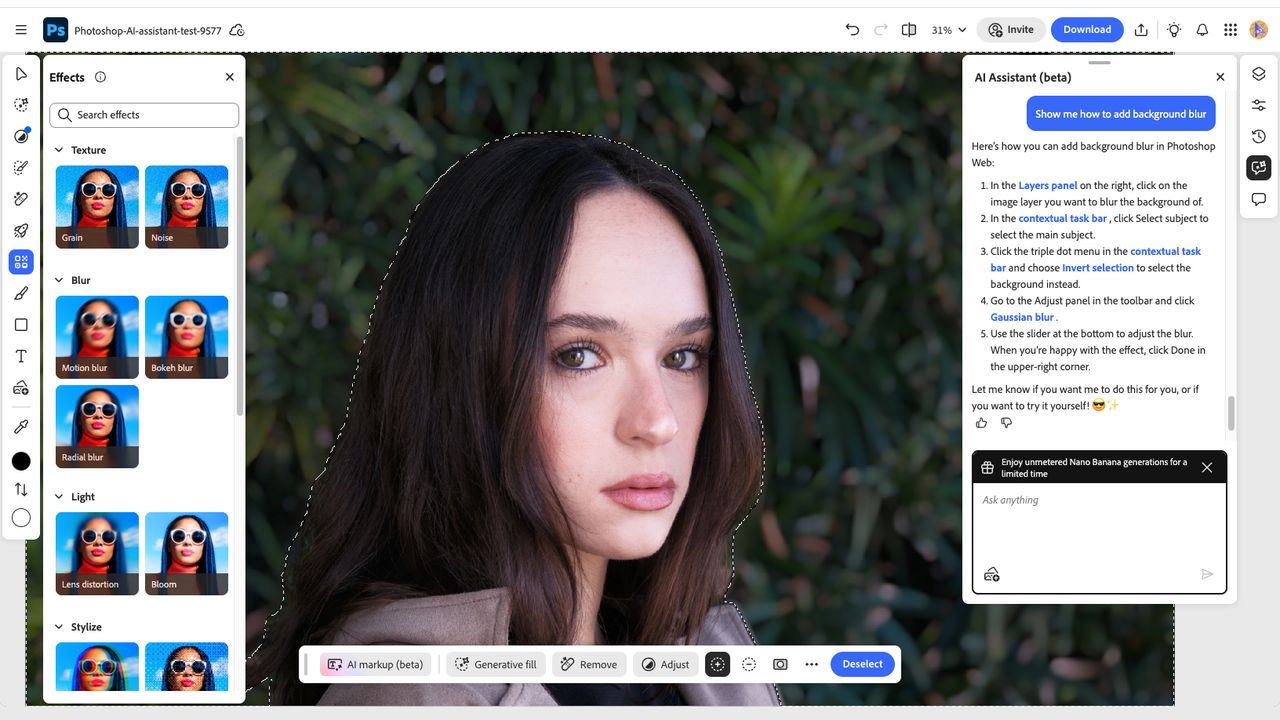
A screenshot of the AI Assistant on Photoshop Web.

I’ve lost track of the number of hours that I’ve spent in Photoshop tackling tedious, boring tasks like resizing images and editing out powerlines and trash cans. But Adobe is working on a fix: An AI chatbot integrated into Photoshop that can tackle edits for you.

I tried the new Photoshop AI Assistant, which launched only in Beta and only on Photoshop Web earlier this week. While the chatbot did carry out a few pleasant edits for me, I was largely left with the overwhelming feeling that I had just worked with an overenthusiastic photo editing intern, from the chatbot not quite doing what I asked to laughable corrections to lengthy waits.

In short, I didn’t get the impression that professional photo editors should be worried about their future career prospects, at least for now. The AI Assistant was, at least, a much more flexible tool than the Photoshop built into ChatGPT that I tried. But, there are a few key areas where I think a Photoshop chatbot could be rather helpful in future renditions.

First, the AI Assistant is only rolling out to Photoshop for Web for now, which isn’t exactly a full version of Photoshop, and it also has difficulty handling larger, high-resolution files. Many of the new tool’s limitations lie just in the fact that it’s only for the web right now.

(Image credit: Future)

One of those limitations is that the web-based Photoshop feels slower than the desktop version. There were a handful of edits that I thought I could have already finished while the AI Assistant was still doing its thing.

The Photoshop AI Assistant works in two ways. First, you can click on parts of the photo and type in a prompt to adjust a specific part of the image. Or, you can talk to the chatbot in the dedicated AI Assistant sidebar.

(Image credit: Future)

I started out editing a landscape photo that I took with a film-inspired preset, exaggerating the purples. The AI Assistant scanned the image, then made suggestions, so even if I come into the program without an idea, it sparks some based on what’s in the image. The AI Assistant is eager to use generative AI, and in a few minutes, it added more glowing city lights to the scene and even a full moon (though the craters didn’t feel quite accurate, never mind that it wasn’t a full moon on that day).

Then, I moved on to trying to edit a few portraits. I asked the AI to help clean up flyaway hair, and instead it removed the entire person…twice. At least the AI owned up to the mistake both times, telling me “Oops, looks like the stray hairs AND the whole subject got zapped!” complete with emojis. The bot told me, “It’s really tough for me (and even for Photoshop pros) to accurately select just the stray hair strands.”

(Image credit: Future)

The overly enthusiastic hair selection wasn’t the only time the selection was off. When I asked the bot to help make the eyes pop, it applied the effect to the face instead, overbrightening and adding saturation that brought out the skin’s redness.

Because of those whoopses that I had to go in and manually adjust – and the slower pace of a web-based software – I was left with the impression that I probably could have just done it myself faster (and without wasting as many resources).

(Image credit: Future)

But, while I won’t be trying the AI Assistant again anytime soon, I was left with an impression that there are a few areas where such a feature could be rather helpful. After all, the AI Assistant is only in beta, which means Adobe is collecting feedback and still making changes.

The feature that impressed me the most is that you can use the AI Assistant in two ways: First, by asking “do it for me” questions, and second, by using “show me how” prompts. The latter prompt I can see growing into a tool to help novices learn the program directly inside the app itself.

The chatbot walked me through the instructions for several common edits, such as adding more background blur and adjusting color casts. Hovering over the blue text in the chatbot’s response highlights where the tools are located, so I’m not searching through different menus and toolbars. (This would, admittedly, be more helpful if Photoshop for Web had more in common with the fully fledged Photoshop, as some tools are in different locations.)

(Image credit: Future)

When I asked the chatbot to carry out those edits for me, I could also see them being completed on the screen in real-time, so it actually shows me what’s happening and leaves me with the layers and tools to make tweaks to those AI-applied adjustments. Thanks to the Cloud, I could also open those files into the real Photoshop for further tweaks, directly from my recent files.

The other thing that I feel the Photoshop AI Assistant could actually be useful for – once it irons out the beta kinks – is as a sort of replacement to the software’s Actions panel. The Actions panel allows photo editors to edit one image and save the steps in order to apply those same changes to another image. I feel like if the AI could watch me carry out one edit, then apply it to other images, the results would feel more customized to my style.

The Photoshop AI Assistant is only in beta and, while I can see it becoming a learning tool and replacing some tedious tasks, the chatbot has a way to go before it feels more like an assistant and less like an intern.

You may also like

Dig through the best photo editing software, or read about the best Photoshop alternatives.

Sign up to read this article
Read news from 100’s of titles, curated specifically for you.
Already a member? Sign in here
Related Stories
Top stories on inkl right now
One subscription that gives you access to news from hundreds of sites
Already a member? Sign in here
Our Picks
Fourteen days free
Download the app
One app. One membership.
100+ trusted global sources.