
Get all your news in one place.
100’s of premium titles.
One app.
Start reading
TechRadar
TechRadar
Timothy Coleman

I tested the retro Instax Mini Evo Cinema for two weeks — it’s awesome and terrible, but it still wins my heart

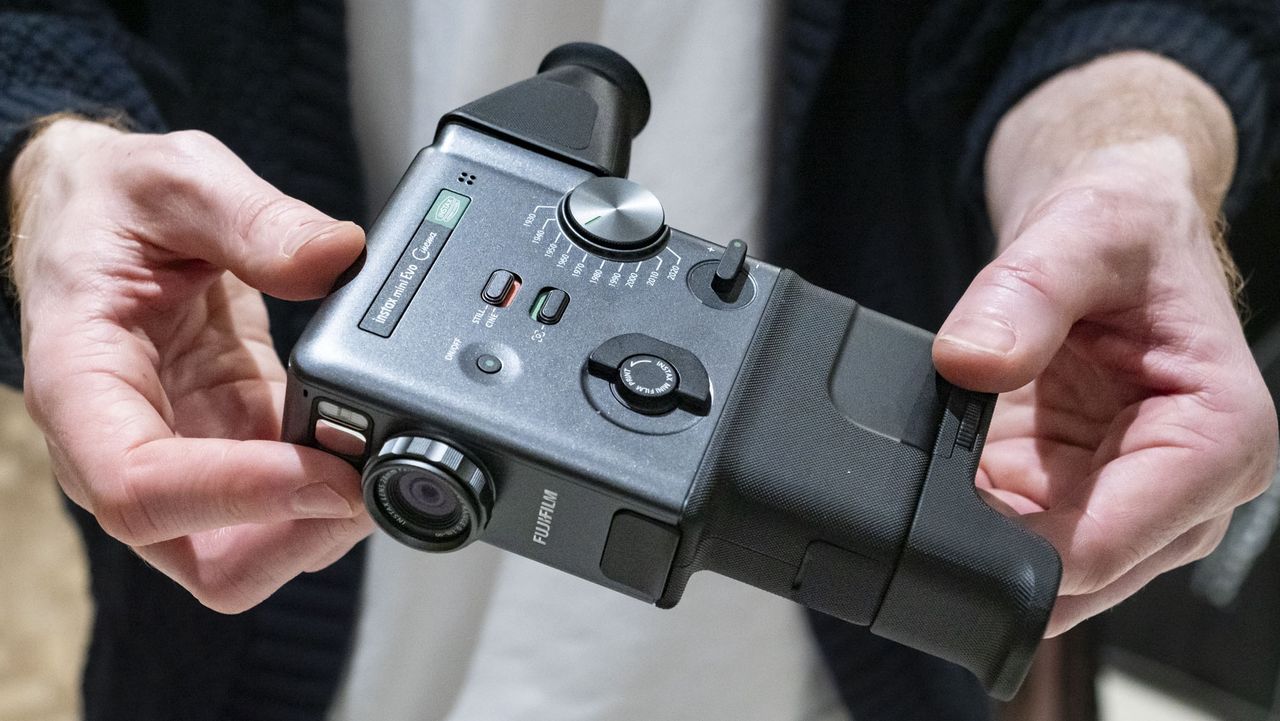
Fujifilm Instax Mini Evo Cinema camera in user's hands.

Fujifilm Instax Mini Evo Cinema: Two-minute review

The Fujifilm Instax Mini Evo Cinema takes instant cameras in a new direction, and let me tell you, it’s heaps of fun. It’s a 3-in-1 digital ‘hybrid’ instant camera; being a stills camera, an instant printer and the very first Instax that shoots video.

We know the instant photography part already: the Mini Evo Cinema packs much of the same lo-fi tech as the Mini Evo – 5MP digital photos through a 28mm f/2 lens, which are saved onto micro SD, that you can select in the camera’s gallery or through a companion app to print instantly onto Instax Mini paper. In this case, the printing process uses an analog-style lift and twist lever.

But it’s the camera's design where things get really interesting. This is a nostalgic, slimline Super 8 camera-style body – which is supposedly inspired by Fujifilm’s ‘Fujica Single-8‘ from 1965 – that easily sits in the hand with the shutter button at your trigger finger.

And for me, it’s the video features that drew me in rather than the traditional Instax photography experience, even if each of the three functions seamlessly blend together.

Then there's the main event – the Eras Dial, with a look for every decade spanning the last 100 years. Fujifilm says these looks ‘pay homage to the characteristics, media and playback devices that defined that time’.

Starting with 1930 and running up to 2020, there's a distinct look for each decade, each with a scale of 1-10 for various 'expressions' of each decade, adjusting either the strength or the look of each style. So yes, that makes 100 styles, all of which work for photos and videos.

Fujifilm is no stranger to introducing never-before seen controls in its recent cameras, from the Film Mode in the fun X half to the aspect ratio dial in the serious GFX100RF, it keeps delivering surprising new features, and the Eras Dial, being at one's fingertips, is more than just a novelty.

Even videos can be shared through an Instax Mini print – the Mini Evo Cinema selects a frame from the video (or the user can manually select a frame) and prints it with a QR code for access to that clip through Fujifilm’s servers.

You can also check out and share photos and videos using the free Instax Mini Evo app, including making short video edits from your video clips (which are limited in length to 15 seconds each).

I've made my own video compilations using the Instax Mini Evo app, combining multiple clips into a 30 second montage (which is the maximum length), printed it with a QR code attached, which then seamlessly took me online to that reel. The editor is a little clunky, and the video length limitations are frustrating at times, but it's an OK experience overall.

Here's the camera alongside a print for every one of the 10 decades featured in the Eras Dial. It's no coincidence that a pack of Instax Mini film produces 10 prints. (Image credit: Tim Coleman)

Inside the box, you get the camera, viewfinder eye cup for the 1.5-inch 170k-dot LCD screen (see it in action, below), a grip extension and a strap.

The Mini Evo might look toy-like, but it is in fact a premium-feel product, everything from the grip to the dials, switches and buttons feel solid.

Performance, on the other hand, during my review was pretty sluggish. I've used the camera at a launch event and again during a two week review period, and with both units the Evo Cinema's wheel of death appeared almost every time I recorded a video or switched eras, taking a few seconds to be ready to use again. A little annoying, but arguably in the spirit of retro tech.

The Evo Cinema handles well, and is such a clever concept - packing Instax tech into a polished, Super 8-style body (Image credit: Tim Coleman)

I actually think the Mini Evo Cinema is the most intriguing Instax camera to date – it feels like the Instax camera that the digital generation has been waiting for.

Its Super 8-style body is a perfect form to host Instax Mini printing, and the multi-media output makes this feel like a camera that'll keep my interest for much longer than a simple instant photography Instax. This is a proper good times camera.

Technically speaking, this is a poor camera. However, it already feels like the one Instax that appeals to me the most in the many years that I've been testing Fujifilm products.

If I was to sum the Mini Evo up in a single word, it would be fun. Fujifilm is having a real go at making cameras fun again with a string of quirky products, and the Evo Cinema could just top the lot.

Fujifilm Instax Mini Evo Cinema: price and release date

  • Costs $419 / £329 / AU$599
  • There's viewfinder, grip extension and strap accessories included
  • Sales began on January 28, 2026

The Fujifilm Instax Mini Evo Cinema went on sale globally from January 28 2026, with a price of $419 / £329 / AU$599.

In the box you'll also find the viewfinder attachment, grip extender, strap and USB-C cable. A purpose-made leather case will be available too, for $40 / £35 (about AU$65).

Fujifilm Instax Mini Evo Cinema: specs

Video

1080 x 1440 x ('2020' setting only) 600 x 800 for all others

Photo

5MP, 1/5-inch sensor

Format

Instax Mini

Lens

28mm f/2

Autofocus

Yes

Screen

Fixed 1.5-inch, 170k dots

Viewfinder

A clip-on viewfinder is supplied for the screen

Dimensions

39.4 mm x 132.5 mm x 100.1 mm (excluding projecting parts)

Weight

270g (excluding film pack and recording media)

Fujifilm Instax Mini Evo Cinema: design

  • Fabulous Super 8-style body
  • A pack of Instax Mini film slots inside
  • Retro controls and a charming Eras Dial

Design is easily the strong side of the Evo Cinema – it's a charming, Super 8-style camera with versatile 3-in-1 skills; digital photos, video, and instant printing.

The body is particularly slimline and designed to be held vertically. With a pistol-like grip, your index finger naturally rests on the shutter button, like a trigger. You press it to take photos, or press and hold to shoot video, with a maximum clip length of 15 seconds. You can customize to a single press to record video too, but I preferred the authentic press and hold for video recording, not least of which to avoid accidental recordings.

Fujifilm provides a grip extension with the camera, but honestly I could take or leave it – because it hardly impacts the camera’s handling. What is a useful accessory, however, is the viewfinder eyecup, which comes included. It attaches magnetically and clicks into place over the tiny 1.5-inch LCD screen, which isn’t touch sensitive by the way, enabling a clear view in bright light, but again more for an authentic Super 8-like shooting experience.

There are several buttons and controls around the camera worth mentioning, one of which is a lift and twist lever used for instant printing – it’s easy to forget that this slim camera can hold a pack of Instax Mini film inside for instant photo prints. A single pack of 10 prints will set you back around $9 dollars or £8 pounds.

Another control is the digital zoom lever – I rarely used this because the Mini Evo Cinema’s image quality is sketchy at best already, but more on this later.

The 28mm f/2 lens is a moderate wide angle optic, with a similar perspective to the main camera on your smartphone, and it has a ring around it which can scroll through color profiles. Above the lens is a selfie mirror which is barely helpful, plus a tiny LED flash light which is useful for indoor party portraits, even if it’s not very powerful.

The Eras Dial starts in the 1930s with a grainy monochrome, the 1990s is the old school handicam look, while 2020 is a crisp quality like today’s smartphones. Gimmicky? Maybe for some, but not for me – this is such a fun feature that I kept coming back to.

It might appear toy-like, but once you get to grips with the Mini Evo, you realise that it's a well-made, well-thought out camera. I really believe Fujifilm has faithfully brought a fabulous concept into life.

Fujifilm Instax Mini Evo Cinema: performance

  • 100 color profiles inspired by decades past and present
  • Poor image quality and limited video clip length
  • Sluggish operation

On the flipside to design, performance is surely the Mini Evo Cinema's weakness – and in that sense it is fully committed to its retro roots!

Having used the Mini Evo previously, I expected poor image quality, especially since the basic sensor hardware is essentially the same as the original Mini Evo. Put simply, don’t expect excellent photo quality – the camera shoots lo-fi five megapixel JPEG photos through that 28mm lens, which are then saved onto micro SD.

From the camera’s gallery, you can then select which images you’d like to print instantly onto Instax Mini paper, using that analog-style lift and twist lever.

Video quality is equally lo-fi at just HD 720p, unless you have the high-resolution option active specifically for the 2020 Eras Dial setting alone, where video resolution can be doubled to 1440p. A frustrating, needless limitation on quality? Not so – it’s authentic.

I prefer the digital hybrid setup to a fully analog instant camera – where the camera prints immediately on capture, whether it’s a ‘good’ photo or not. With a Mini Evo you pick the shot you like for printing, meaning less wasted prints. Sure, it’s not one for analog purists, but I’d rather not waste my money on throwaway prints.

One frustrating experience using the Mini Evo Cinema is its slow operation. Every time you change a setting, or take a photo or video, a spinny wheel of doom pops up on screen as the camera makes those changes or processes images before it’s ready to operate again. The wait is even longer after recording video clips.

I’ve had two samples of the camera, and had the same issue with both. One time, the camera completely froze up, and the only solution was to leave it be until the battery fully drained. Once I charged it up and turned it back on, all seemed well again.

These issues could be bugs with the current firmware, that could be addressed in the future, but I’d be remiss not to mention them.

In one sense, using the Evo Cinema with all its performance-related issues is frustrating, but then I stop and think about the kind of camera that it is, and I can't help but embrace those flaws.

Sample photos – 1930 through to 2020

The 10 photos above cover each of the 10 settings in the Eras Dial, from 1930 to 2020. I kept the 'expressions' control to its auto setting rather than experiment with the 10 different looks available for each of the decades on the dial. Stills are recorded as JPEGs onto microSD, at 1920 x 2560 pixels.

Sample video – 100 years in a minute

I repeated the process for video, capturing each of the 10 Eras Dial looks. The lo-fi video quality is captured at 600 x 800 pixels for every setting except 2020, which is a higher quality 1080 x 1440 pixels.

Should I buy the Fujifilm Instax Mini Evo Cinema?

Buy it if...

Don't buy it if...

Fujifilm Instax Mini Evo Cinema: also consider

How I tested the Fujifilm Instax Mini Evo Cinema

  • I attend a pre-launch Evo Cinema event for an two hour session. Fujifilm consequently sent me the camera for a two week loan period
  • I used it with the viewfinder and grip accessories, and I tried all the Eras Dial settings for photo and video
  • I've printed Instax Mini prints and edited content through the app

I've spent two weeks with the Evo Cinema, which has given me plenty of time to get a feel for how it handles and performs.

At a two hour launch event, I recorded the same video in a studio of a model, using every one of the 10 Eras Dial settings, and repeated that process for photos, printing out each one.

I've since experimented with the various expressions of each decade, taken more photos and videos both indoors and outdoors, in good light and bad.

I've tried the Evo Cinema with and without its viewfinder and grip accessories. The optional case was not supplied to me for the review.

I also made video montages using the basic video editor in the free Mini Evo Cinema app, and printed the QR code for access to those clips.

Sign up to read this article
Read news from 100’s of titles, curated specifically for you.
Already a member? Sign in here
Related Stories
Top stories on inkl right now
One subscription that gives you access to news from hundreds of sites
Already a member? Sign in here
Our Picks
Fourteen days free
Download the app
One app. One membership.
100+ trusted global sources.