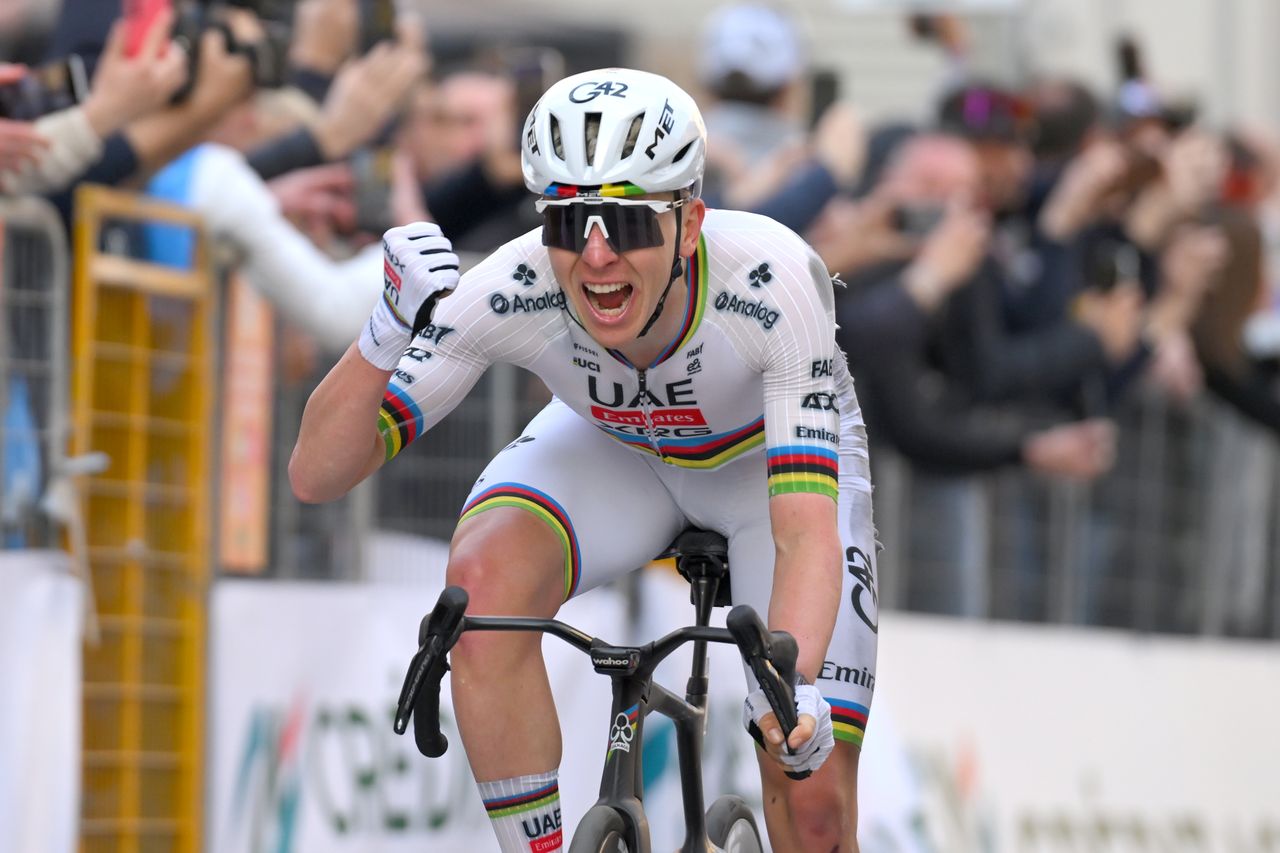
Tadej Pogačar once again showed the true champion that he is, as he won Milan-San Remo ahead of Tom Pidcock in a two-up sprint on the Via Roma. The pair had managed to drop last year’s winner Mathieu van der Poel on the Poggio and came into the final sprint together, but it was the World Champion who emerged victorious, as he claimed one of the few major races to have eluded him thus far in his career.
Though many would have expected Pogačar to win La Classicissima at some point or another, few would have predicted the manner in which he would end up doing so, as the Slovenian rider suffered a crash shortly before the start of the Cipressa, leaving him with road rash, shredded kit and a massive battle to get back to the head of the race with 33km to go.

The crash had clearly had an effect on him, but the short time that it took him to return to the front of the peloton was nothing short of spectacular and a credit to his UAE Team Emirates-XRG teammates, who then launched him onto the attack with 24km to go, with only Pidcock and Van der Poel able to go with him.
“When I crashed, I thought it was all over,” said Pogačar in his post-race interview. “To crash in Imperia just before the most important part of the race is not ideal, but luckily I was quickly back on the bike and there was not too much damage to me or the bike.
“Then I saw my team, Florian [Vermeersch] and Felix [Großschartner], they left out everything to come back to the front. They gave me back hope and the legs were still okay, Brandon [McNulty] and Isaac [del Toro] did the rest on the Cipressa. Today if there’s no team, then I would not go right onto the Cipressa, but I would have gone straight through to the finish line.”
After the trio worked together in the few kilometres between the Cipressa and the Poggio, Pogačar then managed a feat that he has attempted unsuccessfully in each of the previous three editions, as he dropped Van der Poel with an attack on the lower slopes of the Poggio, with the Dutchman unable to hold the wheel on the rapid ascent.
“When we were pulling turns, I was really happy that everybody worked,” Pogačar continued. “It was a bit of a headwind, so not ideal like last year and it was a bit harder in the middle part. When we hit the Poggio, it was a better wind this year, so I tried to go all out there. The ideal would be to go alone, but Tom Pidcock was really strong. Chapeau to Mathieu, he did an amazing race also, but in the end me and Tom came together and I was lucky in the sprint.”
Pidcock was able to stay in contact over the top of the climb and on the descent, despite Pogačar putting pressure on the British rider with multiple accelerations. As they came off the downhill and into San Remo, it was clear that they would have to work together to maintain their narrow advantage over the peloton behind, but once they reached the Via Roma, both riders’ focus quickly turned to the sprint.
Pidcock forced Pogačar to the front in the final few hundred metres, but then slightly boxed himself in against the barriers when the sprint was launched. The Q36.5 Pro Cycling rider then attempted to burst out of the slipstream, but did not have enough to come around his rival, with Pogačar winning by half a wheel on the line.
“Tom is a really fast guy, we all know this. He’s punchy, he’s fast and he looks in really good shape, so I was a bit afraid when he let me go first and I was waiting for as long as possible, but I also know I cannot wait too long, because he has a better kick than me probably. In the end, I was surprised. It was really close and chapeau to him,” the World Champion concluded.
How It Happened
At 298km in length, the men’s edition of Milan-San Remo is the longest race on the WorldTour calendar, known for its long drawn-out prelude before a frantic finale along the coast, with the short punchy climbs of the Cipressa and Poggio in the closing kilometres before the descent into San Remo and the finish on the Via Roma.
The day began with an embarrassing incident for race organisers RCS Sport, as shortly after flag drop, the lead motorcycles and commissaires’ cars took the wrong exit of a roundabout, leading around a dozen riders from the freshly formed breakaway off course and leaving them to chase back on to the peloton.
This is the second mishap in as many weeks for the Italian organisation, as a similar incident occurred at Strade Bianche Donne, where the favourites’ group was led off course by a lead motorcycle.
An early breakaway did eventually form a few kilometres later, with Martin Marcellusi (Bardiani CSF 7 Saber), Manuele Tarozzi (Bardiani CSF 7 Saber), Lorenzo Milesi (Movistar), Manlio Moro (Movistar), Andrea Peron (Novo Nordisk), David Lozano (Novo Nordisk), Alexy Faure Prost (Picnic PostNL), Dario Igor Belletta (Polti VisitMalta) and Mirco Maestri (Polti VisitMalta) forming a nine-rider group at the head of the race.
Their gap was kept in check by the peloton in the early part of the race, with Silvan Dillier (Alpecin-Premier Tech) playing a key role in pacing at the front of the bunch, as he rode with little to no assistance for kilometre after kilometre, just as he did twelve months ago.
Teams did begin to come to the front of the peloton for the Passo del Turchino, as they looked to keep their leaders in good position for the climb and the subsequent descent, and despite pre-race rumours that UAE Team Emirates-XRG would look to make the race hard on the climb, it all remained relatively calm as teams looked to conserve energy for the latter part of the race.
The descent that followed then brought the riders onto the coast, with the pace going completely out of the peloton, as the gap to the breakaway swelled to nearly seven minutes with around 80km to go. This forced Domen Novak (UAE Team Emirates-XRG) to take over from the tiring Dillier, who had been riding almost non-stop on the front for about two-hundred kilometres.
Novak’s efforts did see the gap begin to come down, as teams also began to get organised behind him. The reason for which became apparent with 65km to go, as a tangle between two riders from Ineos Grenadiers and Q36.5 Pro Cycling caused several riders to crash, whilst others were also held up behind. Fortunately for both teams, Filippo Ganna and Tom Pidcock both managed to narrowly avoid the crash and maintain their position at the front of the peloton.
Tension in the bunch then grew further as the race began the approach towards the Tre Capi, with more and more teams trying to come to the fore to position themselves. It was also in the run-in to the Capo Mele that the Novo Nordisk pair of Lozano and Peron were both dropped from the breakaway, leaving seven riders at the head of the race.
As they came onto the Capo Mele, their advantage over the peloton stood at four minutes, but that was reduced by thirty seconds as the peloton came over the top of the climb and continued to tumble as UAE Team Emirates-XRG set the pace on the front of the main group.
Over the Capo Cervo and the Capo Berta, Alpecin-Premier Tech, Ineos Grenadiers and Q36.5 Pro Cycling all began to jostle for position and control. Meanwhile, the breakaway began to splinter at the head of the race, with Faure Prost, Moro, Tarozzi and Marcellusi all dropped from the lead group and their advantage coming down to just over a minute.
Coming off the Capo Berta and into Imperia, one of the biggest moments in the race occurred as Tadej Pogačar (UAE Team Emirates-XRG) slid out through a left-hand bend, causing several riders to crash behind him, including Wout van Aert (Visma-Lease a Bike) and Mathieu van der Poel (Alpecin-Premier Tech).
This left the World Champion battered, bruised and forced to chase back on, whilst Van Aert suffered a mechanical in the crash and had to wait for a bike change. Van der Poel was the least affected of the three and was able to remount his bike almost instantly, despite suffering some abrasions to his left hand and arm.
There was no thought of waiting for them though, with the race was full on in the peloton as they approached the Cipressa, as the unaffected teams continued to drive the pace. Van der Poel was the first to return, as Jasper Philipsen (Alpecin-Premier Tech) helped to bring him back to the bunch around a kilometre before the start of the penultimate climb.
The final three riders from the breakaway were then caught as the peloton went onto the Cipressa, with Josh Tarling (Ineos Grenadiers) leading onto the climb with Filippo Ganna in his wheel. Meanwhile, Pogačar had made his way onto the back of the peloton as they began the climb, with Brandon McNulty (UAE Team Emirates-XRG) dropping back to help navigate him through the bunch and bring him back into contention.
It was not long until the now slightly tattered rainbow bands were visible at the front of the peloton once again and despite the injuries to their leader, UAE Team Emirates-XRG wasted no time in setting up the inevitable attack, as McNulty emptied the tank before Isaac del Toro made an acceleration to launch Pogačar with 24km to go.
Pidcock had anticipated the Slovenian’s move and was equal to it when it finally came, staying glued to the wheel with Van der Poel just behind him. However, unlike last year, Filippo Ganna was unable to follow the move, as he lost the wheel and the three riders began to gain separation.
There were still 2.5km to the top of the climb, but it was clear that this would be the decisive move as the gap continued to grow over the group behind, with Lidl-Trek attempting to organise a chase from the riders they had left.
Over the top of the climb, the leading trio had a gap of twenty-five seconds as they went onto the descent of the Cipressa, with Pogačar continuing to press on. They then rejoined the coastal road and began the run towards the Poggio, working together to maintain their advantage over the chasing group, which had swelled in numbers as riders had made their way back on the descent.
Those extra numbers did help the chase behind, as the leaders’ advantage had come down to under ten seconds as they turned onto the Poggio with 9km to go. It was at this point that Pogačar launched another acceleration, which dispatched Van der Poel, with the Dutchman unable to handle the pressure being applied by the World Champion.
As the defending champion began to drift backwards, Pidcock was forced to jump across to Pogačar’s wheel, as he was the only one able to follow the infernal pace being set at the head of the race. The British rider would then be hit with another acceleration towards the top of the climb, but was once again equal to it and still looked relatively comfortable following the wheel.
Going onto the descent, Pidcock came to the front in an attempt to put Pogačar under pressure, but it was not long until the Slovenian rider was ahead once again and accelerating out of the corners. It was not by no means enough to distance his breakaway companion, but he was certainly not making life easy for him either.
With just over two kilometres to go they came off the descent and entered into San Remo, beginning the final stretch before the finish on the Via Roma. The leading pair continued to work together, as they still only had a slender advantage over the group behind, who had caught Van der Poel on the descent.
A miraculous comeback from Wout van Aert then saw him attack from the group behind, with nobody able to follow the Belgian rider, who was trying to solo across the gap to the leaders.
Under the red kite and into the final kilometre, Pidcock adjusted his race suit as they swung onto the Via Roma. He had forced Pogačar to the front and the cooperation that he had shown in the previous kilometre suddenly disappeared. The World Champion began to freewheel and look behind, wary of his competitor’s punchy acceleration and a charging Van Aert, who was in sight of the two leaders.
Pidcock then attempted to surprise Pogačar by launching his sprint on the barrier side with two hundred metres to go, but got slightly boxed in and had to readjust before going again. However, this had also triggered Pogačar to launch his sprint, leaving the British rider with an almighty task to come around and pass his rival.
As he emerged from the slipstream, Pidcock began to get on terms and looked as though he could snatch the victory in the final metres, but the finish came just that bit too early and despite his efforts to throw his bike at the line, it was Pogačar that won the race by a matter of centimetres.
Behind them, a tiring Wout van Aert just managed to hold off the sprinters from the chasing group to finish in third place and take his first Monument podium since Paris-Roubaix in 2023. He finished ahead of Mads Pedersen (Lidl-Trek), who produced an impressive ride to take fourth place, as his start to the season had been completely derailed by injury after a crash in his first race at the Volta a la Comunitat Valenciana.
In the end, Van der Poel had to settle for a disappointing eighth place on the day, as he finished in the chasing group with thirty-five other riders, including other former winners Matej Mohorič (Bahrain Victorious) and Jasper Stuyven (Soudal Quick-Step).
Results
Milan-San Remo 2026: Pavia > San Remo (298km)
1. Tadej Pogačar (Slo) UAE Team Emirates-XRG, in 3:47:17
2. Tom Pidcock (GBr) Pinarello-Q36.5 Pro Cycling, at same time
3. Wout van Aert (Bel) Visma-Lease a Bike, +4s
4. Mads Pedersen (Den) Lidl-Trek
5. Corbin Strong (NZl) NSN Cycling
6. Andrea Vendrame (Ita) Jayco AlUla
7. Jasper Stuyven (Bel) Soudal Quick-Step
8. Mathieu van der Poel (Ned) Alpecin-Premier Tech
9. Matteo Trentin (Ita) Tudor Pro Cycling
10. Edoardo Zambanini (Ita) Bahrain Victorious, all at same time