Get all your news in one place.
100’s of premium titles.
One app.
Start reading
Guitar World
Guitar World
Entertainment
Andrew Daly

“The recording was brutal. Daytime was Dragon's Kiss, nighttime was Jason Becker's Perpetual Burn. I was in the studio 16 to 18 hours a day”: Marty Friedman on leaving Megadeth, reconnecting with Dave Mustaine, and why he wasn't a good fit for Ozzy

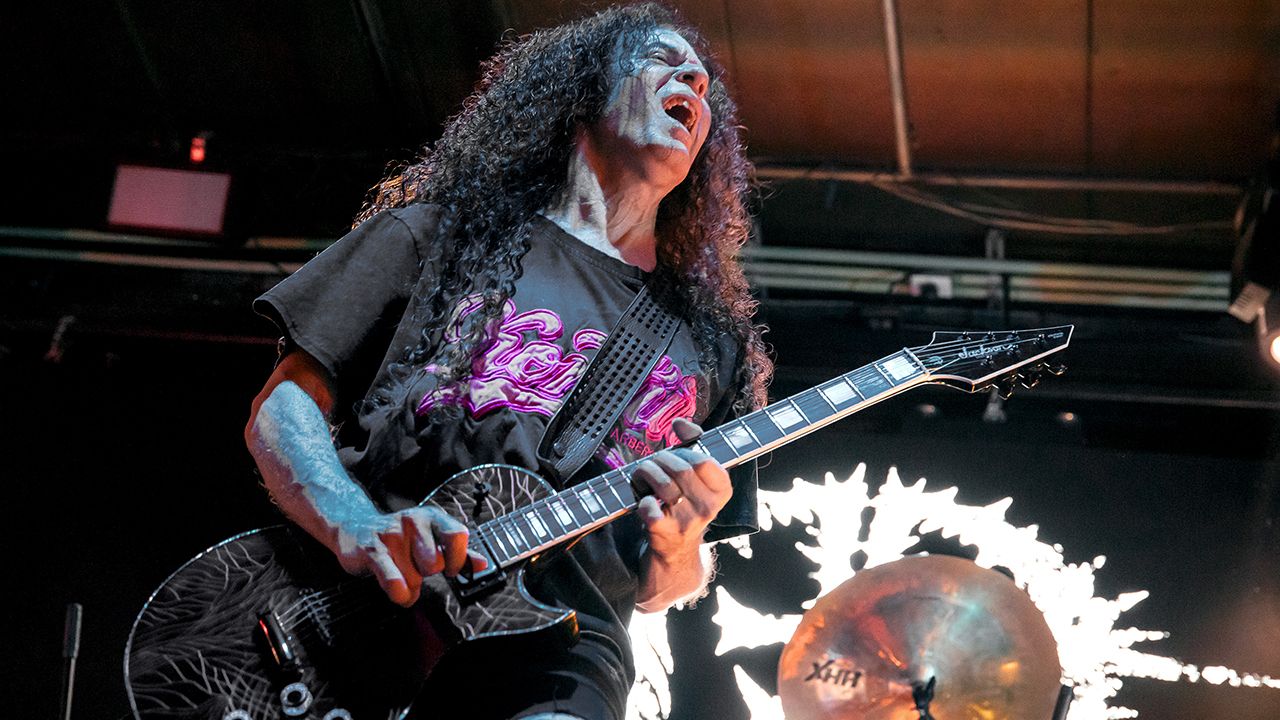
MONTERREY, MEXICO - JUNE 22: Marty Friedman, American guitarrist ex Megadeth band, peforms on the concert at Café Iguana on June 22, 2025 in Monterrey, Mexico. (Photo by Medios y Media/Getty Images).

Marty Friedman states he has no regrets. He’s seen and done just about everything a guitarist can, with career highs including Cacophony’s Speed Metal Symphony (1987), his debut solo record, Dragon’s Kiss (1988), and Megadeth’s Rust in Peace (1990). And in 2024 he dropped what he feels is his definitive work, Drama.

He’s delighted to have reconnected with old pal Dave Mustaine, and to have joined Megadeth onstage for a few songs at Budokan and Wacken in 2023 – which reminded the world how high the stakes go when he’s on a big stage.

“It may be because it’s what I do most naturally and best,” Friedman says. “When someone’s doing what they’re meant to do, it has a profound effect. Perhaps greater than someone who has the gift to play beautifully but who’s multi-talented with a true calling in carpentry or aviation, for example. There aren’t a lot of other things I do well!”

Friedman, of course, is aware that Mustaine is in the process of calling time on Megadeth – which has him thinking about his own past and future.

“I'm proud of the legacy I've built with the band, and I love the fans even more now,” he says. “They remind me of myself as a teenage Kiss fan.

“Whenever Megadeth retires will be the right time. Dave and I could have both retired decades ago, but we’re both lifers – we play music because that is just what we do. When the grind of touring eventually outweighs the joy of playing, I’d say that’s the time to retire.”

What are your earliest memories of music?

Johnny Cash had a TV show when I was a kid, and it came on right at my bedtime, and I used to plead with my parents to let me watch it. Most of the time they didn’t, so I listened to it through the central heating vent in the floor. He was always talking about jail and rebellious stuff – it was this forbidden thing, and I loved it.

What specifically drew you to the guitar?

I never cared about guitar! I thought they were for folk singers and college kids singing around the campfire. When I saw Kiss in concert I just wanted to be in that high-energy, high-adrenaline world, and the guitar seemed to be the way to get into it.

How did the scene you grew up in affect you?

I was very lucky. My first band, Deuce, was the foundation of everything to come. I was playing live in front of people from the very beginning, even though I could barely play! It forces you to be an entertainer, to always play your best and to avoid screwing up at all costs. No one hears your mistakes if you’re in your bedroom.

(Image credit: Medios y Media/Getty Images)

After Jake E. Lee left Ozzy, you auditioned for the job. What was that like?

I was flattered to be flown down to audition. I think I played very well, but my image at that time was more of a guitar nerd than a partying rock star. I didn’t look like the guys in the band. I think Zakk Wylde was absolutely perfect for Ozzy, with more than enough playing ability to back up his wild appearance.

How did you first meet Mike Varney, leading to signing a deal in the so-called shred era?

Back then, “shred” wasn’t a term you heard much. It always made me think of a guy playing as fast as possible in his basement – fingers were flying and looking impressive, but if you closed your eyes it sounds like absolute vomit. But a lot of people listen with their eyes; they see these guys and are impressed and they think shredding is cool. I hated being lumped in with shredders.

I first met Varney by sending a demo to his Spotlight column in Guitar Player magazine. He called me and we made several albums together. But it slightly irked me that despite all that, he never put me in his column!

Tell us about the writing and recording of solo album Dragons Kiss, which put you on the map.

I’d put all my guts and all my material into Cacophony's Speed Metal Symphony, so when Mike Varney signed me on for a solo album, I had no material. I was motivated solely by the fact that a label was willing to put out my music. I didn’t want to let anyone down.

The recording was brutal. It was done in shifts – daytime was Dragon's Kiss and nighttime was Jason Becker's Perpetual Burn, which I was also co-producing. I was in the studio 16 to 18 hours a day, with no time for trivial things like food and sleep. But I wouldn’t have had it any other way!

It was forcing me to come up with so much on the spot. Sonically, Dragon’s Kiss can be hit and miss, but I’m glad I put Forbidden City on there. I feel that was a well-done piece of music, despite my limited life experience at the time.

In one short year Jason went from a crappy demo tape to writing, arranging, and recording Perpetual Burn. It was uncanny

What had led to your hooking up with Jason Becker?

Mike had played me a demo of Jason beforehand, and I was nonplused. The best I could say about it was that he was good for a 16-year-old – but so what? But Mike insisted I meet him, and since Mike was holding the keys to the album I wanted to release, I humored him.

When Jason came into my apartment I immediately fell in love with the guy. I could see that, although songwriting and recording were not yet things he was any good at, he had an unlimited amount of talent for playing the guitar.

(Image credit: Medios y Media/Getty Images)

So I made the ultimate sacrifice and scrapped my solo album to form the band Cacophony with him. We became best friends almost immediately. I was growing as a guitarist at a pretty good pace, but Jason was growing like some kind of Guinness world record holder!

In one short year, at age 18, he went from a crappy demo tape to writing, arranging, and recording Perpetual Burn, an album that stands up today as a benchmark of jaw-dropping guitar playing. It was uncanny.

Your work with Jason, along with your solo work, got your star rising. Is that what first caught Dave Mustaine's attention?

No – Dave didn’t particularly like the Cacophony stuff. One time we were listening to it in the car and he was telling me he liked this part and that part. But he’s always been a song guy, and Cacophony was less about songs, more about new melodies, unique sections, far-out arrangements – and, of course, guitar acrobatics. Great songwriters, we were definitely not!

I was recommended to Megadeth's manager by a mutual friend, after they’d unsuccessfully auditioned around 60 guitarists.

Were you a fan of Megadeth?

I wasn't too familiar with the band, but I remember really liking the Peace Sells album when it came out. What I knew I could bring to the table was a much more melodic way to present the heavy music they were doing, and I could update the lead guitar work.

Megadeth always had good lead guitar work, but when I joined they only had two major-label albums out, and the guitar was not recorded very well – so you couldn’t tell how good it was. I wanted a much stronger and clearer presentation of guitar. We got exactly that when we started recording together.

Leaving Megadeth allowed me to eclipse my role on so many levels and create a niche for myself

It's undisputed that your era with Megadeth bred the band's best work. Rust in Peace and Countdown to Extinction are all-time albums. Why do you think that is?

We were each the perfect guy for the job, all in the band at the same time. No weak links, and we constantly pushed each other. It was a lot of very hard work, and very little resting on laurels, if any. We were deeply emotionally invested in the product we were creating.

In my autobiography Dreaming Japanese, I went into great detail about making the albums. Each had separate challenges; some were more fun than others, but none of us ever slacked off on any of them. It’s no coincidence that they still hold up pretty well today.

(Image credit: Jun Sato/Getty Images)

While you were with Megadeth in the ‘90s, you continued your solo work. Was Dave okay with that?

Dave and Megadeth management were totally cool with my solo career coinciding. At the time I wasn’t touring with my own band, like I am now. That would have likely caused a conflict. But when I was off tour, I was always working on my own music as well as Megadeth stuff.

A lot of people think it was a mistake to leave Megadeth – but there’s a strong argument that you left at the right time.

I understand that, for a fan, anything that changes your favorite lineup is catastrophic. But for me, it was the best career move I ever made. It wasn’t easy to leave such a well-established band that I’d had so much success with.

But leaving allowed me to eclipse my role in Megadeth on so many levels and create a niche for myself that’s served me very well. Megadeth went on to win Grammys and do some amazing things in my absence, so all is well on both sides.

Things seem to have thawed between you and Dave in recent years.

It’s great – we’ve both kept our things going strong for several years, so there’s a mutual respect between us. It was quite casual and easy for us to play together the few times we have at Budokan and Wacken.

You’ve remained prolific ever since, releasing amazing solo records, leading up to Drama. What keeps you chasing new sounds?

There are always new depths of melody to be created and new expressions to share, and I’ve always pursued those things. I think Drama is the ultimate representation of my musical evolution.

I’ve been concentrating on touring the album much longer than usual before starting the next one. I can't imagine topping it – so, being the lazy ass I can often be, I’ll just enjoy playing the Drama music on tour until I feel like I can do something better.

What’s the backstory of your guitars and the gear that gets your notable tone?

I use these products because they’re extremely reliable work tools, rather than having some kind of special sound I can’t live without

I’m very fortunate to have signature guitars, pickups, amps, and pedals. The Jackson Marty Friedman MF-1, the EMG MF pickups, the ENGL Marty Friedman Inferno amp, and the Tech 21 Marty Friedman pedal will lead anyone to the tones I like.

To be honest, though, I’d sound like me through any gear. I use these products because they’re extremely reliable work tools, rather than having some kind of special sound I can’t live without. I just need a workhorse that can take a constant beating.

What are you up to now, and what’s next?

I've been touring for the Drama album since it came out in late 2024 and I plan to tour it even more in 2026. And I’ve been working with several Japanese artists, doing plenty of Japanese TV shows as usual. And I have a YouTube channel called Rock Fujiyama that has me playing guitar with interesting guests every week.

Sign up to read this article
Read news from 100’s of titles, curated specifically for you.
Already a member? Sign in here
Related Stories
Top stories on inkl right now
One subscription that gives you access to news from hundreds of sites
Already a member? Sign in here
Our Picks
Fourteen days free
Download the app
One app. One membership.
100+ trusted global sources.