Get all your news in one place.
100's of premium titles.
One app.
Start reading
Ideal Home
Ideal Home
Lauren Bradbury

I tested Dyson’s very first auto-empty vacuum cleaner – this is how it won me over (and where it fell short)

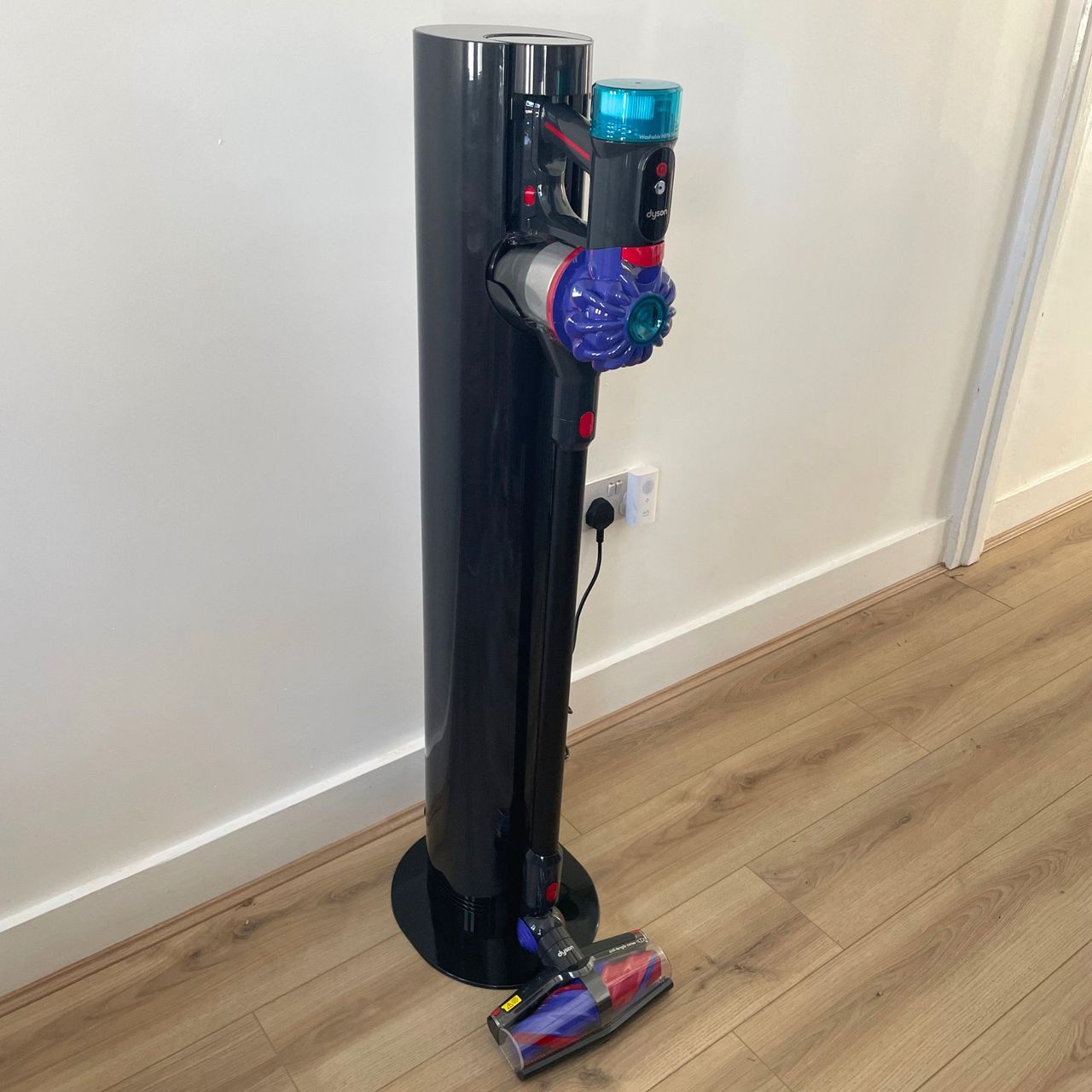
Dyson V10 Konical Cordless Vacuum and Auto-Empty Dok sitting on wood-effect flooring in front of a white wall.

Meet the tester

(Image credit: Future)

I'm Lauren, Ideal Home's resident floorcare expert and Certified Expert in Vacuums. I tested the Dyson V10 Konical Cordless Vacuum and Auto-Empty Dok in my three-bedroom home for two weeks, using our dedicated vacuum cleaner testing process to assess its capabilities.

As Ideal Home’s Certified Expert in Vacuums, I test vacuum cleaners day in and day out. Couple that with homeownership and being a dog mum, and I feel like I’m constantly cleaning and emptying my vacuum’s dustbin. That’s why I’ve really come to love auto-empty vacuums.

And while the best Dyson vacuum cleaners come in so many different shapes and forms, this big-name brand hadn’t entered the auto-empty chat until recently. So, when I got the chance to test out the new Dyson V10 Konical Cordless Vacuum and Auto-Empty Dok for myself, I jumped at the chance. But how did Dyson’s first auto-empty vacuum hold up?

In a nutshell

I love it when the best vacuum cleaners get a refresh, and welcoming auto-empty vacuums to the market is a switch-up we’ve been crying out for. After all, everyone knows that emptying a vacuum’s dust bin is the worst (and messiest) job of all. But the Dyson V10 Konical Cordless Vacuum and Auto-Empty Dok was a strange one for me to review.

From a cordless vacuum cleaner point of view, Dyson has nailed it with the V10 Konical. The 150AW of power is more than enough for everyday cleaning and tackled my rigorous debris testing with ease, and the brand’s famous conical floorhead dealt with the pet hair in my home without getting tangled or caught once. It’s also extremely lightweight, has a long 60-minute run time, and has an average-sized dust bin on the main unit.

(Image credit: Future PLC/Lauren Bradbury)

The brand’s new Auto-Empty Dok, however, didn’t impress me the same way. Although I liked the onboard tool storage, it was way too big and cumbersome for my house and stood out like a sore thumb in terms of both size and aesthetics. And while, in theory, the Auto-Empty Dok should empty the V10 Konical vacuum automatically after each use, I found that it struggled to expel all of the debris and hair almost every time.

Of course, larger homes with less pet and human hair may find space for it and experience full auto-emptying capabilities. But these niggles, and the fact that I’d need to buy replacement dust bags in the long run, left me feeling a little disheartened. However, I do see the vacuum itself being a huge hit, and I think it was a great idea from Dyson to allow customers to buy the vacuum without the Dok. It’s obviously cheaper this way, and I’ve popped links to where to buy it below.

Specifications

(Image credit: Dyson )
  • Weight: 2.65kg (vacuum), 7.2kg (Dok)
  • Suction power: 150 Air Watts (AW)
  • Bin volume: 0.5L (vacuum), 2.5L (Dok)
  • Run time: 60 mins
  • Charge time: 4 hours
  • Modes: Eco, Medium, MAX
  • Noise level (tested by us): 79-86dB
  • In the box: Main unit, Auto-Empty Dok, Conical Floorhead, Mini Motorised Tool, Crevice Tool, Wall Dok

Unboxing, setting up and first impressions

Floorcare appliances aren’t exactly small, and I’m used to receiving large parcels as Ideal Home’s Floorcare Editor. But was I expecting the box of the Dyson V10 Konical and Auto-Empty Dok to be as giant as it was? Well, no.

Not only was the box almost as tall as me (I come in at 5’2”), but it was also incredibly heavy at almost 20kg. There were some carry handles to make manoeuvrability easier, but I still struggled to get it over the threshold of my home by myself. So, bear this in mind if you live solo or have any mobility issues.

Inside the main box was a game of eco-friendly Tetris, as it was filled with three more boxes - one large one and two smaller ones. I soon learned that the larger box held the Auto-Empty Dok, one of the smaller ones held the base of the Dok, and the third held the V10 Konical vacuum in its entirety.

There was very little plastic to contend with, which pleased me, and as someone who hates reading instructions, I was happy to learn that I could assemble both the Dok and the vacuum without consulting the written instructions. In fact, it took me less than two minutes to get everything where it needed to go.

One thing I loved straight off the bat was that everything was very self-contained. The vacuum sits in the Dok, and both the dust bag (which was already inserted, although Dyson also provides a spare) and the tools sit in their respective compartments within the Dok. This is a nice perk for me, as smaller vacuum bits and bobs do tend to go walkabout in my house.

However, the (very big) elephant in the room was that this vacuum and its Dok aren’t small. The Dok is huge and completely overtook my dining room. Granted, I’m in the process of moving house, and my dining room is also serving as a storage space for boxes, but there’s no denying that this will really stand out in any home.

This was a bit off-putting for me, to be honest, as I do feel like it could have been designed to be smaller, but I appreciate that looks and size aren’t everything. So, I let the Dyson V10 Konical charge on the Dok for a few hours before testing it out properly.

Using the Dyson V10 Konical Cordless Vacuum and Auto-Empty Dok

Offering 150 Air Watts (AW), the Dyson V10 Konical Cordless Vacuum sits comfortably alongside the Dyson V8 Cyclone in terms of power. And what I loved about this budget-friendly model was that it offered just enough power for everyday cleaning - and the V10 Konical is no different.

This was proven when I threw oats, rice, and sugar onto my hard flooring as part of our vacuum cleaner testing process. The idea here is that a good-quality vacuum with effective suction power should be able to remove all of the debris from the floor in as few passes as possible - ideally just the one forward pass. Amazingly, that’s exactly what the Dyson V10 Konical did. There were a few stragglers that needed a backwards pass, but overall I was really impressed with the pickup power.

I then repeated the process on carpet, and was just as impressed. It tackled both the larger debris and the smaller debris with ease - and one look at the onboard dust canister proved that it also managed to pick up some lingering hair that was embedded into my carpet fibres.

I continued to be impressed with the Dyson V10 Konical as I continued using the cordless vacuum around my house for general cleaning. At 2.65kg, the cordless vacuum is incredibly lightweight and manoeuvrable, and I personally love the conical floorhead and its pickup ability (although I do know that some people don’t like it as much as Dyson’s older design).

It tackled hard flooring, carpets, and rugs with ease, and I didn’t feel like the suction power lowered as I moved from one flooring type to the next. Plus, the classic Dyson green laser made invisible dust and debris visible - offering a more efficient overall clean.

There are three modes available - Eco, Medium, MAX - but I rarely found myself having to stray from Eco, as this was enough to tackle the everyday debris in my home over the course of almost two weeks. Because of this, I was able to make use of the 60-minute run-time, which is extremely generous.

Using the attachments

The Dyson V10 Konical and Auto-Empty Dok comes with two attachments: the classic crevice tool and a mini motorised tool. These can be used when the vacuum is in its handheld form, and overall I found this to be super quick and convenient to grab for smaller messes.

It’s extremely lightweight in handheld mode, and while the crevice tool is nothing remarkable (I’ve yet to find a crevice tool from any brand that has wowed me, as it’s just a nice extra), it still managed to get into the smaller nooks and crannies of my house.

(Image credit: Future PLC/Lauren Bradbury)

As a dog mum and the owner of woollen carpets that hide hair and debris, I love any motorised tool, and the Dyson motorised tool was definitely a handy addition to my cleaning routine. I used it to clean everything from my carpeted stairs to my dog’s bed and a velvet sofa bed, and found it did exactly what I needed it to.

Another thing I do really love is that the tools can be stored in a little compartment on the Dok. This meant that they were always accessible for when I needed them, but still tucked away so they didn’t clutter up my space.

It’s also worth noting that you can buy extra accessories for the V10 Konical on the Dyson website if you need more. These vary in price from around £19 up to £80, so they can be expensive, but it’s nice to have the option to add more if you would benefit from using them.

Cleaning and maintenance

The beauty of the Dyson V10 Konical Cordless Vacuum and Auto-Empty Dok is that cleaning and maintenance is fairly limited. The vacuum itself has an on-board dust capacity of 0.5L, which was enough to successfully vacuum my small three-bed terrace without needing to empty it. But even if you do fill up the 0.5L onboard capacity before you finish vacuuming, you can simply pop it on the Auto-Empty Dok and empty it in seconds.

Dyson claims that the onboard bagged capacity of 2.5L should offer space for up to 60 days’ worth of dust, depending on your cleaning habits. And after almost two weeks of testing, I can confirm that it’s nowhere near full.

The Auto-Empty Dok wasn’t flawless, though. I have a very hairy household thanks to my dog’s hair and my long hair that seems to get everywhere. And while the V10 Konical excels at sucking up this hair without it getting stuck, the Dok doesn’t have as much luck. On almost all occasions, the auto-emptying function just couldn’t pull the last bit of hair out of the onboard canister and down into the bag.

(Image credit: Future PLC/Lauren Bradbury)

This didn’t happen every time, but it happened enough for it to become annoying and meant that I either had to start cleaning with the canister already partially filled, or I had to manually remove it. So, it seemed to defeat the object of the Auto-Empty Dok slightly.

Of course, another negative of being a bagged Dok is that you need to buy replacement bags. Dyson includes two as part of the purchase, but at the time of writing, I can’t actually find the replacement bags on the Dyson website. So, this is something that Dyson needs to address as soon as possible, as ongoing costs are a factor many people consider when buying a new vacuum.

(Image credit: Future PLC/Lauren Bradbury)

Nevertheless, the Dok also serves as a charging point for the V10 Konical, and it will start charging it as soon as you pop the vacuum on it. This means that you’ll never be without battery power - as long as you remember to place it back on the dok. A full recharge takes about 4 hours.

In terms of other cleaning and maintenance, the Dok has a HEPA filter that needs to be washed every two months - or when the Dok alerts you with a warning light. All you need to do is pull it out, rinse it under cold water, allow it to air dry fully for at least 24 hours, and then re-insert.

The vacuum itself also has a washable filter, which should be washed every two to four weeks depending on use and cleaning habits. Again, let it dry completely before putting it back in the vacuum.

How does it compare to similar models?

I’ve tested a lot of vacuums over the years, but auto-empty docks are still relatively new to the game. Because of this, it’s hard to compare it to many alternatives, but there’s no denying it’s very similar to the Shark PowerDetect Speed Clean and Empty Pet I tested a few months ago.

These are two new auto-empty vacuums from two very big vacuum brands, and they’re also at a fairly similar price point - the Dyson is £569.99, and the Shark is £499.99. They also both have the exact same suction power of 150 Air Watts (AW), and two attachments that can be stored on the docks.

There are some differences, though. The Shark auto-empty dock is bagless - meaning it’s less hygienic but will cost less in the long run- while the Dyson is bagged - which means it’ll suit those who struggle with allergies better. But you will need to pay for bags as the months go by.

There’s also the size difference. For me, the Shark is way more accessible for the everyday household as it’s so much smaller, even with the auto-empty dock. It’ll neatly tuck away in a corner, and it looks fairly inconspicuous thanks to the variety of colourways available.

The Dyson is not inconspicuous. It’s big, it’s bold in its black colourway, and I think Dyson has limited its customer pool by making it so large. For my cosier home, the Shark suits me better. If you have the space, though, the Dyson should fit into a larger home.

In terms of performance, though, they’re both incredibly similar and offer many of the same functionalities. So, which one is better ultimately depends on your preference in terms of size, look, and ongoing maintenance.

Verdict: Should you buy the Dyson V10 Konical Cordless Vacuum and Auto-Empty Dok?

I’ve now spent almost 500 hours testing vacuum cleaners with Ideal Home, and this has definitely been one of the most difficult vacuums to rate. Because, yes, I would recommend the Dyson V10 Konical Cordless Vacuum.

It offers the premium quality and capabilities you’d expect from a big name like Dyson, and I genuinely enjoyed cleaning with it and seeing the impressive results. At £469.99, I do think it’s on the cheaper end of the Dyson spectrum, and is a nice, affordable option for those who can’t quite justify their more expensive models.

(Image credit: Future PLC/Lauren Bradbury)

However, the Auto-Empty Dok just didn’t hit the mark for me. Considering it adds over £100 to the price tag, I expected it to blend seamlessly into my home and offer a convenient, auto-emptying function that meant I wouldn’t need to lift a finger until the dust bag was full and needed replacing. As that wasn’t the case - and the Dok is just way too big for my liking - I’m not sure I’d recommend it unless you have the space.

I’d like to think that this is a first iteration for Dyson, though, and they’ll continue to work on bringing more auto-empty docks into the mix as the years go by. After all, the idea is there, and I do believe people want auto-empty docks in their homes. But the execution is just a little off.

Sign up to read this article
Read news from 100's of titles, curated specifically for you.
Already a member? Sign in here
Related Stories
Top stories on inkl right now
One subscription that gives you access to news from hundreds of sites
Already a member? Sign in here
Our Picks
Fourteen days free
Download the app
One app. One membership.
100+ trusted global sources.