Get all your news in one place.
100's of premium titles.
One app.
Start reading
Tom’s Guide
Tom’s Guide
Technology
Darragh Murphy

I tested Control Resonant on an RTX 5090 — and I'm now preparing for a new benchmark for PC gaming

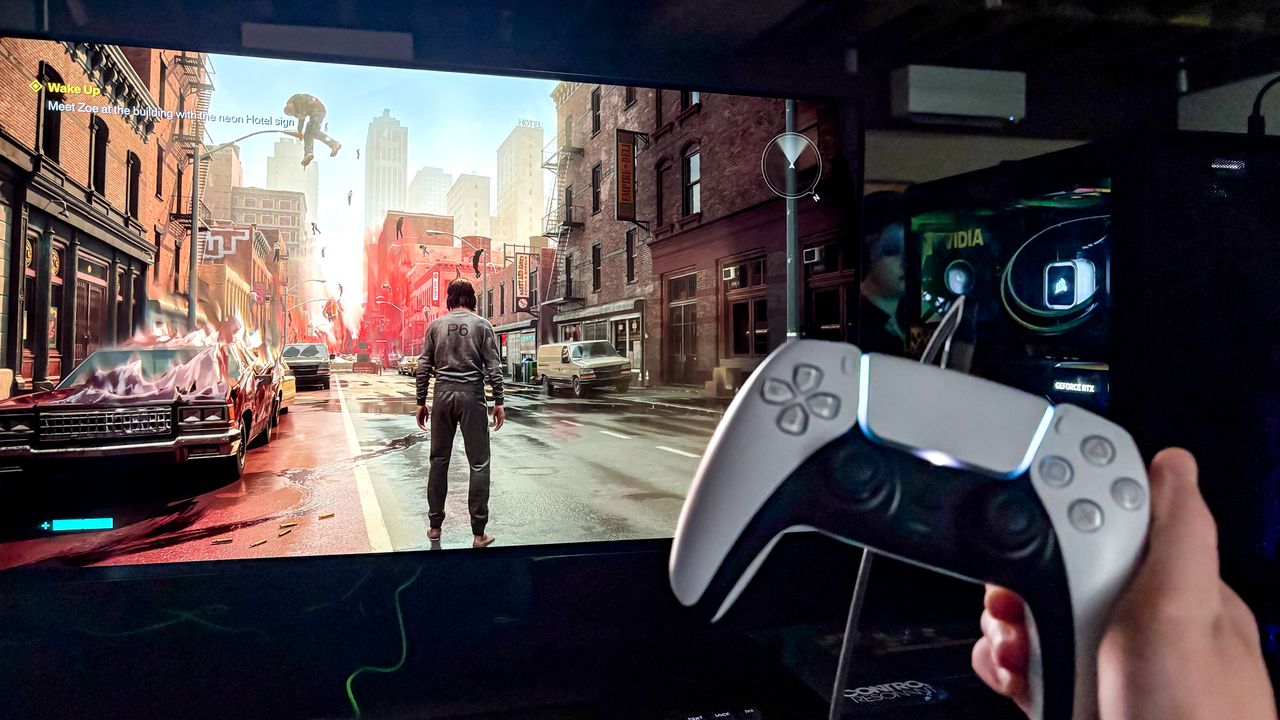
Control Resonant on display next to PC.

Whenever I get the chance to test out the best gaming laptops, my first port of call is to actually game as a form of benchmarking. For years, Control has long been one of my go-to titles, but that will quickly change once Control Resonant arrives on PC.

Horrifying, bleak and messy — not exactly "positive" words to use for developer Remedy Entertainment's upcoming action-heavy sequel, but I mean these in the most endearing way possible from what I saw when playing Control Resonant on an RTX 5090 gaming PC during a three-hour hands-on session.

Fighting off hordes of The Hiss (the main threat in the game) is thrillingly horrifying with their grotesquely detailed forms, the bleak atmosphere of a warped Manhattan is enthralling and the mind-bending, twisted environments you get to explore are satisfyingly messy. If you thought The Oldest House in Control was a trip, just wait for what Control Resonant has to offer.

With Nvidia's RTX 50-series GPUs lending their power, though, with DLSS turned on and ray tracing set to high, Remedy's follow-up had me immersed. From the expert use of lighting in a chaotic world to the smooth, fast-paced combat, I already see Control Resonant being an all-new PC gaming benchmark.

You can check our Control Resonant preview for how the game plays and our interview with Remedy Entertainment's Creative Director for more on what is now one of my most highly anticipated games of the year. But for how it handles on PC, let's dive in.

Control Resonant PC requirements

(Image credit: Future / Tom's Guide)

While I played Control Resonant on a monster of a gaming PC (the RTX 5090 says it all), I was assured by the team at Remedy Entertainment that PCs that don't reach those heights, like many of the more affordable best gaming PCs, will be able to play the game without trouble.

Take a look at the system requirements for Control Resonant below, along with the PC specs I played on. Spoiler alert: you will need a lot of storage.

Control Resonant System Requirements

Minimum specs

Recommended specs

Tested specs

CPU

Intel i5-8500 or AMD equivalent

Ryzen 7 3700X or Intel equivalent

Intel Core i9-14900K

GPU

Nvidia GeForce GTX 1070 / AMD Radeon RX 5600 XT (6GB)

Nvidia GeForce RTX 3070 / AMD Radeon RX 6700 XT (8GB)

Nvidia GeForce RTX 5090

RAM

16GB

16GB

128GB

Storage

100GB

100GB

100GB

Brimming with power

(Image credit: Future / Tom's Guide)

First, a few preliminary points. As with most previews, this isn't the final version of Control Resonant. Not only is lighting and framerate still being worked on, but also audio mixing, hit impacts and more. This is still very much in beta, but honestly, from the time I had playing through the opening act and a mid-game area called The Sinkhole (it's a masterpiece), it's already looking to be in good shape.

I can imagine a lot of that has to do with the RTX 5090 working behind the scenes. With DLSS upscaling (no frame generation) and DLSS Ray Reconstruction (for sharper reflections and accurate lighting), zipping and levitating through a disfigured Manhattan as the all-powerful Dylan Faden (our up-close-and-personal protagonist) was a treat for the eyes.

And that was with graphics and ray tracing presets set to high, only made better by the 4K (3840 x 2160) resolution I was playing on. From the many twisted forms of The Hiss shown in terrifying detail to the deep contrast of red hues streaking across the screen, along with the subtle yet clear reflections in windows of buildings turned upside down, it's all beautifully crafted — and I often found myself taking it all in.

After leaving The Oldest House after the opening act, I was impressed by the visual distortion effect beaming off cars, with The Hiss floating in midair endlessly in the background. That, along with blaring, dangerous red lighting reflecting off the pavement. For those stationary moments, it all hits right.

In combat, with Remedy changing pace from a third-person shooter to pure melee action, things can get chaotic, but unsurprisingly, this rig could handle it all. As in, the copious amounts of rubble Dylan hurls at enemies while quickly dashing to slash through them using his Aberrant weapon (I chose the sword-like Flurry form as my weapon of choice), while the almost faded rainbow oil mist blasts off foes as he hits them.

It's smooth, clean action, which is what you'd want in a fast-moving action game. It's the little nuances, like the aftereffect of dashing being so crystal clear, like a sleek afterimage of static video, that make it work.

Now, I wasn't able to see frame rates or tinker with different settings, as it appeared the game was locked at a rock-solid 60 frames per second (FPS) for beta purposes. But even with the mass of Hiss shooting red beams from every direction during The Sinkhole section, along with the gravity-bending environment Dylan can shift through, it's clear Control Resonant will be taking full advantage of what Nvidia's GPUs have to offer.

And I'm here for it.

Reaching a new PC benchmark

(Image credit: Future / Tom's Guide)

While Remedy is still polishing off Control Resonant, especially the PC version, we can expect plenty of RTX features to be fully on show (just like path tracing in Resident Evil Requiem). That includes DLSS 4.5 and its dynamic multi-frame gen tech (expect frame rates to hit over 200 FPS), DLSS Super Resolution and path tracing for photorealistic lighting, no less.

That's exciting, considering just how well it already looks, and there's still plenty of time for the team at Remedy to cook. During my session, I had a chat with Lead Gameplay Designer Sergey Mohov, and he explained how there's now more to play around with.

"We weren't limited by hardware in terms of gameplay. It's very helpful that computers and consoles these days can actually run games like this, and we're able to put all of these enemies on screen, all of these effects and make it look nice while feeling very satisfying to kill them all.

"The hardest thing was actually making the world, making it bigger and increasing draw distances. But we've invested in improving our in-house engine (Northlight Engine) to handle these things. But, you know, we've done it."

I believe Mohov is spot on, taking the improvements we saw in Alan Wake 2 and pushing it even further. Of course, just like how Control is now available on iOS, there's the aim for Resonant to be flexible enough to be played on, well, anything that isn't just an RTX 5090 while still delivering great visuals and performance.

"We have a lot of people who are really excited about putting all the latest tech in. Nvidia is helping out, and we'll have all the latest Nvidia stuff in [Control Resonant]. So that's going to be pretty cool. But if somebody can run Control on, like, a potato or a fridge, I'll be pretty happy."

Control Resonant is set to launch on September 24, available on PS5, Xbox Series X/S, macOS and cloud streaming via Nvidia GeForce Now. But just from my brief experience, it will be a PC purchase for me.

More from Tom's Guide

Sign up to read this article
Read news from 100's of titles, curated specifically for you.
Already a member? Sign in here
Related Stories
Top stories on inkl right now
One subscription that gives you access to news from hundreds of sites
Already a member? Sign in here
Our Picks
Fourteen days free
Download the app
One app. One membership.
100+ trusted global sources.