
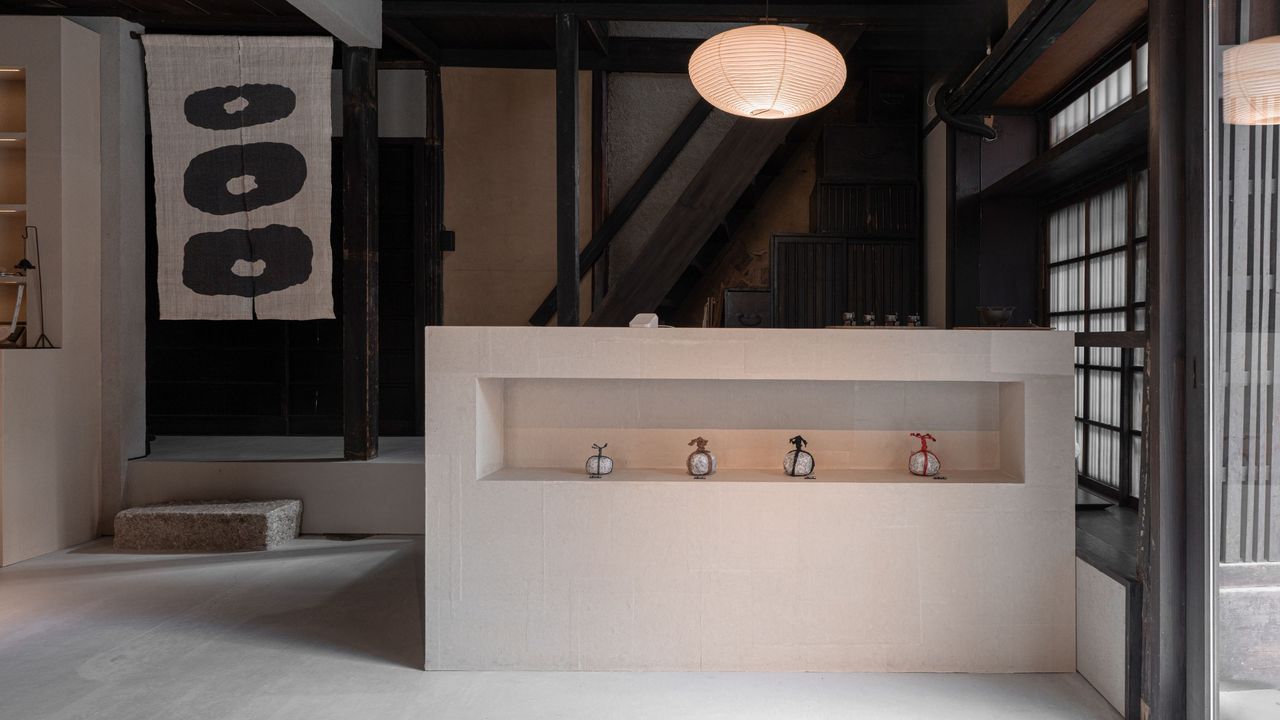
With the craziness of the world around us, it makes sense we're all craving a little more serenity at home — a place that calms us and allows us to unwind at the end of the day. Certain colors can help, or soft furnishings to fall into, but recently I've come across replacing your doors with traditional, flowing noren, a traditional Japanese curtain style.
Though admittedly new to me, noren is a type of curtain long been used in Japanese homes. Traditionally, noren are fabric curtains (most often made of linen) used as room dividers. But in Japan, you'll commonly see them hung at the entrance of shops or restaurants, too, signaling that the business is open.

Their presence is purposeful yet natural and tranquil, characteristics we have come to commonly associate with Japanese design principles and Japandi interior design styles. And when used in modern homes, noren can promote both form and function — a soft moment to accentuate doorways or a textile hung as art. Here's everything you need to know.
The History of Noren

By definition, a noren (暖簾) is a short, split hanging made of textile that sits on the upper part of a doorway, and "functions as a soft partition you pass through rather than a full curtain you draw back," explains London-based interior designer, Yoko Kloeden.
Stylistically, noren are a set of two linen curtains made from straight pieces of fabric without frills or folds, and are slightly longer than a typical cafe curtain. You'll most commonly see these curtains at shop fronts as signage in Japan — businesses will often have a design or a logo printed on the front of the noren.
However, in a residential context, "you can use them as a threshold in areas such as a pantry or utility opening," explains Yoko. Or in more modern settings, even as a type of tapestry.
The simplicity of the curtain doesn't overwhelm or dramatize the doorway in the same way that a pooled doorway curtain idea does. Instead, noren add thoughtful, peaceful texture to a space that feels calming, minimal, and harmonious.
How to Style Noren in Contemporary Homes

While a traditional part of Japanese decor, in modern interiors, noren can be used in creative ways —perhaps as a closet curtain idea, a traditional curtain over windows, or to cover storage and utility rooms.
"In my own home, for example, I use them to divide my walk-in closets — both at the entrance and between the closet and the bedroom," says designer and founder of POJ Studios, Tina Koyama. "They help hide clutter while still allowing easy movement between spaces, which is something a traditional door cannot do as effortlessly."

Plus, noren can help a smaller home or apartment feel more open and breezy, creating a flowing passage rather than another closed-off, solid door.
While noren are best used either to divide spaces or as textile wall decor, they're also incredibly versatile. "Deciding which spaces to divide — whether between a hallway and a room, a closet and a bedroom, or even within a larger open space — can actually be the most fun and creative part," says Tina.
A plain noren can soften a minimalistic room, while one with a print or color-blocking adds a visual pop without shouting for attention.

How you choose to style noren in your home really depends on the direction of your interior. Tina says, "Sometimes it's nice to match the colors with the surrounding space, while in more neutral homes, a noren can also work beautifully as an accent piece."
"What is also fun about them is that you can change their color or design, which can bring in more seasonality into spaces," she adds. A softer off-white for spring color palettes and a deeper blue in the winter.
Just remember that material is important as well, both for staying true to the cultural context of the design and to create the desired look. "Our noren, for example, are made from 100% linen, which gives them a natural texture and allows them to age gracefully over time."
Shop Noren For Your Home
Noren is a simple yet striking aspect of Japanese design, and an element you'll often find in Japanese homes. Perhaps next you'd like to explore the concept of "ma", which Livingetc's design writer, Maya Glantz, has discovered as a way to curate a more intentional kitchen.