I am a sociolinguist who specialises in how language is understood and interpreted in society. I also have Tourette syndrome. Tourette’s is a genetically determined neurological condition in which a person produces both motor and vocal tics (movements and sounds), and in most cases occurs with conditions such as autism, OCD, ADHD and sensory processing difficulties.
I am typically very private about my condition, but I feel compelled to write about it following events at the 2026 Baftas ceremony, where Tourette’s advocate John Davidson produced several offensive tics, including the N-word which was aired in error in the BBC coverage. I do not pretend for one moment to be able to fully understand how traumatising and deeply upsetting hearing such language must be for black people.

But the misinformed views circulating online suggesting that Davidson must be a racist deep down, or that his tic was akin to a Freudian slip are fundamental misunderstandings about Tourette’s that need to be addressed.
Davidson has coprolalia, a particularly distressing type of Tourette’s that affects between 10% and 20% people with the condition. Coprolalic tics are when a person says offensive or obscene things. They are deeply upsetting for the person who produces them and they are not intentional. Often, the tic is the very worst thing that they could possibly say in any given situation, and the opposite of what they truly believe.
Davidson has said that his tics “have always been so aggressive that I have no idea when they are coming or what they will be”.
Read more: Baftas racial slur controversy: what should the BBC have done?
Many people do not know that I have Tourette’s. I can often suppress my tics, or they are subtle enough to fly under the radar. But suppressing tics requires a great deal of concentration, and I often feel itchy and uncomfortable. Tic suppression is not always possible and women tend to be able to mask their tics to a greater degree than men.
Even when a person can suppress a tic, they can only be held off for so long. The length of time differs from person to person and moment to moment. Whenever I get home after being around people other than my family, I am often overwhelmed by tics.
Meaning and intention
When we hear speech, our brains work quickly to make sense of its meaning. This includes both the literal meaning and the intention behind it. This is referred to as Gricean implicatures. A classic example is if a person says, “the window is open”, they might not just be stating a fact: they may be telling you that they are cold and would like you to shut the window.
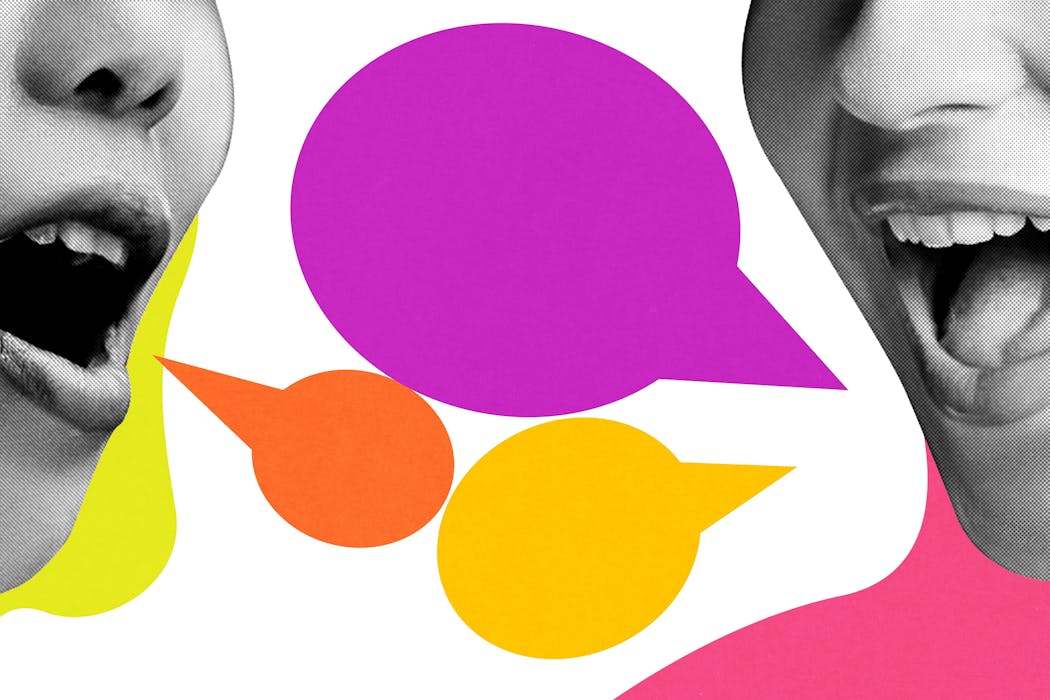
Tics are very different to language. Vocal tics can have literal meaning, but there is typically no intention behind them. The words and phrases that a person produces are no more meaningful than grunts, coughs, sniffs or whistles which are also very common vocal tics. They are a neurological event.
In my own household – the only place I really feel safe to tic – we continually (and quite successfully and often tacitly) discriminate between the things I say which I mean, and those which are a tic and should be entirely disregarded. Sometimes this is straightforward, such as when I say “good night” at seven in the morning. Other times it is more complicated. My tics include saying my husband’s or my son’s names aloud, but I am not addressing them and they do not need to respond.
However, words can still be hurtful even if they are not said with an intent to hurt. I am in no way suggesting that it is wrong to feel deeply upset or offended by coprolalic tics. It has been well established that the way the Baftas and BBC managed Davidson’s tics let down both black people and people with Tourette’s. But I hope that a greater understanding of Tourette’s and that tics do not reflect a person’s beliefs or character can inform discussions about how we view offensive tics.
Tourette’s can be an incredibly difficult condition to live with. A reported 87% of adults living with Tourette’s experience physical pain because of their tics, 72% have considered suicide at some point in their lives and 60% believe their tics have prevented them from fulfilling their fullest potential.
I thought that vocal tics would ruin my life and any potential future career. The first tics I developed as a teenager were motor tics. I was terrified that I would develop vocal tics – which I did.
I have since established myself in a career I love, and yet I ask myself: would I have got here if I could not suppress my tics as successfully as I can? Or if what I said was vulgar or offensive rather than harmless and sometimes humorous? Sadly, I think the answer is no.
We have a duty as society to support people with Tourette’s to realise their potential. People with Tourette’s may need specific adaptions, but we also have a lot to offer. A range of research has found some extraordinary skills in people with Tourette’s such as being creative, articulate, quick-thinking, empathetic and having exceptional focus and problem solving.
I wish I could tell my younger self – sick with worry and feeling that Tourette’s was a curse I couldn’t escape – that sometimes Tourette’s is my greatest strength.
Amanda Cole does not work for, consult, own shares in or receive funding from any company or organisation that would benefit from this article, and has disclosed no relevant affiliations beyond their academic appointment.
This article was originally published on The Conversation. Read the original article.