Get all your news in one place.
100's of premium titles.
One app.
Start reading
Tom’s Guide
Tom’s Guide
Technology
Camilla Sharman

I’m a gardener, and this single plant will give you backyard privacy in just one season

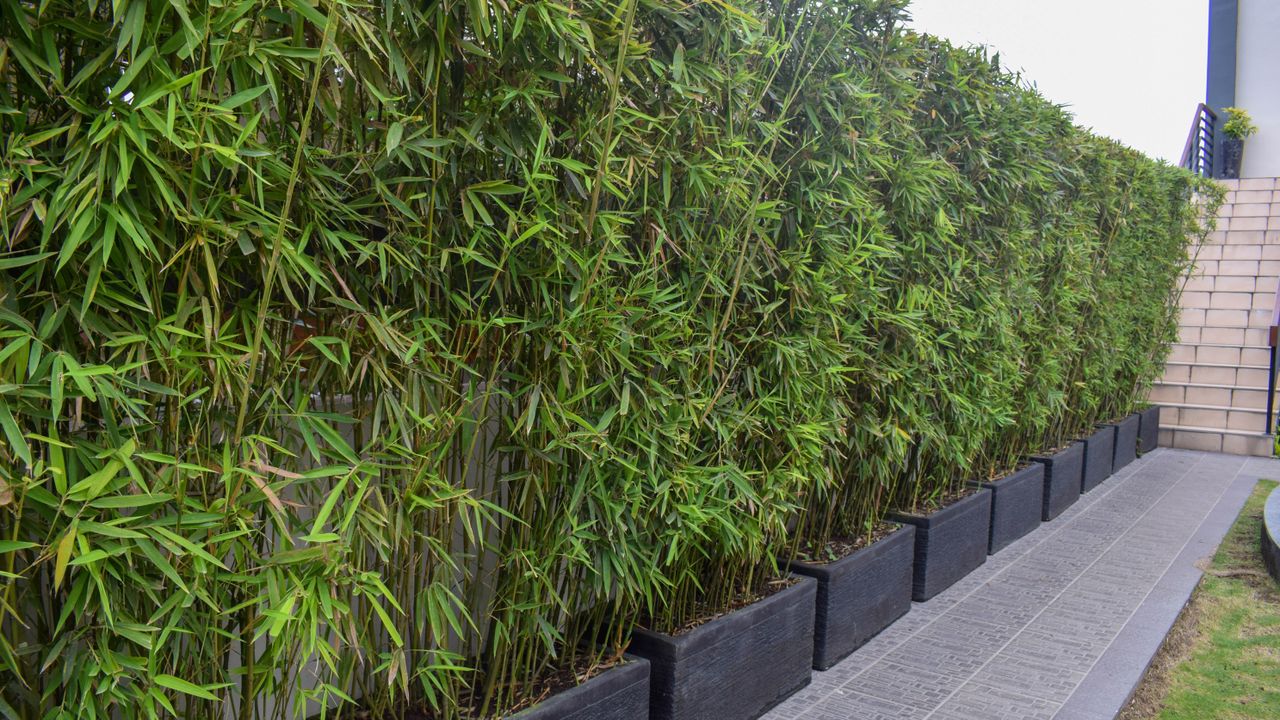
Dragon head bamboo planted in containers along a pathway.

It’s easy to get privacy once you are inside your home, but it can be a challenge in your backyard, especially if you’ve got a small garden or your neighbors are sometimes a bit too friendly.

When you’re enjoying a morning brew or quietly reading a book, you don’t always want to be disturbed by someone’s smiley face popping over your fence.

While fencing adds height, serves as a boundary to define your yard, and provides a level of privacy, it might not achieve the desired aesthetic. Even if you decide to add a splash of color to your fence with paint, it won’t provide the natural environment that planting will achieve.

I’m not suggesting that you screen your whole yard with tall plants, but you may have certain areas that you’d prefer to keep more private, such as a patio or seating area. What’s more, I’ve used this particular screening plant to block my neighbors' view down the side of my house, and it works a treat to add privacy without being offensive.

The benefits of bamboo as a screening plant

(Image credit: Shutterstock)

I’m talking about bamboo. “Bamboo can be an effective screening plant because it is fast-growing, often evergreen, and capable of forming a dense vertical barrier relatively quickly. In the right context, it can provide privacy, wind protection, and even useful yields — canes, edible shoots — without taking up too much space,” explains Elizabeth Waddington, garden expert and writer at First Tunnels.

Maksim Kazakou, resident botany expert at Plantum, adds that bamboo offers year-round ornamental appeal, is low maintenance, can grow in very tight spaces, and adapts well to containers.

Types of bamboo

(Image credit: Shutterstock)

“Lots of people who think of bamboo don't realize there are two main kinds, those that clump and those that run,” says Tammy Sons, founder and CEO at TN Nursery.

“Bamboo that clumps stays in one spot, and is usually what I tell folks to use for privacy in their yards. Running bamboo, though, sends out roots under the ground and spreads all over.”

The tradeoff is to opt for a clumping bamboo which is a slower grower, but not invasive.

What type to choose
In most situations, clumping bamboo is the best choice, as it spreads much more slowly than the invasive running type. Kazakou explains that you’ll notice they grow in a vase shape, “narrow at the base and wider at the top”, and adds, “Choosing a sufficiently cold-hardy species for your region is key.”

She suggests the genus Fargesia , especially for colder climates. “They’re relatively cold-hardy and tend to have that vase-like form. Over time, they resemble green clouds about 7–10 ft tall.”

What suits your USDA zone?
“Bamboo can be grown across a range of climates, but suitability varies significantly by species,” says Waddington.

Cold-hardy bamboos, such as many Fargesia species, mentioned above, are suitable for USDA zones 5-7, such as Fargesia rufa.

In USDA zones 7-9, where winters are less severe, both clumping and some controlled running types are suitable. You could try Farfesia rubusa and Phyllostachys aurea, and Pseudosasa japonica.

When is the best time to plant bamboo?

The exact timing to plant bamboo depends on your climate, but generally April is an ideal month.

“I like to plant it in the spring, after all danger of frost is over, though if your area isn't very cold, early fall is fine,” says Sons.

What is the best way to plant bamboo for privacy?

(Image credit: Shutterstock)

If you’re planting bamboo to create a screen Kazakou advises planting clumping types every 2-3ft to achieve faster coverage. However, she says wider spacing, every 3-5 ft, is preferable to reduce competition and allow plants to establish more easily.

Rather than planting one species of bamboo, Waddington recommends creating a layered or mixed screen. “Combining bamboo with shrubs, small trees, and climbers can create a more resilient, wildlife-friendly, and multifunctional boundary that evolves over time rather than relying on a single fast-growing solution.”

What are the best growing conditions for bamboo?

Bamboo is often described as a low-maintenance plant, and once it’s established it can be relatively easy to care for, although it does require sufficient moisture — especially container grown plants — and will benefit from a feed. It wil also thrive when planted in full sun or light partial shade.

“Bamboo prefers moist but well-drained soil with plenty of organic matter. Mulching with organic materials, integrating compost, and maintaining living ground cover are the best ways to achieve this,” explains Waddington.

Regular watering is particularly important while the plant is becoming established, but over time, she explains, improving soil structure and water retention should reduce irrigation needs.

Kazakou suggests applying an nitrogen fertilizer in the spring to stimulate growth, particularly in poor soils, but adds, “it’s best to go with balanced complex liquid fertlilizers and apply them 2-3 times during the growing season.

Does bamboo need pruning?

(Image credit: Shutterstock)

Bamboo will need to be pruned, but no more than once a year, and springtime is best. Taking a clean and sharp pair of pruning shears, Kazakou suggests removing dry and damaged shoots first, and then, if needed, thin the plant by removing thin or old canes that are 5 to 7 years old.

She also advises that ‘topping’ the plant will control its height and to create denser foliage, and for species with decorative canes, she suggests removing lower leaves that obscure them.

To make the most of the plant, Waddington suggests using the pruned canes as stakes, and using any harvested material as mulch.

Gardening essentials we love

More from Tom's Guide

Sign up to read this article
Read news from 100's of titles, curated specifically for you.
Already a member? Sign in here
Related Stories
Top stories on inkl right now
One subscription that gives you access to news from hundreds of sites
Already a member? Sign in here
Our Picks
Fourteen days free
Download the app
One app. One membership.
100+ trusted global sources.