
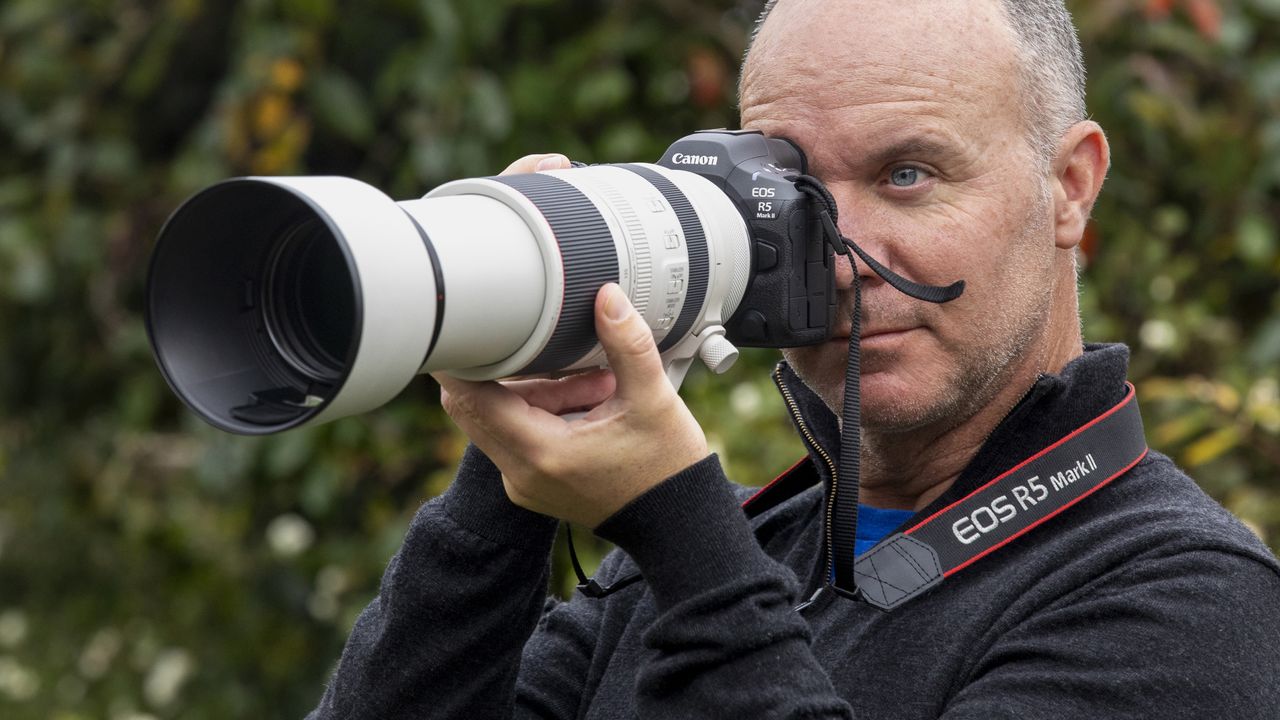
Electronic viewfinders (EVFs) on mirrorless cameras have evolved to be so much better over the last 5-7 years that they leave old-fashioned optical viewfinders (OVF) on DSLRs in their digital dust.
In case you didn’t know, an EVF uses the data from the camera’s imaging sensor to display an image on a small OLED screen (or LCD on the rear of the camera). This means that an EVF shows the image that the sensor outputs. EVF resolution, colour and contrast is much improved, and there’s less lag in the digital live image we see now.

For example, the Canon EOS R5 Mark II’s 0.5-inch OLED EVF has a refresh rate of up to 120fps; in real terms, the lag is measured in milliseconds.
An EVF can also shows you the scene as you’ll capture it, depending on your exposure settings, and show you the effect of changing settings like white balance. Plus when you’re shooting in low light, you can see the subject or scene – making it easier to compose and focus compared to an OVF that shows a near-dark frame due to the lack of ambient lighting.
You can also see things like the digital spirit level better via the EVF, to adjust a tripod head for level horizons, and also dial in a bit more positive or negative exposure compensation as necessary, with the confidence that it’s correct as you get a live preview of the image.

However, it’s not when shooting that I really love using EVFs. I love how I can use an EVF to review my images much clearer, even in bright conditions – which will leave DSLR users searching for shade to get rid of the reflections as they’re squinting to try to see images on the rear LCD.
Another reason EVFs are so brilliant is because, when you’re checking images through the finder, your eye is closer to the image, so you see the image a lot closer and a lot sharper. Plus, you can set up the viewfinder for your eyesight (via the dioptric adjustment dial).
This is great for someone like me who’s short-sighted and wears contact lenses for long distances, as sometimes I have to hold my camera at arm’s length to check the sharpness of images when I’m looking at the screen on the back of the camera!

The EVF is also brilliant for looking at menu screens, again if a font is too small and you can’t read it properly, or simply want to avoid moving your camera into the shade to read the rear screen. Or if you don’t want to take your camera away from your eye as you’re in position to take a shot, and just need to tweak a setting.
You might also like…
Take a look at the best lenses for the Canon EOS R5 Mark II, as well as the best Canon RF lenses overall.