I've been wearing the Garmin Cirqa screen- and subscription-free fitness tracker for over two weeks, and I'm a fan. Reasonably comfortable, customizable, long-lasting, and accurate, the Garmin Cirqa is easily one of the best fitness trackers in 2026.
Garmin officially entered the no-screen fitness tracker/band wars in July with the launch of the $199 Cirqa, but how does it compare to its biggest competitors?

While the popular $99 Fitbit Air is aimed at enthusiasts and the subscription-only Whoop 5.0 is geared more toward hardcore athletes, the Garmin Cirqa strikes a balance between the two in terms of features, cost, and specs. That's a good thing.
The question is, has Garmin carved out enough of a niche between the entry-level Air and top-tier Whoop for the Cirqa to succeed? I sure think so. Read on to find out why.
Garmin Cirqa: Cheat sheet
- Price: $199 with core feature subscription-free; the optional Garmin Connect+ plan is $6.99 a month or $69.99 a year
- Design: Screen-free, the Cirqa is a lightweight, plastic fitness tracker with a single button, haptic feedback, and... that's it; it's bigger and heavier than the Fitbit Air but more wrist-friendly than the Whoop 5.0
- Health features: Comprehensive sleep reports, women's health tracking (with support for the Natural Cycles app), 24/7 heart rate monitoring, Sp02 readings, jet lag advisor
- Fitness features: Supports 80+ workout types with support for auto-workout tracking for popular exercises; users can manually start and stop a workout using a customizable physical button
- Battery life: Up to ten days of battery per charge, a little less than the Whoop 5.0 (14 days) but more than the Fitbit Air (7 days)
Garmin Cirqa: Versus competition
Garmin Cirqa |
Fitbit AIr |
Whoop 5.0 |
|
|---|---|---|---|
Starting price |
$199 |
$99 |
Free with subscription |
Subscription cost |
Optional; $6.99 a month or $69.99 a year |
Optional; $9.99 a month or $99 per year |
$199, $239 or $359 per year depending on tier |
Dimensions (without strap) |
47 x 17 x 9 mm |
35 x 17 x 8 mm |
35 x 24 x 11 mm |
Weight (without strap) |
14.8 g |
5.2 g |
26.5 g |
Sensors |
Heart rate, SpO2, Skin temp, Accelerometer, Gyroscope |
Water resistance |
50 meters |
50 meters |
10 meters |
Battery life |
10 days |
7 days |
14 days |
Compatibility |
Android, iOS |
Android, iOS |
Android, iOS |
Garmin Cirqa value: 3.5/5
- More affordable than Whoop but twice the price of the Fitbit Air
- Core features and insights are subscription-free
- An optional Connect+ plan is $6.99 monthly or $69.99 annually, cheaper than Google Health Premium
- Garmin Cirqa accessories are pricey; extra straps start at $50
Similar to the Fitbit Air, the Garmin Cirqa is a one-and-done affair in terms of cost. Once you have it, all of the core health and fitness features are yours to use without the need to ever pony up for a subscription.
In terms of value, had Google not launched the Fitbit Air a few months before the Garmin Cirqa's debut, Garmin's screen-free wearable would hands down be my go-to budget-friendly alternative to the Whoop 5.0. I also probably would have scored it a 4.5 or even 5/5 for value.
Unfortunately for Garmin, the Fitbit Air does exist. And while the $199 Garmin Cirqa is certainly affordable for a modern Garmin wearable, it's still twice the cost of its Google rival.
Like the best Fitbits, users can unlock additional holistic insights and personalized training advice for a recurring fee. The Garmin Connect+ plan is $6.99 monthly or $69.99 annually. That's a better value than the Google Health Premium plan for the Fitbit Air, which will set you back $9.99 a month or $99 a year.
Whoop takes a different approach entirely to pricing, where users get the device itself on the house but pay a much higher annual subscription cost ranging from $199 to $359 depending on your tier.
Ultimately, the Garmin Cirqa is more affordable than the Whoop 5.0 but pricier than the Fitbit Air. Still, for $199, and with the vast majority of insights you’ll care about being free, the Cirqa is still a good bang-for-the-buck. After all, the cheapest current Garmin watch with equivalent features to the Cirqa is the Vivioactive 6, which costs $100 more.
That said, I'm knocking half a point off the value score because, unlike Google, which sells additional Air straps starting at $35, accessory straps for the Garmin Cirqa start at a whopping $50.
Garmin Cirqa design and comfort: 3.5/5
- Not as small or comfortable as the Fitbit Air, but lighter and comfier than the Whoop 5.0
- The Cirqa strap takes some time to break in; unfortunately, it also seems to retain moisture
- Proprietary strap design is annoying to remove/attach
- Customizable onboard button to start/stop workouts with haptic feedback to confirm your selection
- 50 meters of water resistance is a match with the Fitbit Air and better than the Whoop 5.0
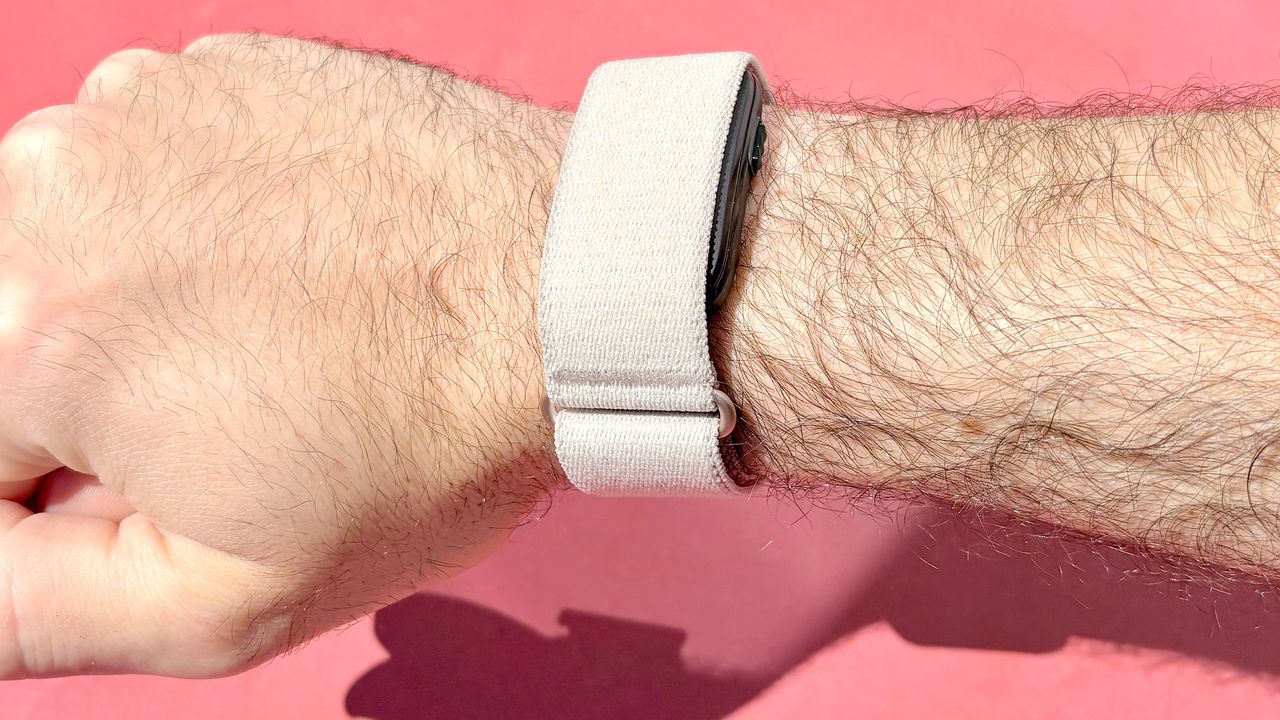
The Garmin Cirqa is bigger and heavier than the Fitbit Air, with a noticeably wider strap (24 mm vs 18 mm). Compared to the Whoop 5.0, it's roughly the same shape and size, but a whole lot lighter. Depending on your preference, the Cirqa is designed to be worn either around the wrist or your upper arm.
The included fabric strap is a tad scratchy for my liking, but it does seem to be softening up a bit with wear. That said, unlike the cloth straps for the Fitbit Air, the Cirqa strap seems to retain water rather than dry quickly.
Removing the strap, should you choose to fork over $50 or more for an additional one, is a pain in the butt. While the Fitbit Air pops right out of its strap, I had to use a dedicated watch spring bar tool to get the job done on the Cirqa. The spring bars are also an oddly thin length, limiting third-party strap options.
Like the Whoop 5.0 and Fitbit Air, the device itself — a plastic case with a sensor array, status lamp and single button — is protected by the strap. Water resistance is 50 meters, the same as the Fitbit Air, but better than the Whoop 5.0, which is rated at just 10 meters.
As expected, the Garmin Cirqa easily survived thirty minutes submerged in a foot of water.
One thing that really sets the Cirqa apart is the inclusion of a single physical button on the side of the tracker used to start and stop a workout.
One thing that really sets the Cirqa apart from the competition, design-wise, is the inclusion of a single physical button on the side of the tracker used to start and stop a workout. Users can customize exactly what that workout is in the Connect app.
When pressed, an onboard vibration motor provides haptic feedback confirming that your workout has begun. Another buzz happens when you end a workout.
The button has additional functions: A triple-press forces the Cirqa into pairing mode, while a press-and-hold turns on the broadcast heart rate feature. Unfortunately, at this time, additional customization options for these actions are limited, but I'm hopeful Garmin will expand what they can do soon.
Garmin Cirqa health tracking: 4.5/5
- Garmin's sleep reports are highly detailed, with lots of unique and actionable insights and metrics
- In terms of tracking sleep duration, stages, and heart rate, the Cirqa and Air perform similarly well
- Heart rate tracking is nearly as accurate as a dedicated chest-mounted heart rate monitor, despite the Cirqa not using Garmin's latest/greatest sensor array
- The Cirqa works with the popular Natural Cycles women's health app; an onboard skin temp sensor helps track ovulation cycles
Sleep and women's health insights
Garmin smartwatches and wearables offer some of the most comprehensive, subscription-free sleep insights around. And even though the Cirqa is not FDA-approved to detect potential signs of sleep apnea, it does monitor your breathing while you snooze, along with your heart rate, body temperature, and movement.
Users are greeted each morning with a numeric sleep score out of 100, along with detailed insights into sleep cycles, disturbances, and more. The Cirqa also boasts a skin temperature sensor, which is used for both women's health tracking and early illness detection.
I wore the Garmin Cirqa every night for over two weeks, including a week-long period where I wore the Fitbit Air on the opposite wrist. After one fairly average (my rating) night of rest, both wearables reported similar sleep durations — 7:02 for the Garmin and 6:45 for the Fitbit — and nearly the same sleep score: 82 for the Garmin and 83 for the Fitbit.
My average resting heart rate was also a near-match between the two: 60 bpm for the Cirqa and 61 bpm for the Air. Garmin, however, provides additional sleep insights that Google doesn't.
For example, that same Garmin sleep report tells me exactly how many restless movements I had (58), average respiratory rate (13 breaths per minute), Body Battery Charge (+77)... more on this metric below, and my average changes in skin temperature compared to previous nights (-.03 degrees).
Speaking of skin temperature, the Garmin Cirqa is compatible with Natural Cycles, one of the most popular women's health apps for tracking fertility, postpartum health, and perimenopause. While the latest Whoop also works with Natural Cycles, the Fitbit Air does not support it at this time.
Smart Wake Alarm
The device additionally supports Garmin's Smart Wake Alarm feature. Users pre-select a wake-up window, and the device uses sleep stage tracking to gently nudge you out of bed via vibrations.
I've been using it for the past several nights, and it's a delightful way to rise, even if the vibrations occasionally seamlessly work their way into my dreams for a few moments before I actually wake.
Heart rate accuracy
It may not be as precise as a dedicated chest-mounted heart rate sensor (duh), it comes pretty darn close.
The Cirqa uses Garmin’s older Gen 4 heart rate sensor; Gen 5 is the latest. Still, HR accuracy impressed in our testing. While it may not be as precise as a dedicated chest-mounted heart rate sensor (duh), it comes pretty darn close.
For folks with a compatible Garmin device, like the Garmin Edge cycling computer, the Cirqa can be programmed to broadcast your active heart rate while you log a workout.
An onboard SpO2 sensor continuously tracks your blood oxygen levels either all the time or only while sleeping. However, it's off by default. Switch it on from the Connect app > Health and Wellness.
Garmin Cirqa fitness tracking: 4/5
- The Garmin Cirqa lacks an onboard GPS, so you need to carry a paired smartphone for location-based workout insights
- The Cirqa proved to be an accurate overall tracker with lots of unique/actionable metrics to help you train, including Body Battery and Fitness Age
- 80+ workout types are supported; auto workout detection could be more reliable/requires user dedication to set up at first
- Users can seamlessly switch between the Garmin Cirqa and other Garmin wearables without a trip to the Connect app
Fitness tracking accuracy
Like the Whoop 5.0 and Fitbit Air, the Garmin Cirqa lacks onboard GPS. This means that you'll need to carry your paired phone along with you — and provide the Connect app with 24/7 location permission — when logging outdoor workouts for accurate distance, pace, and climb data.
Fortunately, in our testing, the Garmin Cirqa proved more than accurate enough across a wide range of activities. It may not be as precise as the best Garmin watches out there, which can cost as much as $1,000, but it comes pretty darn close.
Having just reviewed the Fitbit Air, I can confirm that the Cirqa seems a bit more reliable at tracking outdoor workouts, especially for climb data.
I recently logged a particularly hilly walk with the Garmin Cirqa on one wrist and the Garmin Instinct 3 — my go-to wearable for logging outdoor adventures — to see how their distance and climb data compares. For good measure, I also logged the trek using the Strava app on my phone.
The Instinct 3 logged 328 feet of elevation gain, Strava logged 326 feet, and the Cirqa logged 301 feet; perfect? No, but probably close enough for most folks.
Having just reviewed the Fitbit Air, I can confirm that the Cirqa seems a bit more reliable at tracking outdoor workouts, especially for climb data. In a separate comparison (see data chart below) with the Cirqa vs Air vs Strava, the Garmin impressed, while the Fitbit came up way short in terms of elevation gain, a recurring issue.
Garmin Cirqa |
Fitbit Air |
Strava (iPhone 16) |
|
|---|---|---|---|
Distance |
2.13 miles |
2.06 miles |
2.03 miles |
Climb |
333 feet |
222 feet |
349 feet |
Steps |
3,856 steps |
3,790 steps |
3,828 steps |
Average pace |
16 mins 58 secs per mile |
17 mins 21 secs per mile |
17 mins 13 secs per mile |
Supported activities, auto-detect, and LiveTrack
The Cirqa supports over 80 common workout types, including winter sports, team sports, and common gym exercises. Users can pre-program up to ten of their favorite activities for quick access in the Garmin Connect app.
Unlike the Fitbit Air or Whoop 5.0, manually starting a workout with the Cirqa doesn't require a trip to the app. Users can start and stop any workout of their choosing with a press of the device's only button. By default, the button logs a basic timed workout with limited metrics. However, users can change that via a setting in the Connect app.
Like the competition, the Cirqa supports auto workout detection, but it demands some effort on the part of the user to work reliably. Based on my discussion with Garmin, the device is programmed to recognize the activities you do most frequently; however, users will need to manually log those workouts for the first few weeks they use the Cirqa before it eventually figures things out.
It would appear I need to spend a little more time with the Cirqa before it can accurately distinguish between a bike ride and jog without my input. For now, I manually start those activities via a trip to the app; I've set the onboard button to start and stop walking workouts.
When doing outdoor workouts, the Cirqa supports Garmin's LiveTrack safety feature, which allows friends and family to receive live location updates while you sweat it out. This, of course, requires a paired smartphone.
Fitness training and recovery metrics galore
Garmin provides users with some of the most detailed non-subscription training and recovery insights out there, including recovery time suggestions, a daily readiness score and status, VO2 max metric, and your "fitness age" based on your recent fitness and health habits versus other users in your gender and age group.
For example, my current fitness age, according to Garmin, is 35.5-years-old (I'm nearly 39), with my target fitness age set to 32.5. In addition to these stats, the Connect app provides you with useful recommendations to help you better reach your target. In my case, the app suggests I add weight-based workouts, while increasing the number of "vigorous" workouts I do a week.
Body Battery is another handy Garmin metric, similar to other brands' Energy Score, to help you better plan your day's activities. The more consistent your sleep, workout, and recovery times are, the better your Body Battery score (from 1 to 100).
Plays nicely with other Garmins
The Cirqa is designed to work seamlessly with other Garmin wearables. So, if you use a Forerunner or a Fenix to log workouts but want something a little comfier and lighter for sleep tracking, the Cirqa provides that. Best of all, users don't need to manually switch between the two devices in the Connect app settings; it does it automatically.
Garmin Cirqa battery: 4.5/5
- The Cirqa surpassed its ten-day-per-charge rating in my test
- Battery life is better than the Fitbit Air (7 days) but behind the Whoop 5.0 (14 days)
- It takes roughly an hour to fully recharge the Cirqa battery
Garmin says the Cirqa should last up to ten days per charge with normal use, which I can confirm. I wore the Cirqa for ten days straight, including while sleeping and logging my daily workouts, and had 20% battery remaining.
By default, the Cirqa does not continuously measure your blood oxygen saturation using the onboard pulse oximeter. Users can opt to turn this on 24/7 or just while they sleep. I did the former and surprisingly discovered that it had little impact on battery performance. At most, it draws an additional 1% to 2% per day.
Compared with the competition, the Whoop 5.0 lasts around 14 days per charge while the Fitbit Air is good for roughly seven days per charge.
The Garmin Cirqa is also impressively fast to recharge; a 5% to 100% power-up took about an hour, with the Garmin Cirqa drawing around 2 watts of continuous power during that duration.
Garmin Cirqa review: Verdict
As noted in the title, the Garmin Cirqa strikes a compelling balance between the entry-level Fitbit Air and the pro-level Whoop 5.0. Like the Fitbit Air, the Cirqa is reasonably priced and doesn't require a subscription.
It's not quite as small or light as the Air, but it does have better battery life and more detailed and actionable sleep, training, and workout recovery insights.
In terms of size, the Cirqa is more similar to Whoop 5.0, just much lighter. Battery life is nearly as good as the higher-end rival. However, Whoop still wins when it comes to heady training and recovery insights and advice for hardcore athletes, but Garmin comes darn close, even without a subscription.
For a lot of folks, the Fitbit Air is more than good enough at providing a cheap, distraction-free health and fitness tracking experience. However, if you want to step up your game with more advanced fitness and health metrics — without committing to a subscription — then the Cirqa is worth the extra $100 over the Air in my opinion.