The best earbuds offer incredible portability and versatility, but they do have one key weakness to some audiophiles: They don't sound natural. After all, when you're in the same room as musicians and speakers or in a concert, there's air and the structure of your ear that the sound has to get through before it reaches your earholes.
Because of their ear canal-blocking design, earbuds simply can't replicate that same style of sound. But what if there was a solution to that problem?
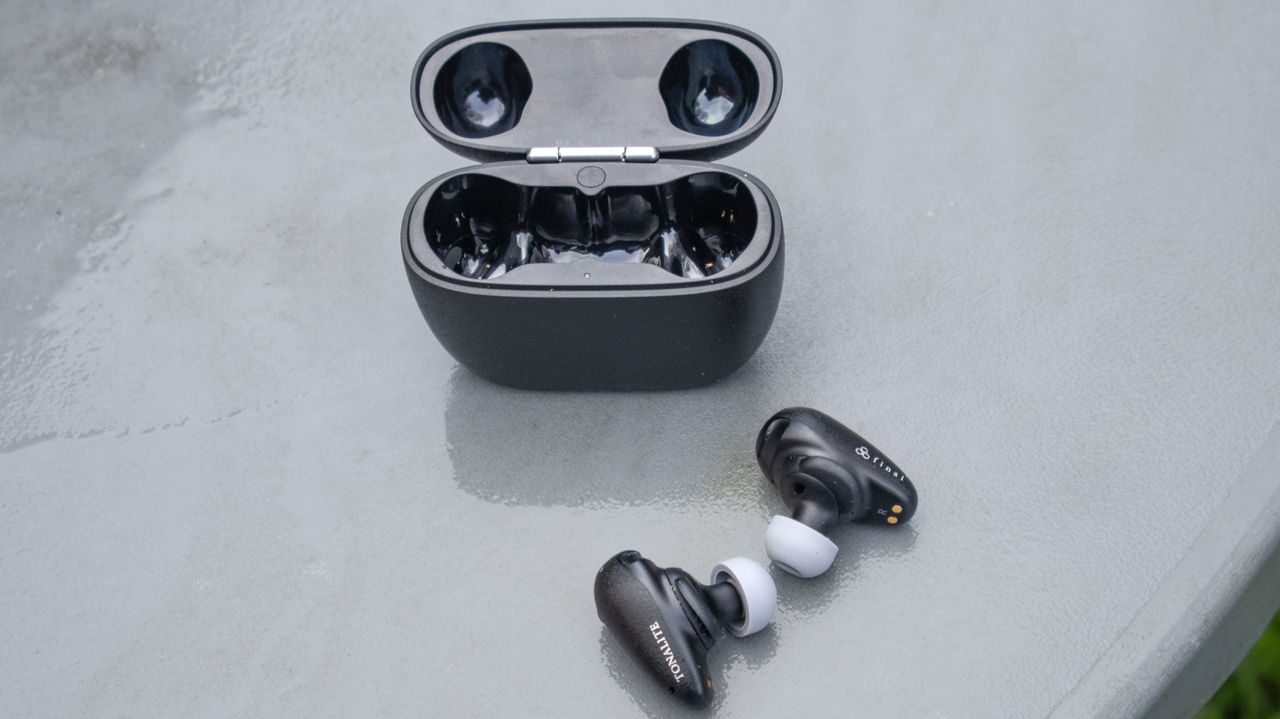
If you're Final, then you invent a system that replicates all of those different environmental factors and, using 3D models of users' heads and ears, create a digital avatar and special DSP to replicate the effect in a pair of funky-looking earbuds. Meet the Final Tonalite.
Setting the tone
The buds at the heart of the DTAS system are the funkily shaped (and named) "Final Tonalite". That's not "Tona-lite", as I expected, but "Tone-a-lit-é". Like tonality, only, like French.
I like it. It's better than some mad selection of letters and numbers.

They're a funny shape, which can make them a little fiddly to fit when combined with their foam eartips. You'll know once they're in properly, but the fancy 3D scanning technology and DSP rely on a solid fit — so you'll want to make sure you get it right every time.
Once they're in, they're comfortable enough. There is a little pressure from the foam tips, but that soon goes away once they've warmed up in your ears.
The out-of-the-box sound is also good. Bass heads might be wanting for more bass, but there's detail for days and some very well-formed mids. I would never doubt Final's earbud tuning — it's one of the best firms around.

To add to their functionality, they've got 8 hours of battery life, and ANC that keeps the noise out with no problems at all. They're a little more expensive than some of the competition, pushing them forward into "premium" territory, but I think they're great even without their party trick.
So what does that party trick do?
What's a DTAS?
It's all about "timbre", or, as Final puts it, "tone color," which "allows us to distinguish between different instruments or voices, even when they play the same note."
Some of this is thanks to the acoustic structure of the ear and the air (and other stuff) that music has to travel to when it's being played in front of you, either by a musician or a pair of speakers.

The Tonalite and DTAS want to make it sound like you're in the room with your music.
Still with me? Good. Let's make it simple — it's about making things sound more natural. While spatial audio tries to make music sound as large, emotive, and "3D" as possible, the Tonalite and DTAS want to make it sound like you're in the room with your music. Think up close and personal in the recording studio rather than in the midst of an arena show.
To do this, Final has developed the aforementioned DTAS, which stands for "Digital Twin Audio Simulation." That takes a 3D model of your head and your ears, and adjusts the sound (in a cloud server, no less) so that it sounds more natural. The digital twin is the 3D model — get it? Because it looks like you. And presumably likes the same flavor of Cola.
How does it work?


This is a fairly long and involved setup with plenty to go wrong (as it did), so get that seatbelt, prepare the flight controls, and buckle in. We're in for a bumpy ride — with a pretty special destination.
In the box of the Tonalite, you get a box. Inside you'll find some funky stickers, and a headband. Don't get too excited, it's not particularly fetching. You place two of the stickers on the headband, where your ears would be. Then you put it on.


This is where I opened the app and started the setup. It's like setting up Face ID initially. Make sure nothing is hanging over your ears, like hair or feathers. The headband helps here. Then, you put your face in the circle on the screen, and turn in different directions when the phone vibrates. This bit is easy enough.
Once you're happy with the snaps of the sides, top and bottom of your face, you can pull that dastardly headband off and move on to the next step. This, ostensibly, is quite easy, but I did have a couple of hiccups. Thankfully, the setup saves after each successful step, making it easy to pick up after mistakes.
You pop the buds into each ear individually, where a quick frequency sweep is played. This maps out the interior of your ear. Then you pop the ear tips off, and do it all over again. This is where I had problems — you have to hold the earbuds in place, and I must have gotten it wrong at least four times.
Still, my setup was eventually finished, and my "digital twin" was created in Final's DTAS cloud. Not that I got to meet my audio-clone — I was instantly whisked away into the DTAS settings menu so that I could dial things in to my taste. Shame, we could have been friends. Given that we probably like the same flavor of Cola.
How realistic is the sound?
I wasn't entirely sure what to expect, given that these kinds of systems can often land firmly in the "gimmick" camp (I'm looking at you, most spatial audio implementations), but this one makes a meaningful difference to how the buds sound.
They really do sound more "natural," and there's a palpable increase in instrument separation.
They really do sound more "natural," and there's a palpable increase in instrument separation. I can also detect a slight blending of the left and right channels, akin to the crossfeed feature found in other headphones.
Despite this blending of the two channels, the soundstage remains lovely and wide. Bass has taken a slight hit, and there's an increase in the highs that's almost bordering on piercing, but they never cross the line.

The term "as the artist intended" is frequently used by audiophiles, often without really knowing what the artist intended. I wouldn't say that the Tonalite help this misconception, but they certainly make you feel more involved with your music: I whipped up Dave Brubeck's Take Five, and found not only an increased soundstage but a comfortable, involving listen. The sax was soft and smooth, the piano inviting, and the cymbals crystalline. I was in the room with the ensemble.
My quick listen to Hurt (the Nine Inch Nails version, obviously) showed that electronic music benefited as well. Trent's breathy vocals were clearer and more uncomfortable, and the plucked guitar was well separated from the disturbing synth.
There's something that makes me wish that this technology would come to other earbuds, but given the depth of setup and the effort needed to get it working, I can see why it might not. Right now, though, it's a great reason to buy the Final Tonalite.

Follow Tom's Guide on Google News and add us as a preferred source to get our up-to-date news, analysis, and reviews in your feeds.