Get all your news in one place.
100’s of premium titles.
One app.
Start reading
Cycling News
Cycling News
Sport
Alasdair Fotheringham

'Bikes now are pieces of wood, they're no longer suitable' – Damien Touzé highlights safety concerns after life-threatening horror crash at Tour of Oman

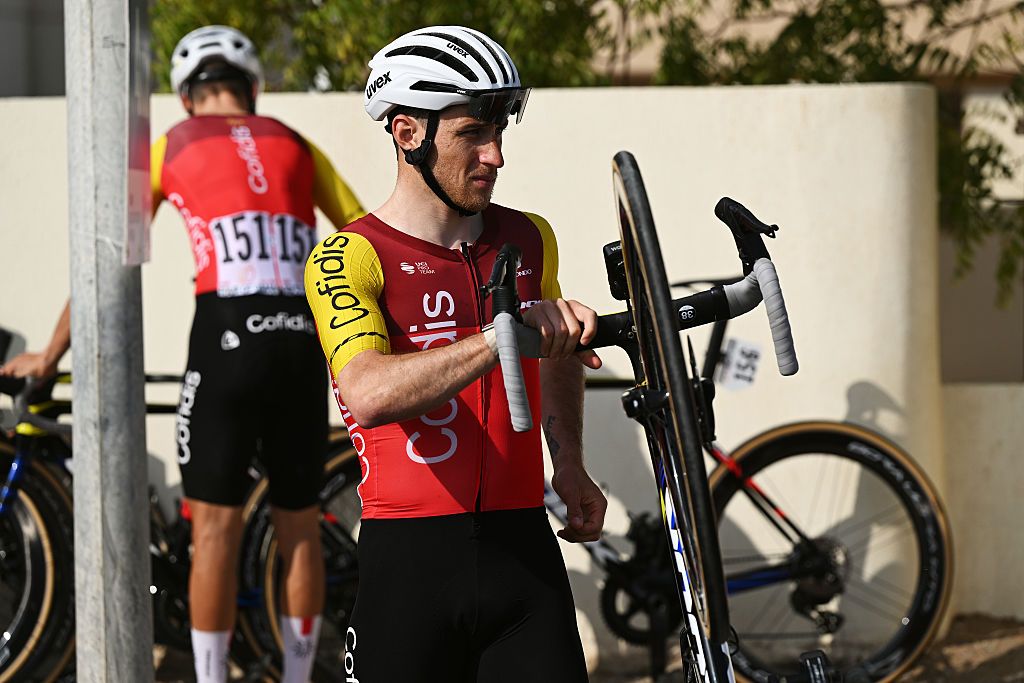
Damien Touzé during the 2026 Tour of Oman.

Damien Touzé returned to Belgium following a horrendous 60 kph crash during stage 4 of the Tour of Oman, but the Cofidis racer said his career was now on hold and his season over as the battle to recover from his injuries continues.

Touzé, 29, suffered a perforated intestine, ripped spleen and broken knee in the crash and remained in hospital in Oman for 10 days before doctors decided the French pro had recovered enough to be put on a flight back to Europe. During that time, he's had two operations and lost 10 kilos in weight.

"I even thought I might never make it home," Touzé told Ouest-France on Wednesday from his hospital bed in Menen, Belgium.

A pro since 2017 in French teams throughout his career, first with the low-level HP BTP-Auber '93 squad, and then as part of Cofidis, AG2R La Mondiale and then Cofidis again, Touzé said he had no idea what the future holds for him.

As for the crash itself, it happened when his bike skidded on a cat's-eye, a raised reflective pavement marker, just as he was about to take a drink from a bidon. In a chain reaction, he let go of the handlebars, lost balance and hit the crash barriers, all at 60 kph.

"Instantly, I managed to get up. But what was the most shocking thing of all was my leg, because my foot was twisted round next to my thigh," he explained. "I told myself that wasn't normal."

Presumably in a state of severe shock, the pain in his abdomen was "really bad", he said. "But at first I didn't realise how serious things were."

Once in hospital in Oman, "Initially they didn't realize that I had a hole in my intestine, so that's what made my condition worse," Touzé added.

"I was starting to suffer from peritonitis and had a high temperature. I went more than ten days without eating."

With his issues in his abdomen only partly resolved, the doctors in Belgium had to operate on the injury, with Touzé explaining that after everything had been put back in place, he had a new wound that needed to heal.

"I am open from the sternum to the lower abdomen," he said.

Then there was his knee injury to handle as well. Touzé is still waiting to see how multiple torn ligaments will be treated, but it's estimated that it'll take anything up to eight months for him to recover fully.

Due to be concentrating on the Spring Classics before his crash, now racing again at any point this season is out of the question and his career may even be over.

Touzé already had bad accidents in the 2020 Tour de Pologne and the 2022 Vuelta a Burgos. In Poland he was caught in the same mass crash where Fabio Jakobsen had a life-threatening fall, in the Frenchman's case fracturing a finger in three places. Then in Spain two years later, like several others, he lost control of his bike on a speed bump organisers had failed to remove from the course and hurt his head badly.

Out of contract at the end of the year, but receiving lots of support from friends and family, Touzé said his future remained very unclear. But despite the uncertainty he was trying to stay philosophical.

"After all this, frankly I didn't think about the bike at all," Touzé told Ouest-France .

"A fracture is one thing, but when your internal organs are affected, you feel like things are moving on another level. These things take time to assimilate. [But] there's not just the sporting side to think about, either."

Safety and modern bikes

In a separate interview with Belgian broadcaster RTBF's podcast, On Connaît Nos Classiques, Touzé questioned the safety credentials of modern bikes.

Another podcast guest, the former Belgian pro Tom Pacquot, started by arguing that today's bikes are "harder and harder to handle". Touzé agreed, pointing to the increasing speeds in the peloton.

"The bikes now, I get the impression that they're no longer suitable for us, in fact," he said. "Because now, you can ride at 60km/h on the flat quite easily, let's say, in the wheels. Whereas maybe if I have the same crash at 40km/h, the injuries are a lot less severe."

The UCI has been looking to reduce race speeds with a number of equipment rules, including handlebar width and wheel depth, but for Touzé, the problem runs deeper than that.

"But for sure the bikes now are 100% rigid – they're slices of wood. So the slightest shock that you take on the wheel, it's amplified x100 on us. So what's for sure is you can't rectify anything on the bike."

Touzé also pointed to the general stress levels in the peloton, which appear to have increased not only in the biggest races but also the smaller ones, like the Tour of Oman. A key part of that, he says, is the battle for UCI ranking points in the recently started three-year cycle that decides WorldTour licences.

"You feel that all teams are flat out. They're not going to let anything go. And now, the tension is already there 100km from the finish. Before, at the early-season races, let's say 20km from the finish, you might start to feel the tension.

"Now, even the races like Oman, where the roads are relatively wide and well-surfaced, the slightest gust of wind and the peloton is immediately stressed. Everyone wants to be well-placed. The tension is really at the maximum, and you can see it since the start of the season – there has been at least one big crash at every race."

Sign up to read this article
Read news from 100’s of titles, curated specifically for you.
Already a member? Sign in here
Related Stories
Top stories on inkl right now
One subscription that gives you access to news from hundreds of sites
Already a member? Sign in here
Our Picks
Fourteen days free
Download the app
One app. One membership.
100+ trusted global sources.