Get all your news in one place.
100’s of premium titles.
One app.
Start reading
Tom’s Guide
Tom’s Guide
Technology
John Velasco

I drove the new Nissan Leaf for a week — this $30,000 EV sets a new standard

2026 Nissan Leaf test drive.

When my colleague Myriam Joire got a sneak preview of the new Nissan Leaf, she was so impressed and said that it’s an “affordable EV that’s light years ahead of its predecessor.” I can attest to that sentiment after driving the 2026 Nissan Leaf Platinum+ for a week, proving how this budget EV is stirring things up in a big way.

First of all, you should know that the base trim, the Leaf S+ FWD, has an entry price of $29,990, which is about half the cost for an average EV today. What’s also important to know is that it shares the same 75 kWh battery and 214 hp performance as the more expensive Platinum+ trim — and it even gets nearly 40 miles more on a charge.

The cost balloons up to $41,930 for the Platinum+ trim, but it comes with extra features — like a panoramic glass roof, Bose sound system, heated seats, a larger 14.3-inch display, and more.

Quite frankly, I think it sets a new standard for budget EVs and it’s easily one of the best electric cars I’ve tested this year. Here’s why.

(Image credit: Tom's Guide / John Velasco)

2026 Nissan Leaf: Specifications

2026 Nissan Leaf S+ FWD

2026 Nissan Leaf Platnium+ FWD

Battery

75 kWh

75 kWh

Motor

AC Synchronous motor

AC Synchronous motor

0 to 60 mph

N/A

N/A

Range

300 miles

259 miles

Horsepower

214 hp

214 hp

Wheels

18-inches

19-inches

MSRP

$29,990

$38,990

Price Tested

N/A

$41,930

2026 Nissan Leaf: Testing summary

(Image credit: Tom's Guide / John Velasco)

Not only is the 2026 Nissan Leaf one of the cheapest EVs you’ll find around, but it’s also pretty efficient too. In my week’s worth of testing it out, I achieved an average efficiency of 3.6 mi/kWh driving 372 miles — which is above the 3 mi/kWh average I’d like to get with any EV. While it beats the Chevrolet Equinox EV, it still trails what I got with the Hyundai Kona Electric. However, I would gladly take the Nissan Leaf any day because of its larger size.

Even though the Platinum+ trim has an EPA estimated range of 259 miles, the efficiency I managed to get means it’s possible to get closer to 270 miles. I suspect it’s the heavier weight of the Platinum+ trim that holds it back from getting a better efficiency, as the base model is rated for 300 miles of range.

Impressively, its Level 1 charging speed at home is incredibly fast. I averaged a rate of about 4.24 mi/hr, which added back 58 miles of range to the battery with 13.6 hours of charging. The only other EV I’ve tested that charges faster at home is the Lucid Air Pure at the rate of 4.91 mi/hr — but it’s a luxury EV that costs $70,000.

2026 Nissan Leaf Platnium+ FWD

2025 Hyundai Kona Electric N Line

2025 Chevrolet Equinox EV LT

Price tested

$41,930

$39,880

$35,995

Total miles driven

372 miles

412 miles

351.6 miles

Average Efficiency

3.6 mi/kWh

4.3 mi/kWh

3.5 mi/kWh

Best long distance driving efficiency

4.1 mi/kWh

4.4 mi/kWh

3.7 mi/kWh

Best short distance driving efficiency

5.1 mi/kWh

5.8 mi/kWh

4.5 mi/ kWh

Level 1 charging rate

4.24 mi/hr

3.96 mi/hr

3.96 mi/hr

2026 Nissan Leaf: What I like

Ultra affordable for an EV

(Image credit: Tom's Guide / John Velasco)

I have to talk about its price first and foremost because the ongoing challenge car buyers face is the ever increasing cost of electric vehicles. The 2026 Nissan Leaf is one of the cheapest models around with an MSRP of $29,990 with the base trim, which despite having tradeoffs like manual seats, is still an incredible value. Just to put it into perspective, this is cheaper than the base trims of the Hyundai Kona Electric and Chevrolet Equinox EV, which were the two prior cheapest models I’ve tested this year.

Refreshing design makeover

(Image credit: Tom's Guide / John Velasco)

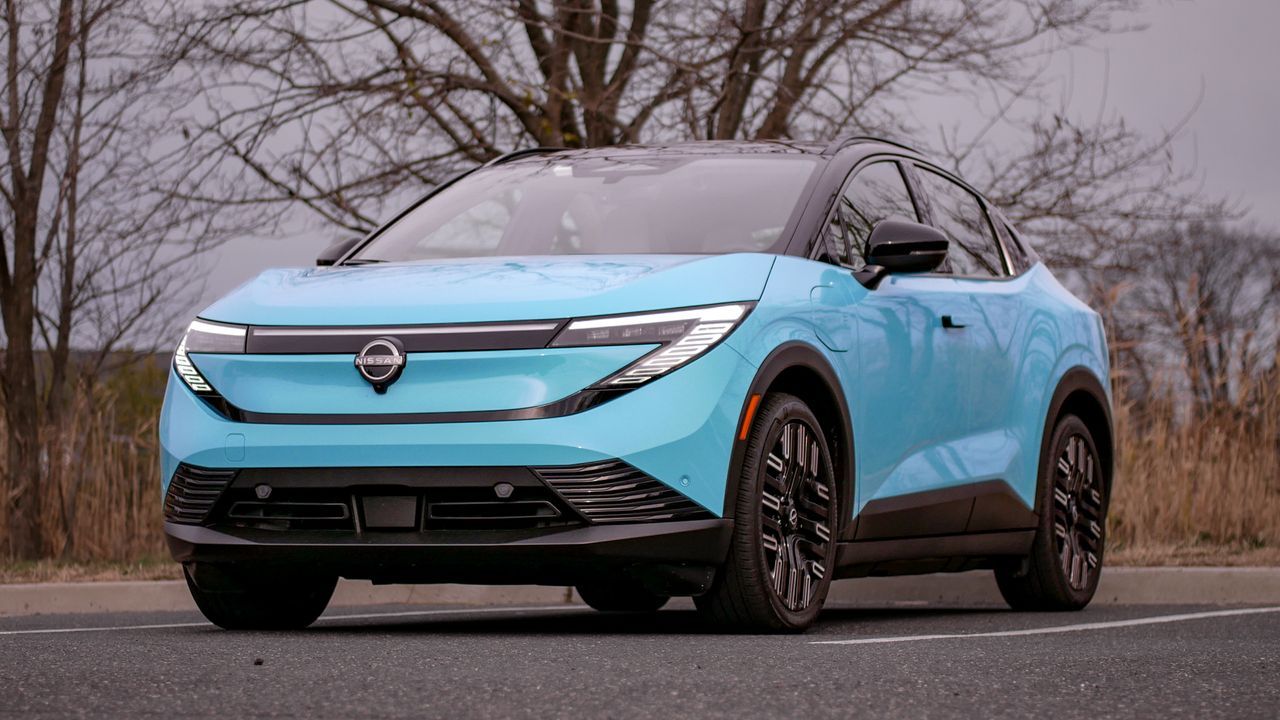
Do you remember what the Nissan Leaf looked like before? It was dorky looking, something I wouldn’t want to be caught driving on the road. Thankfully it’s been redesigned with a more modern style that certainly borrows from the sporty aesthetics of the Nissan Ariya.

I really have to hand it to the designers because the new Nissan Leaf is a totally different looking EV from its predecessors. Detailed touches, like the 3D effect of its stacked rectangular taillights and illuminated emblem, really shows off the sporty meets modern design of the 2026 Nissan Leaf. For a sub compact SUV, it’s an attention grabber.

Electronic glass roof

One perk you get with the Platinum+ trim is a panoramic glass roof that offers sprawling views of the sky. I’m okay that it’s fixed and doesn’t open up because of how it offers an electronically controlled sunshade.

Instead of a retracting cover, it uses Polymer Dispersed Liquid Crystal technology that makes this smart glass go from transparent to opaque, much like on other luxury EVs like the Rivian R1S, Audi A6 Sportback, and Lexus RZ 450e. The effect is similar, but you’re not spending crazy gobs of money to get this feature like those other luxury vehicles.

Responsive performance in Sport mode

(Image credit: Tom's Guide / John Velasco)

The Platinum+ trim is no slouch, especially when I put it into sport mode, which amps up the acceleration and steering. Budget EVs aren’t known for their handling and drive performance, but the 2026 Nissan Leaf doesn’t disappoint — which makes it even better since it’s a smaller vehicle. I wouldn’t go far to say it’s more fun to drive than the Volvo EX30 or Ford Mustang Mach-E, but I didn’t expect it to be this good for a budget EV.

You'll get good efficiency out of it

(Image credit: Tom's Guide / John Velasco)

Again, I have to point out the better-than-average efficiency I got from the 2026 Nissan Leaf Platinum+. The 3.6 mi/kWh average I got in my week’s worth of driving means it’s very possible to get more range than what it’s rated for, just as long as you’re mindful of your driving — which means putting it into Eco mode for most of the time.

If you’re in urban areas, the Leaf really excels at city driving. I averaged about 5.1 mi/kWh with my short distance test. On the highway, too, it’s pretty efficient, averaging about 4.1 mi/kWh in my tests.

Really fast Level 1 charging

(Image credit: Tom's Guide / John Velasco)

As I’ve pointed out already, the 2026 Nissan Leaf offers fast Level 1 charging speeds. The 4.24 mi/hr average I got at home is tops in its class, beating out all other subcompact SUVs I’ve tested all year. What makes it even better is that it comes with not one, but two charging ports — J1772 on the left and Tesla’s NACS on the right.

However, you need to know that faster DC charging is only available through the NACS charging port. I stuck with the J1772 charging port at home, but it’s nice that it opens up more opportunities to charge it on the road.

More premium features with Platinum+ trim

(Image credit: Tom's Guide / John Velasco)

The bigger question I think most people will have about the Nissan Leaf is whether or not it’s worth spending the extra money to get the Platinum+ trim over the base one. I’ve already mentioned its electronically controlled glass roof, but the Platinum+ also features a wireless charger for your phones, head-up display, outstanding 10-speaker Bose audio system, auto-dimming rearview mirror, powered liftgate, heated seats, and the cooler set of taillights.

You end up paying $10,000 more to get these conveniences, but it definitely makes it feel more luxury. Other SUVs, like the Honda Prologue and Subaru Solterra, start off at around $40,000 and don't come with these premium features unless you opt for a higher trim.

2026 Nissan Leaf: What I don't like

Underpowered in ECO mode

(Image credit: Tom's Guide / John Velasco)

If there’s one thing I don’t like about the 2026 Nissan Leaf is that it feels underpowered in Eco mode. While driving it in this mode definitely scales back its acceleration and responsiveness, it allows the vehicle to be way more efficient — and as a result — you’ll get more range out of the battery. I personally strive to get the best efficiency possible with my testing, but this makes the Leaf agonizing to drive whenever I’m accelerating to cruising speed.

2026 Nissan Leaf: Bottom line

(Image credit: Tom's Guide / John Velasco)

I cannot express how much of a big deal is the 2026 Nissan Leaf. It’s the sort of thing I’d recommend as a starter EV for anyone because of its utility of being an SUV, sportier design style, and really good efficiency and charging. It sets the bar for all other budget EVs coming out in 2026 because it sets it so high — more so when it’s one of the cheapest EVs around.

Follow Tom's Guide on Google News and add us as a preferred source to get our up-to-date news, analysis, and reviews in your feeds.

More from Tom's Guide

Sign up to read this article
Read news from 100’s of titles, curated specifically for you.
Already a member? Sign in here
Related Stories
Top stories on inkl right now
Our Picks
Fourteen days free
Download the app
One app. One membership.
100+ trusted global sources.