
Get all your news in one place.
100's of premium titles.
One app.
Start reading
Motor1
Motor1
Business
Jeff Perez

I Drove The Mercedes C 111, The Legendary Sports Car It Never Actually Built

Few Mercedes models have a reputation as legendary as the C 111. The remarkable part is that not a single customer was ever able to buy one, no matter how badly they wanted to.

While the 300 SL, and later the CLK GTR, at least made it into limited production, the C 111 remained exactly what it was intended to be: a pure experimental vehicle that would never see series production.

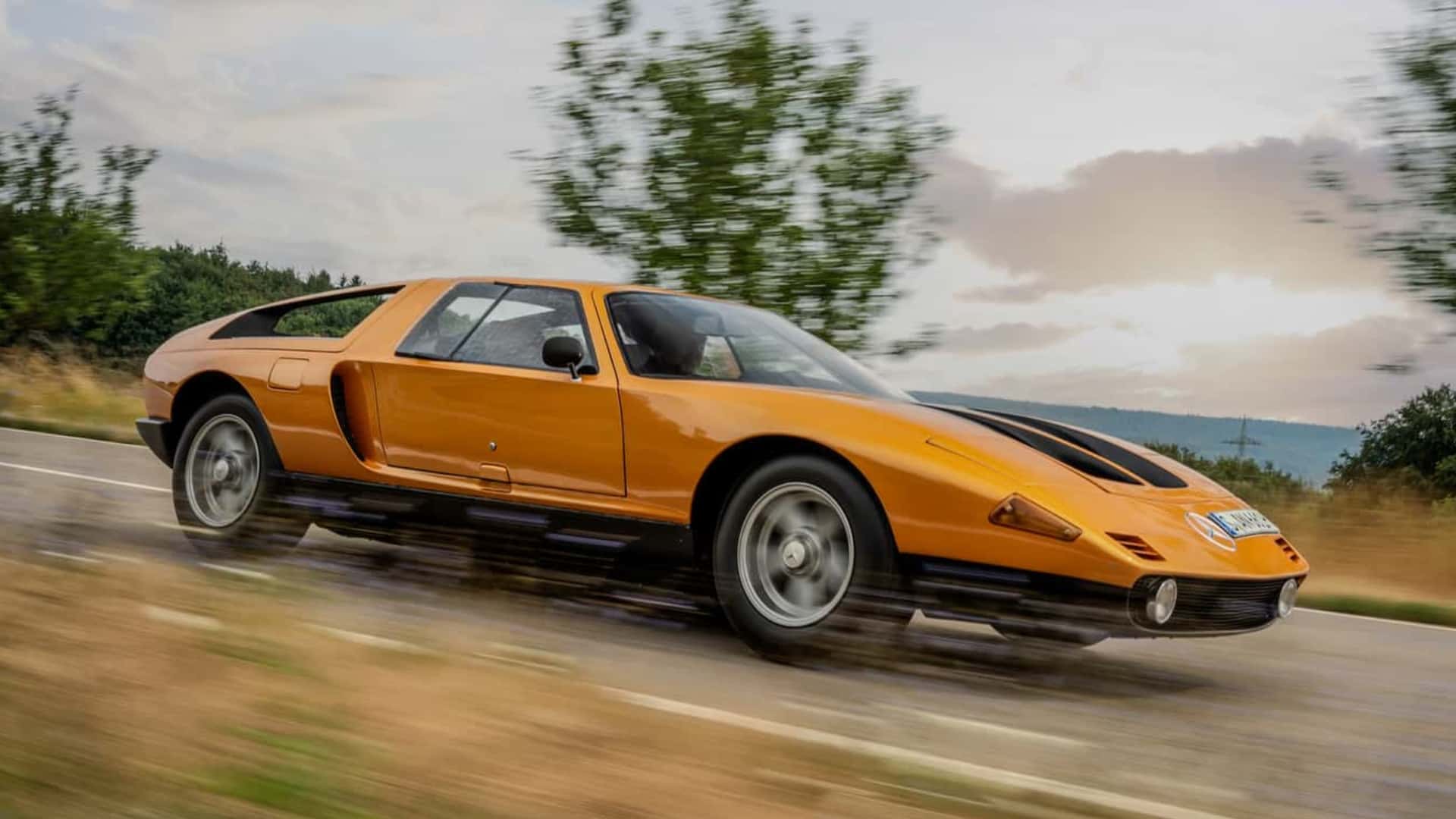
Even so, every sports car fan knows what it is: a low, wedge-shaped body, distinctive gullwing doors, and vivid orange paintwork—or, as Mercedes would insist, "Weissherbst." That design made it an icon, even though very few people have ever seen one in person.

For many, it remains the sports car Mercedes never actually built, and if you couldn’t put one in your garage, at least you could put a scale model on your shelf.

This story originally appeared on Motor1 Germany

A Rolling Laboratory

Mercedes had a very different goal from the beginning. When the C 111 made its debut at the Frankfurt Motor Show in September 1969, engineers weren’t thinking about sales figures or a successor to the 300 SL. Instead, the car served as a rolling test lab for new powertrain concepts, particularly the rotary engine, as well as chassis technology, aerodynamics, and the then-exotic use of a fiberglass-reinforced plastic body.

Showgoers saw things a bit differently.

Crowds gathered around the Mercedes stand, assumed the futuristic gullwing coupe was the brand’s next great sports car, and immediately wanted to order one, whatever the cost. After the further-developed C 111-II was shown in Geneva, legend has it that would-be buyers even sent blank checks to Stuttgart, apparently convinced that enough money could soften any refusal.

Mercedes still said no. The C 111 remained what it had always been intended to be: a research project.

Keys In Hand

More than 50 years later, I’m standing in front of one of these legends myself, and the experience is almost surreal. After all, the C 111 is one of those cars you know from books, posters, and museums—not from a test drive. Fortunately, Mercedes-Benz Classic actually handed me the keys, as if this were another normal review.

The briefing is correspondingly short. The cars are fully insured, which is reassuring only at first glance. In a worst-case scenario, a modern AMG could be repaired. With the C 111, that would be considerably more difficult. This is a prototype, and there’s no parts shelf to pull from. Anything damaged would have to be fabricated by hand.

No pressure.

Almost Production-Ready

The first surprise comes as soon as the gullwing door opens. Because the cabin is astonishingly close to production-ready, there are large round gauges, logically arranged switches, and a seating position that immediately feels right. It feels more like an early-1970s Mercedes production car than an experimental vehicle. Of course, a few quirks remain.

The radio, for example, is mounted vertically in the center console because there simply wasn’t enough room to install it horizontally. Occasionally, a wire peeks out somewhere, almost as if to remind you of the car’s origins in the experimental workshop.

Still, it all feels remarkably complete overall—and that was the goal.

Mercedes didn’t want to build an uncomfortable experimental car. Instead, it wanted its test vehicles to deliver the kind of comfort expected from any other sports car wearing the three-pointed star. Read the period test reports, and this comes up again and again.

Racing driver and journalist Paul Frère described the C 111 in early 1970 as a car with an "unmatched combination of comfort and handling," while colleagues at Road & Track and Auto Motor und Sport also praised its exceptional smoothness and impressive refinement for the era.

Once you’ve clumsily hauled yourself over the wide sill, you settle into the low-mounted seats surprisingly well. Even at 6 feet 2 inches, there’s enough room, though you probably wouldn’t want to be much taller. Otherwise, closing the gullwing door could result in a painful knock to the head.

V8 Instead Of Wankel

Anyone expecting the famous four-rotor Wankel engine, however, is in for a disappointing surprise. For our drive, Mercedes-Benz Classic provided one of the far less frequently discussed V8 comparison cars.

The company does still have a running Wankel-powered C 111, but beneath this car’s low rear deck sits a 3.5-liter V8 producing around 197 horsepower. It was built at the time so engineers could compare the rotary engine with a conventional piston engine.

From the outside, the two cars are barely distinguishable. Technically, however, they tell two very different stories—as different as a marathon runner and a sprinter who just happen to be wearing the same jersey.

A Tricky Clutch, Friendly Road Manners

The V8 fires immediately and sounds exactly as you’d imagine a Mercedes engine of this era should: refined, restrained, and not remotely interested in shouting. That impression is confirmed when pulling away... except for the clutch, which clearly has plans of its own.

It bites almost immediately, within the first millimeter of pedal travel, and initially causes a few unintentional stalls. It’s embarrassing, but not necessarily a sign of poor driving. The Mercedes-Benz Classic staff simply nod knowingly. The clutch has long been considered one of this prototype’s quirks, and with no replacement parts available, it can’t simply be swapped for a new one.

The V8 fires immediately and sounds exactly as you’d imagine a Mercedes engine of this era should: refined, restrained, and not remotely interested in shouting.

Once the C 111 is moving, the biggest surprise of the day may be just how normal it feels to drive. Its age is certainly noticeable, particularly in the steering, which is far more indirect than that of a modern sports car. Combined with the large steering wheel, it requires some fairly broad arm movements.

The suspension is firm and somewhat dry without ever becoming unpleasant, and the C 111 never feels like a fragile museum piece. Quite the opposite. After just a few miles, the initial reverence begins to fade, and you simply start driving the car as if it were something quite ordinary—albeit something extraordinarily beautiful.

A Grand Tourer, Not A Race Car

That’s the last thing I expected. The C 111 doesn’t feel like an exotic Italian-style supercar. It drives more like a very quick grand tourer.

The engine moves the just-over-2,200-pound car along briskly, yet it always remains pleasantly civilized. Aggression is completely foreign to this car, which makes surprisingly good sense given its actual purpose. The C 111 was never meant to be a race car. It was a development vehicle.

The C 111 doesn’t feel like an exotic Italian-style supercar. It drives more like a very quick grand tourer.

That it still moves with such harmony is surprising, especially because its prototype status is barely apparent from behind the wheel. Yes, you notice small peculiarities here and there, but overall, the car feels astonishingly well developed.

You begin to understand why so many visitors to the 1969 Frankfurt Motor Show were convinced Mercedes would surely put it into production.

Timeless Design

The design plays a major role in that impression. More than five decades after its debut, the C 111 still looks strikingly modern. With a few subtle updates to the lighting and wheels, it could easily pass for a contemporary concept car.

That helps explain why it still draws so much attention today. People stop, pull out their phones, or give an approving thumbs-up. Around Stuttgart, people also know exactly what’s coming toward them.

During a short break, conversations start quickly, and more and more enthusiastic onlookers gather around the car. Older spectators, in particular, usually have a story to tell, while younger ones simply enjoy the spectacular design.

Positive vibes, as they say.

From Wankel Dream To Record Car

The C 111’s real career, however, began only after the dream of the Wankel engine had already started to fade. Fuel consumption and emissions dealt the concept a serious blow, particularly as the oil crisis approached, while the reliability of the rotary engine left too many questions unanswered.

Mercedes wound down Wankel development by 1976 but continued to use the C 111 as a test vehicle. First came the diesel-powered C 111-IID, which set 16 world records over 60 hours at Nardò in 1976.

It was followed by the aerodynamically optimized C 111-III and, finally, the C 111-IV, which set a new closed-course record in 1979 at nearly 251 mph.

The former Wankel sports car had definitively become a record machine.

More Than A Museum Piece

When I park the C 111 back in front of the Classic Center, one thought lingers above all: this car is far more than a beautiful exhibit.

It represents the courage with which Mercedes pursued new ideas at the end of the 1960s, even if not every one of them ultimately prevailed. The Wankel engine disappeared, many technical solutions evolved or were simply discarded, but the C 111 itself remained.

Perhaps that’s where its true significance lies. New manufacturers can develop good cars within a few years, but what can’t be built in a few years is history.

The C 111 is a reminder that this history can be at least as valuable to a brand as its newest models. Mercedes has recognized that, which is why the company keeps some of its most significant vehicles not just in a museum, but in running condition.

Thankfully.

Because some cars can only truly be understood when you experience them yourself. And for that reason, our thanks and respect go especially to the people at the Classic Center, who not only preserve these automotive treasures but are also brave enough to let people like me drive them.

Sign up to read this article
Read news from 100's of titles, curated specifically for you.
Already a member? Sign in here
Related Stories
Top stories on inkl right now
One subscription that gives you access to news from hundreds of sites
Already a member? Sign in here
Our Picks
Fourteen days free
Download the app
One app. One membership.
100+ trusted global sources.