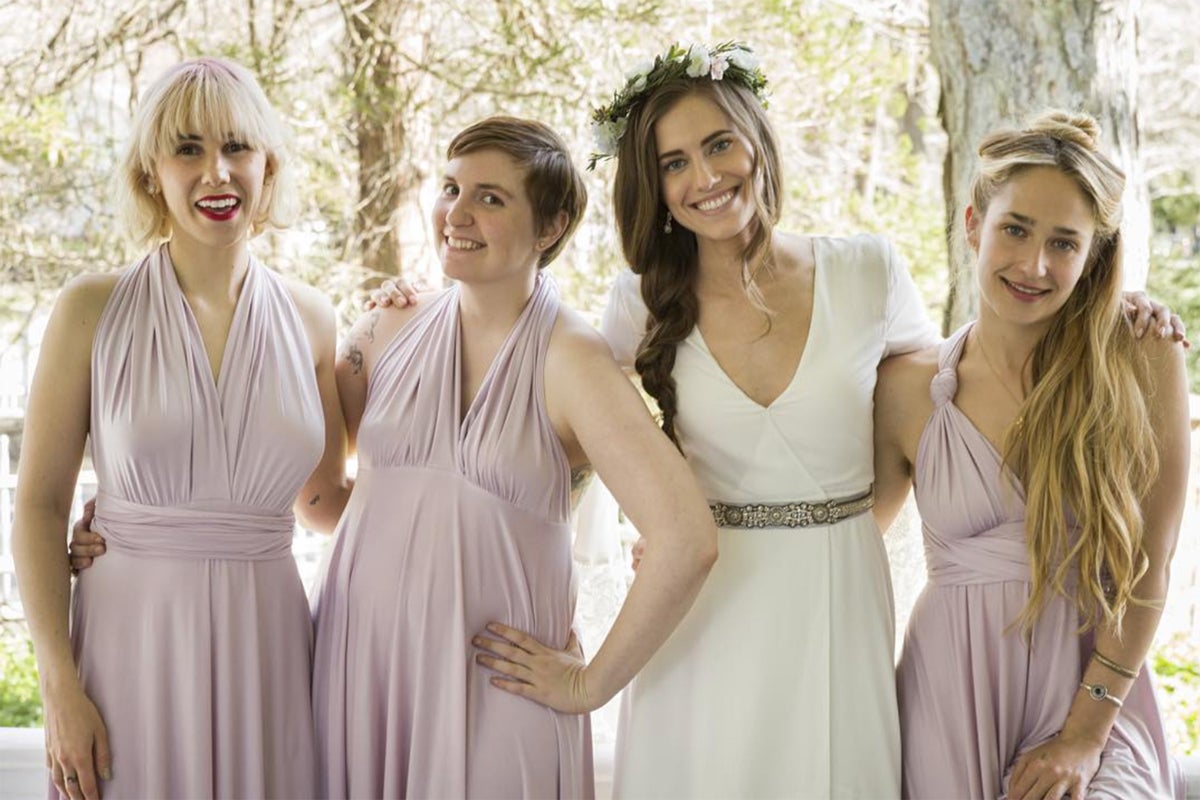
Being asked to be part of a wedding party is one of the biggest honours that a friend can bestow, a sign that they truly value the relationship – or, perhaps, that they know you’re pretty handy with a spreadsheet and won’t stand on ceremony when it comes to chasing up that final hen do payment.
They’re trusting you to help them to manoeuvre the bathroom in a bridal gown and to smooth any tensions that might bubble over when emotions are running high. They want you in the wedding photos that they’ll keep forever and to place you at the heart of their celebrations.
But it is also a major responsibility, one that can come with a financial and emotional cost. Yet in an era when bridesmaid “proposals” can be almost as elaborate as the main event – think special boxes filled with curated gifts, personalised with the ubiquitous sprawl of the live, laugh, love font – turning down such a request can feel almost taboo. So what happens when you need to say “I don’t” to being a part of your friend’s “I do”?
Laura*, who is in her mid-thirties, found herself in that situation when an old friend got engaged. She’d drifted away from the pal in question when they’d ended up on opposite sides of the country, and didn’t know much about her partner, but she was still really happy when she received an invite to their wedding – she was looking forward to just being a guest, after putting in a gruelling bridesmaid shift for a family wedding a few months earlier.
When her friend invited her out for a meal soon afterwards, Laura assumed it was just a long overdue catch-up. But on her arrival, she saw the bridesmaid request written on a card on the table. “It feels bad, but the first thing that was in my head was: ‘are you f***ing kidding me? I’m gonna have to be skint again,” she admits.
Is it really a surprise that her first worry was money-related? In 2024, one study estimated that the average cost of being a bridesmaid was around £670, and it is only likely to have crept up further since (attempting to book flights for a hen party abroad while the price of jet fuel is in flux? A truly hellish task). That’s almost double the estimated cost of attending a wedding as a guest, which a new study from Tesco Bank puts at £316 per person. “I’d said that the next year was going to be about me, as the family wedding took over my life,” Laura says. “I didn’t mind that, but there were so many things I wanted to do and I couldn’t, because I had to save [money], take annual leave for hen dos.”
The prospect of doing it all over again, so soon after she’d faced bridesmaid burnout, was not an appealing one. Yet she still felt like she “had to say yes” – and frankly, who wouldn’t baulk at the prospect of having to immediately knock back a friend, then sit through an awkward dinner?
When it came to planning a hen party, though, she and her fellow bridesmaid struggled to meet their friend’s expectations. “We were having arguments because she didn’t like the layout of an Airbnb,” she says. It became clear, too, that the bride-to-be wasn’t going to pay for the bridesmaids’ dresses or their hair and makeup on the day. When Laura totted up the spiralling costs, she thought: “You know what? I don’t want to do this any more.”
It feels bad, but the first thing that was in my head was: “are you f***ing kidding me? I’m gonna have to be skint again”
Laura*
It wasn’t an easy conversation – although in this case, it was mitigated by the fact that the friendship had already faded due to distance (would they even have been chatting if there wasn’t a wedding to plan?) And for Laura, the upshot is that she’s no longer attending the wedding at all, although she does plan to send her congratulations afterwards.
But she has no regrets. “I definitely did the right thing,” she says. “If I were still a bridesmaid now, there’d be so much stress, and I feel stress-free. My money is my money now, and the annual leave I’m booking is for things that I want to do.”
An imbalance in friendship, it seems, can prove difficult to navigate; if you don’t necessarily see the bride as part of your closest circle, the responsibilities that come with being a bridesmaid might come to feel more like a burden than a privilege. And if the bride is your in-law? It’s even trickier.
When Helena* was asked to be a bridesmaid at the wedding of her partner’s sister, she immediately felt awkward. That was in no small part thanks to a clumsy comment made by that partner, Oliver*, who was helping to contribute to the cost of the ceremony. When the two couples were out celebrating, Oliver joked that his financial help didn’t mean that his sister had to ask Helena to be part of the wedding, as a sort of quid pro quo.
His remark caught her off-guard. “I thought he was joking, but I honestly couldn’t tell,” she says. Later, her sort-of sister-in-law told Helena that she had, in fact, wanted her to be a bridesmaid. Even though her future with her partner already “felt uncertain”, she “didn’t want to create tension or ruin the moment”. Social pressure won out, and she agreed. “Looking back, I should have listened to that instinct,” she says.
But as the preparations for the wedding got started in earnest, Helena began to notice that Oliver was throwing all of his energy into ensuring that his sister’s big day would go perfectly… leaving very little in reserve to keep his own relationship going.
As he “became deeply involved in almost every decision”, Helena recalls, “the irony became impossible to ignore” – he seemed more invested in another couple’s future than their own. Seeing how much “care and commitment he could pour into helping build that future made it impossible not to notice what was missing in ours”, she says. “If the commitment had been there for me, if a future together had felt real and actively being built, none of it would have unsettled me,” she adds.
It wasn’t that she disliked Oliver’s family or resented the time he spent with them. “The wedding itself was never the problem,” she explains. “It simply exposed the contrast.” While she was secretly hoping that he would “save some of that energy for building a future with me”, she ended up being asked to “celebrate a level of commitment that had slowly disappeared from my own relationship”.
It was as if the preparations for the ceremony had exposed the fault lines. When the relationship eventually ended, she could step down from her bridesmaid role without too much drama – it seemed like an inevitable side effect of the breakup, and it became less about Helena appearing to back out.
All of this might lead you to wonder whether it’s even possible to let your friend down gently. Writer and friendship expert Aimée La Fountain explains that saying “no” doesn’t mean setting fire to that relationship. When a friend she’d known since she was a teen asked her to take on bridesmaid duties, she was really touched – she’d previously had a tricky experience of being in a wedding party, plus she was dealing with the fallout from an abrupt breakup with another friend.
If someone makes a friendship conditional upon serving in their wedding, then the friendship is already damaged
Aimée La Fountain, friendship expert
She quickly told the bride-to-be that she wasn’t sure. “I think this interaction went a long way,” she says. “I didn’t immediately say yes or no and explained my reasoning, which she, to her credit, listened to and understood.” Eventually, she came to realise that she wasn’t in a good place to take that responsibility on. “So accepting could’ve been detrimental to both of us.”
When she shared that final decision with her friend, the bride took it well, appreciating her honesty. She even deemed Aimée an “honourary bridesmaid”, and they are still close today. “The first time I considered being in a wedding, I ultimately said yes because I feared that saying no would ruin the friendship,” she says. “What I wish I realised back then was that if someone makes a friendship conditional upon serving in their wedding, then the friendship is already damaged. In fact, participating in a wedding against your better judgment could strain the friendship further.”
Wedding expert Zoe Burke, head of brand at wedding planning app Bridebook, agrees that you need to communicate your decision as early as possible. “The sooner you have the conversation, the easier it is for everyone involved,” she says. “Backing out a few weeks before the wedding is very different from politely and respectfully declining on the day you’re asked.”
As tempting as it might be to fire off a text, this is a conversation to have face to face, she adds, or at least over the phone. “Tone is so important when it comes to a conversation like this, and it can be misconstrued over WhatsApp,” Burke says.
If money’s a major reason for your polite decline, that doesn’t mean that you owe anyone a detailed breakdown of your finances, she adds (in fact, if anyone starts making snidey comments about the big holiday you’ve just been on, and how you managed to afford that just fine, then consider it proof that you’ve dodged a bullet). But you should still give the request the respect it deserves, she says.
She suggests telling the bride that you’re honoured they asked, but you just can’t give the role the commitment it deserves. “Say that you would prefer to celebrate the wedding as a guest,” she says. “This works because it’s truthful, it’s warm and it still focuses on celebrating the couple”.
And if the friendship doesn’t survive a “graceful and considerate decline”? “They were likely already fairly fragile to begin with,” says Burke.
*Names have been changed