
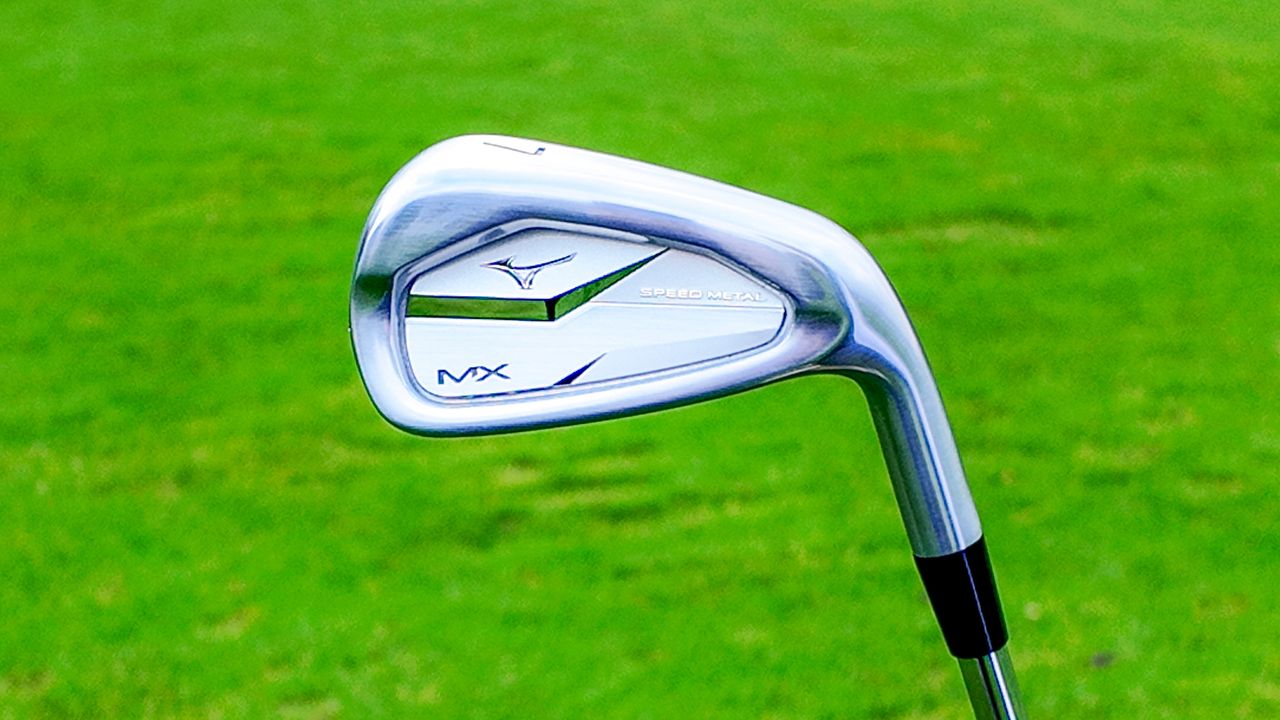
Mizuno is renowned for making some of the best irons in the game and so when it brings out a new set, the golf world is keen to know about it. But there was a launch earlier this year that went completely under our radar. We never received the usual press release, nor was it listed on the Mizuno website. I discovered it a UK-based golf retailer and was immediately intrigued… why is Mizuno keeping this iron a secret and how does it perform?

The answer may lie in the proposition of the MX Speed Metal iron (that’s its name, in case you were wondering). Having been sent the technical information, I would class it as a game improvement iron for the budget-conscious golfer. MX was in fact Mizuno’s game improvement franchise before JPX came along (do you remember the MX-300 irons from 2010? Of course you do).

It appears MX is back, well sort of, as a more affordable alternative to the rightly popular JPX925 range, which tested very favorably for irons expert Joe Ferguson.
You can only buy the MX Speed Metal irons from American Golf - we’ve seen retailer SMU (Special Make Up) products in the past with examples like the Callaway Hex Bite Soft ball - and while the fitting options are limited, the price point is very appealing. A set from 5-PW will cost you around £649 whereas for the JPX925 Hot Metal, you’re talking upwards of £900. Is the price too good to be true? It was time to find out.
In terms of the tech, the MX Speed Metal has a Seamless Cup Face to create a deeper center of gravity for a higher launch angle and controllable land angle. It also allows the leading edge to act as a hinge, which facilitates greater ball speed.
A Cortech Face maximises this ball speed across the face while sound ribs across the top line and optimized head geometry are said to provide that signature Mizuno feel and feedback.
The look of this iron is simple and unfussy, which I like and actually prefer to the more filled in cavity of the JPX925 Hot Metal with its unnecessary white sections. Behind the ball, the MX Speed Metal inspires confidence through generous heel-to-toe length as well as a top line that isn’t too chunky. This does mean from 7-iron down, the sole creeps into view behind it, but this is only a minor visual gripe.

The impact experience is also very pleasant. There’s no harsh or hard sensation on strikes that connect with or miss the sweetspot. It feels lively and solid, like minimal energy is being lost in the collision of club and ball, with a relatively muted sound.
The 7-iron in this set comes in at 29°, which is a degree weaker than the JPX925 Hot Metal. I tested them both in the new Golf Monthly Performance Lab using the Bushnell Launch Pro Circle B Edition launch monitor.
The MX Speed Metal more than held its own here. Where the slightly more ball speed and carry distance from the JPX925 Hot Metal could be attributed to the loft differential, elsewhere the performance was where it needed to be and you could argue the higher launch, peak height and steeper descent angle will be suitable to a broader audience.
I wasn’t even testing in my usual stiff shaft (the samples I had were in a KBS regular steel shaft) but to be honest, they felt great and I didn’t experience excessive height or spin or a wide dispersion.

I tested this iron outdoors too and the ball flight was noticeably stable in terms of shot shape bias and where the balls finished. You could manufacture a fade or draw if you tried very hard, but the majority of shots, even pretty obvious mishits, held their line admirably, even in some pretty strong wind.
All in all, there’s a lot for golfers to enjoy here. For over £250 less, I’m not seeing a great deal of trade off against the more premium JPX925 Hot Metal irons. For inconsistent golfers seeking a new set that performs and doesn’t break the bank, the MX Speed Metal is a compelling, online-only alternative - providing you can get them built in a spec that closely matches what you need.