
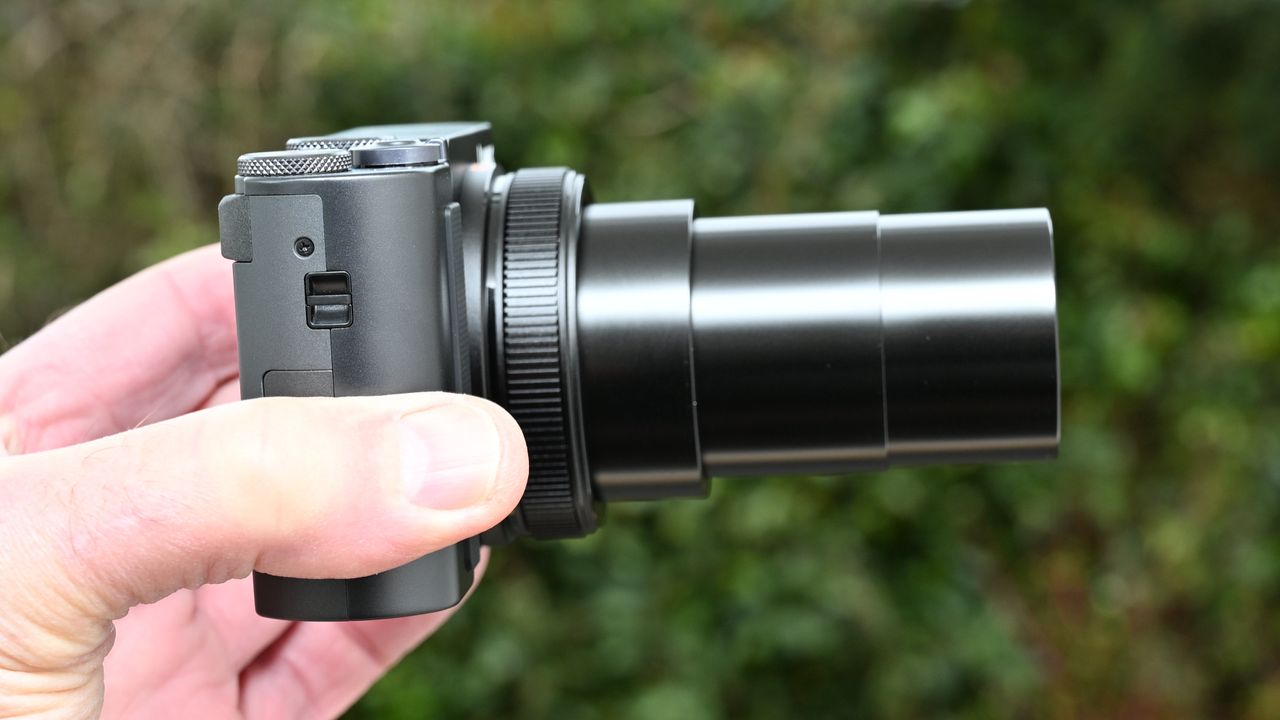
As the retro appeal of compact digital cameras shows no sign of abating, I reckon it’s worth focusing on the attributes that can make them genuinely useful – as opposed to deliberately naff.
To take one leading example, Panasonic’s ‘TZ’ Travel Zoom series of digital compacts became popular from the get-go, because back in 2006 the inaugural Lumix DMC-TZ1 was the smallest compact to offer a 10x optical zoom. It provided a useful 35-350mm focal length in 35mm terms while still slipping into my pocket.

Given that, I was able to excuse the relatively weedy 5MP resolution delivered by its tiny 1/2.5-inch CCD sensor at the time.
Camera phones were already popular. So, subconsciously, if I was going to choose a dedicated digital camera to take snaps, I wanted extra poke. Our phones didn’t feature optical zooms, only a digital equivalent that degraded the image. The compact camera still had the advantage in this respect – genuinely zooming in rather than just cropping the image to fake that it hadn’t.
It’s not a complete surprise then to find that, in the present, Panasonic’s one of the very few major manufacturers re-engaging with compact snapshots. It’s stepped up to satisfy re-emergent demand with 2025’s 30x zoom TZ99 / ZS99 and has this year introduced the 15x zoom, one-inch sensor incorporating Lumix TZ300 / ZS300.
The alternative recommendation to those who felt a pocket snapper didn’t offer enough hands-on features, or an eye-level viewfinder, but who didn’t want the comparable bulk – or expense – of a DSLR or mirrorless with a large zoom lens, was always the bridge camera, or ‘superzoom camera’.

From a period of 10 to 15 years, from the early 2000s onwards, almost every camera manufacturer offered several bridge cameras to choose from.
Even if the small sensors in such cameras weren’t any different from those in point and shoot snapshots, and could in no way match the performance from a ‘proper’ APS-C or full frame DSLR, I always found bridge cameras sat well in the hand and offered a shooting experience closer to the interchangeable lens camera they superficially aped in looks and layout.
Of course, the whole selling point was that with the 20x, 30x and 60x optical zooms they incorporated, with a bridge camera you didn’t need to wish you could swap the lens out for something else. It was a jack of all trades.
In more recent times, here again Panasonic, along with Kodak’s current license holder, has led the compact bridge camera revival. Panasonic unveiled the 60x Lumix FZ82D / FZ80D in 2024, introducing USB-C charging and improved screen and viewfinder resolution, making for a solid option for beginners, anyone trading up from a pocket snapshot – or Gen Z scouring eBay for secondhand options.
If you really want to go nuts, the Nikon Coolpix P1100 offers a maximum 3000mm equivalent at the telephoto end. But it’s bulky, expensive and it’d be a stretch to recommend it to anyone after a higher-powered ‘compact’.
Sometimes good things really do come in small packages. But there’s no need to take the mickey.