
Get all your news in one place.
100's of premium titles.
One app.
Start reading
TechRadar
TechRadar
David Nield

Humanoid robot beats human world record for the first time at the Beijing half marathon — but some are still stumbling at the starting line

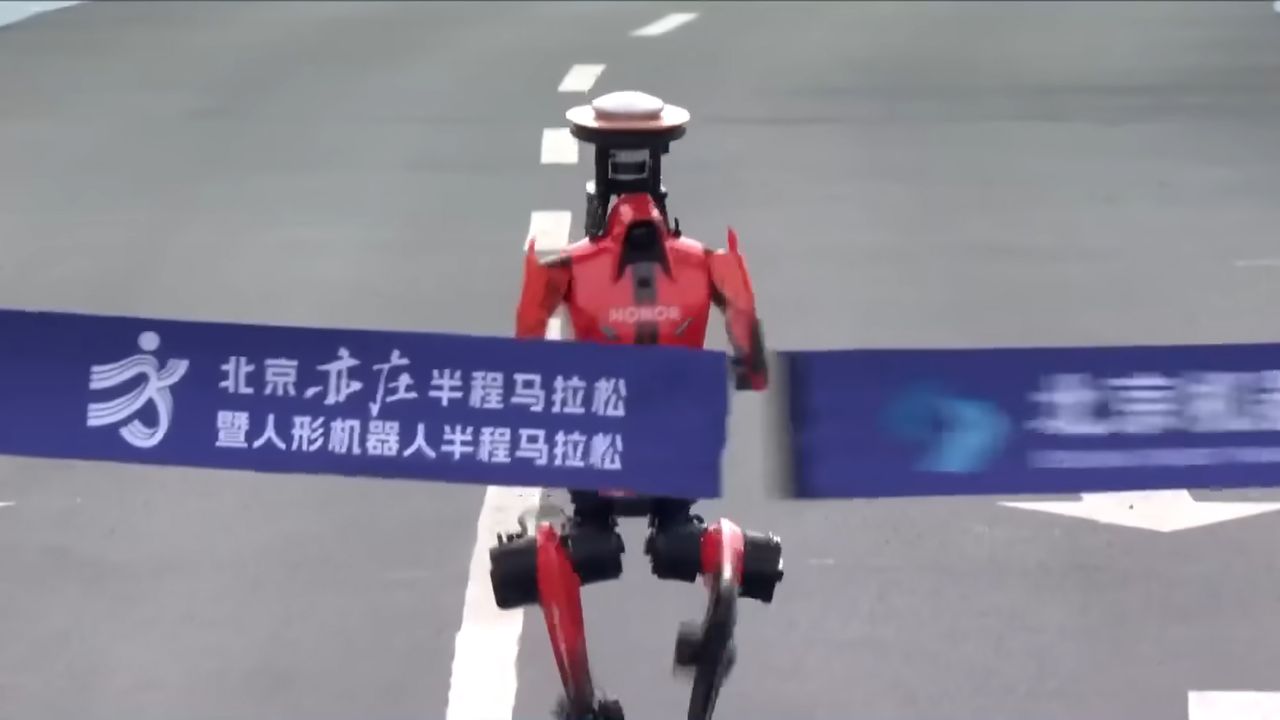
Honor Lightning.
  • An Honor robot has beaten a world record for the half marathon
  • The time was set during a joint humanoid and human race
  • Over 100 robots were entered, and almost half of them were autonomous

Humanoid robot runners have performed notably better at the second Humanoid Robot Half Marathon in Beijing than they did at the inaugural event last year, even beating the fastest ever time set by a flesh-and-blood person — but there were still plenty of technical challenges and mishaps along the way.

As reported by Interesting Engineering and others, the race was run by the Honor Lightning robot, which completed the 13.1 mile / 21.1 kilometer course in 50 minutes and 26 seconds. That beats the world record 57 minutes and 20 seconds set by Ugandan runner Jacob Kiplimo just last month.

It's also a big improvement on the fastest robot time logged in the 2025 event, which was 2 hours, 40 minutes, and 42 seconds. This year, the robots have beaten people for the first time — though the humans were racing on a separate track, to avoid any collisions and injuries from wayward machines.

According to Honor engineer Du Xiaodi, Lightning's prowess is partly down to its long legs (measuring 0.95 meters or 37.4 inches) and a custom liquid cooling system developed in-house. Temperature control and avoiding overheating is actually one of the most difficult aspects of getting humanoid bots running races like this.

'From the very beginning of the design, our robot was modeled on outstanding human athletes, with long legs of about 0.95 meters," he said. "This is a major improvement and highlight in terms of its appearance and design. We equipped it with a very powerful liquid-cooling system, which is also largely developed in-house."

'Just like a T-1000'

Another significant change this year: almost half of the robots in the race were autonomous, meaning no human controls were necessary. The bots had everything they needed on board to navigate the course and complete the race, though some manual battery swaps were required along the way.

More than 100 robots entered this year's race, compared to 20 last year — but as you can see from the video below, not all of them successfully made it to the finish line. In fact, some of them struggled to get over the starting line, showing there's still plenty of room for improvement when it comes to these robot athletes.

Of course, the main aim with these humanoid robots isn't to run races, but to develop them to a stage where they can be as useful as possible — whether that's on an assembly line or in a disaster zone that's too dangerous for a human to head into. Speed and dexterity are crucial for robots in many scenarios.

Reactions online have been mixed: despite the technical prowess on show, many observers are worried about keeping the bots in check. One commentator compares the racing droids to "how the T-1000 ran to catch John Connor" in Terminator 2, while another says "I just want one to clean my house".

Sign up to read this article
Read news from 100's of titles, curated specifically for you.
Already a member? Sign in here
Related Stories
Top stories on inkl right now
One subscription that gives you access to news from hundreds of sites
Already a member? Sign in here
Our Picks
Fourteen days free
Download the app
One app. One membership.
100+ trusted global sources.