
Get all your news in one place.
100’s of premium titles.
One app.
Start reading
Space
Space
Science
Stefanie Waldek

Hubble Space Telescope captures the stunning final breaths of a dying star

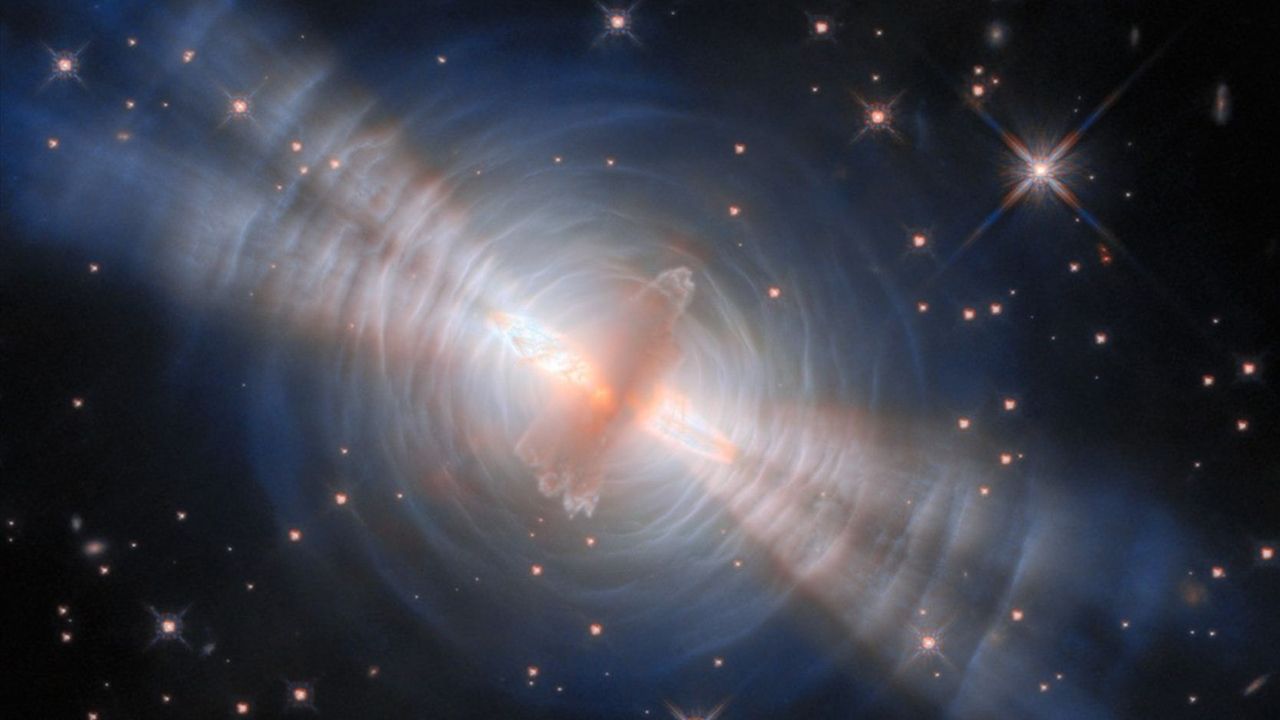
A cropped version of the Egg Nebula image from the Hubble Space Telescope. .

It's the final act for a star in the constellation Cygnus, some 1,000 light-years away. But this star is not dying without one final show, it appears — and NASA's Hubble Space Telescope has captured the last act in astonishing detail.

The Egg Nebula, so-named for its yolk (the star) surrounded by egg white (clouds of dust and gas), is extraordinarily dynamic, with twin beams of light punching through a series of rippling arcs. Whereas most nebulas glow on their own, thanks to the ionization of gas, the light here comes from the dying star itself, emerging through gaps in its dusty shell.

This Hubble Space Telescope image is not just a beautiful scene, but also a tool scientists can use to study stellar evolution. The Egg Nebula is a pre-planetary nebula — an early form of a planetary nebula, which is a glowing shell of gas and dust shed from a dying sun-like star. And it's "the first, youngest, and closest pre-planetary nebula ever discovered," according to NASA. While planetary nebulae don't have anything to do with planets directly, they do provide the seed material for future star systems that do have planets, much like our own.

A full version of the Egg Nebula image. (Image credit: NASA, ESA, Bruce Balick (UWashington))

Because the pre-planetary stage lasts only a few thousand years, the Egg Nebula provides scientists a chance to watch the ejection process practically in real time. Over time, the star's core will grow hotter and begin ionizing the surrounding gas, causing the nebula to glow in its own light and marking the next stage of evolution.

Early observations have homed in on the symmetrical patterns in the nebula. Because they're so orderly, scientists believe they did not stem from a violent supernova explosion. Instead, they likely indicate "a coordinated series of poorly understood sputtering events in the carbon-enriched core of the dying star," writes NASA. That, of course, warrants further study.

By combining past and recent Hubble observations of the Egg Nebula, researchers have assembled the most detailed portrait yet of its layered structure, offering new clues about how dying stars sculpt the material that will eventually help form future generations of stars and planets.

Sign up to read this article
Read news from 100’s of titles, curated specifically for you.
Already a member? Sign in here
Related Stories
Top stories on inkl right now
One subscription that gives you access to news from hundreds of sites
Already a member? Sign in here
Our Picks
Fourteen days free
Download the app
One app. One membership.
100+ trusted global sources.