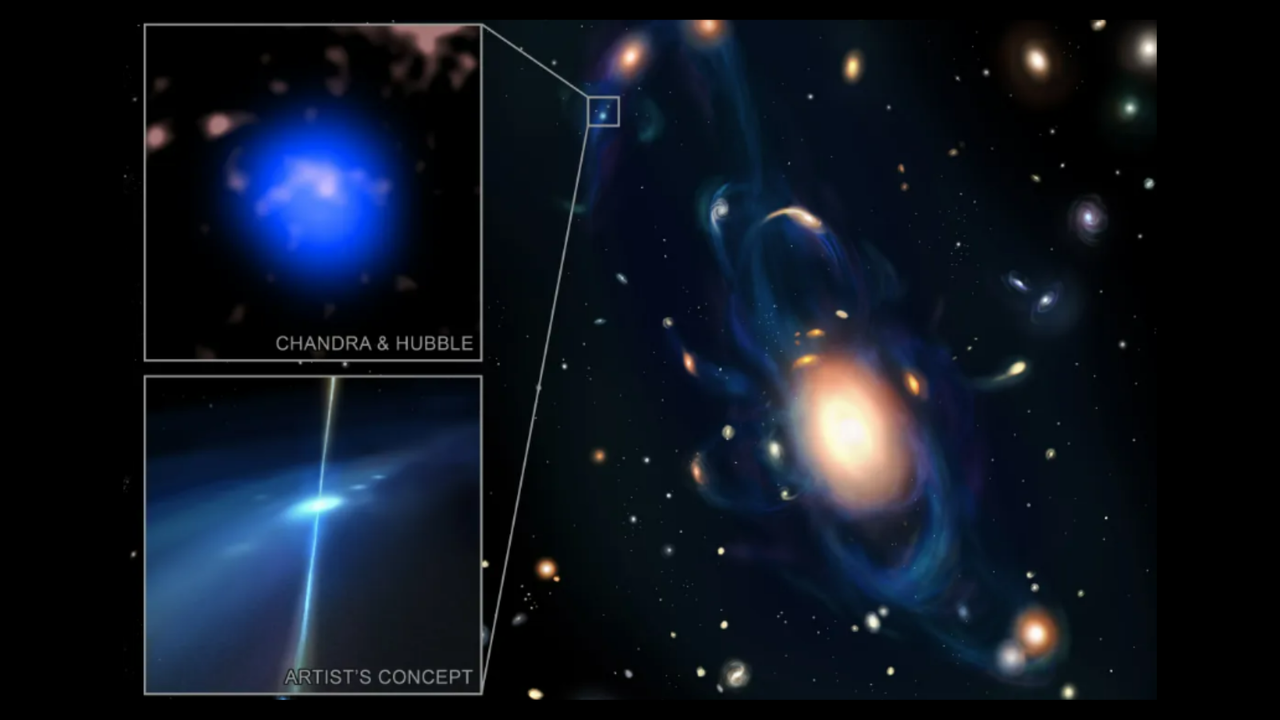
Astronomers have tracked a powerful blast of radiation called a gamma-ray burst (GRB) back to its source, finding a collision between extreme stellar remnants called neutron stars within colliding galaxies. This could reveal more about these extraordinary collisions, thought to be the only events in the universe capable of generating heavy elements like the gold and silver we wear on our fingers and around our necks.
The GRB, designated GRB 230906A, was spotted on Sept. 23, 2023, by an array of NASA space telescopes, including the Chandra X-ray Observatory, the Fermi Gamma-ray Space Telescope, the Neil Gehrels Swift Observatory, and the Hubble Space Telescope. GRB 230906A was tracked back to a neutron star merger within a tiny galaxy that is itself embedded in a river of gas 600,000 light-years long, or about six times as long as the width of our entire galaxy.