Get all your news in one place.
100’s of premium titles.
One app.
Start reading
Newslaundry
Newslaundry
Sumedha Mittal

How we broke the voter roll story before it became a national conversation

More than a year ago, when I began looking into possible manipulation of voter rolls, the first person to help me understand it was Dr SY Quraishi, former Chief Election Commissioner of India. 

One evening last September, he spent three hours patiently answering my questions on how the EC adds and subtracts a voter, offering an observation: “I am just tired of explaining this to people who talk about ‘EVM rigging’ that voter rolls are the real underbelly of the Election Commission – and they don’t yet have a solution to foolproof them.”

This remark really piqued my interest in the story. Until then, I believed it was impossible for a voter to be wrongly deleted or added, and that an actual irregularity like this could have slipped under the radar. 

By January 2025, Newslaundry published a four-part series pointing out how EC norms were seemingly flouted in hundreds of deletions and additions in certain Lok Sabha constituencies. And how there was a pattern even in the small sample size we scrutinised with a random selection.

For example, when the BJP scraped through Farrukhabad with a margin of around 2,700 votes, the scale of deletions that had preceded the election told a larger story. More than 32,000 voters had been struck off the rolls, most of them in Aliganj, an assembly constituency dominated by Yadav and Muslim voters.

In Meerut, we found that two booths had 27 percent fake voters, and the Uttar Pradesh chief electoral officer (CEO) admitted that there was no mechanism to delete them. The voter rolls were rife with fake addresses, making it impossible for booth-level officers (BLOs) to trace them.

And in the Chandni Chowk constituency of Delhi, we found that the Model Town assembly constituency – populated by Punjabi and upper-caste voters – had a deletion percentage that was three times lower than that of assembly segments housing Muslim and backward voters. These were just some of our findings. 

(You can read our four-part story here, here, here and here.)

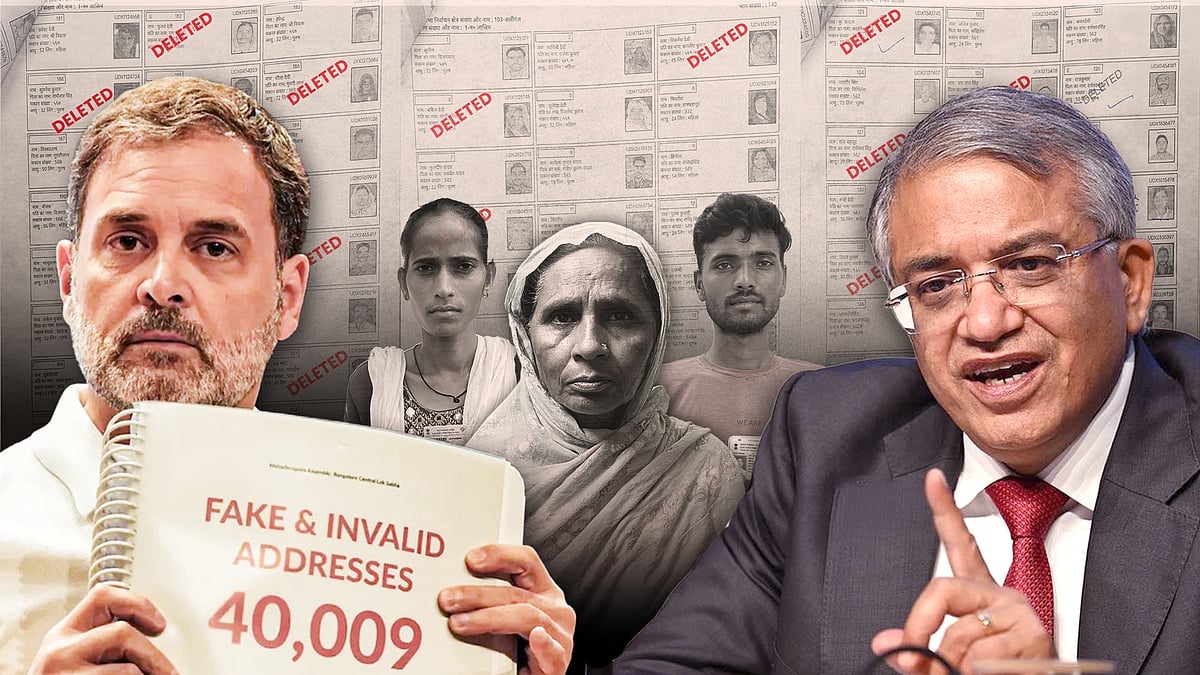
At that time, the issue did not immediately ring a bell with political parties. Until August 2025, when Leader of Opposition Rahul Gandhi held his first press conference alleging large-scale voter roll irregularities in two constituencies in Maharashtra and Karnataka and gave it a political term - ‘vote chori’.  

The story became even bigger when the Chief Election Commissioner, Gyanesh Kumar, introduced the Special Intensive Revision (SIR) in the run-up to the Bihar assembly elections. In this exercise, for the first time, the commission sought proof of citizenship and refused to accept a voter ID card as proof of eligibility. 

Most opposition parties knocked on the doors of the Supreme Court, demanding the scrapping of the exercise, and launched a political campaign around it. Even political strategist-turned-politician Prashant Kishor, who earlier criticised Gandhi on the allegations of voter list manipulation, vaguely hinted at it after his party’s disastrous performance in Bihar. 

The Bihar SIR was marred by irregularities. Following the publication of the state's draft voter rolls on August 1, I found that 2,92,048 voters had house numbers listed as ‘0’, ‘00’, or ‘000’ in this exclusive report. CEC Gyanesh Kumar claimed this was standard when local administrations hadn't allotted house numbers, but as I explained in a follow-up report, this justification didn't withstand closer examination. In a separate investigation, Newslaundry found that in Rahijagatpur village, Madhepura district, 1,069 voters were listed under a non-existent house.

Deciphering voter roll manipulation 

To unpack how voter rolls were manipulated in these constituencies, my editor, Raman Kirpal, drafted a three-step methodology: 1) Randomly select three Lok Sabha constituencies where the victory margin was thin; 2) shortlist three booths from each one of them where the deletions were the highest; 3) and then visit each voter whose name was wrongly struck off – the easiest part of the assignment. 

The most challenging task was identifying booth-level additions and deletions. Yes, this data is not easily accessible. It is publicly disclosed in a non-machine-readable voter roll, accessible via a captcha on the commission’s website. To examine data of over 5,400 polling stations in three Lok Sabha constituencies, I, along with three interns, manually entered 5,400 captchas. When the internet speed was good, the download took about two to three minutes as files were non-machine-readable and heavy. Then, we scrolled to the last page of each voter roll to find additions and deletions on that booth and noted them in an Excel sheet. 

It took us three weeks to compile all the data. The results were shocking.  

Missing out on the more minor battles, the Opposition could’ve won

I don’t know how Quraishi would feel today about politicians finally talking about voter rolls. However, a senior election commission official told me in confidence that he sees it as a “big win” because, all these years, they had to advertise hard to make voters check that their names were not wrongly struck off the rolls. 

On the face of it, the discourse sounds like the Opposition is fighting the right fight for a cleaner electoral process. But they missed out on the two smaller fights that were easier to win – and could have made election forensics easier to scrutinise. 

First, they could have pushed the Election Commission to publish booth-level data on the number of voters added and deleted in each revision process, in a listicle format – much like how the commission publishes candidate-wise vote counts.

Second, they could have ensured a uniform format for Form-20 – final result sheet at the constituency level – across elections. It remains the most important and underutilised dataset in election forensics, showing booth-level vote tallies for each candidate.

While Uttar Pradesh has published this data in an Excel sheet only up to the 2022 assembly elections, I wonder what stopped them from doing so afterwards, or why other states like Maharashtra publish it in a non-machine-readable PDF, or worse, why Bihar published it in an unreadable format for some constituencies

Correlating these two data sets would have answered the crucial question in a jiffy: which parties, if any, are benefiting from voter additions and deletions. But as Quraishi had warned earlier, the problem was never a lack of outrage – but a lack of scrutiny.

Twenty-five years have transformed how we consume news, but not the core truth that democracy needs a press free from advertisers and power. Mark the moment with a joint NL–TNM subscription and help protect that independence.

Newslaundry is a reader-supported, ad-free, independent news outlet based out of New Delhi. Support their journalism, here.

Sign up to read this article
Read news from 100’s of titles, curated specifically for you.
Already a member? Sign in here
Related Stories
Top stories on inkl right now
One subscription that gives you access to news from hundreds of sites
Already a member? Sign in here
Our Picks
Fourteen days free
Download the app
One app. One membership.
100+ trusted global sources.