
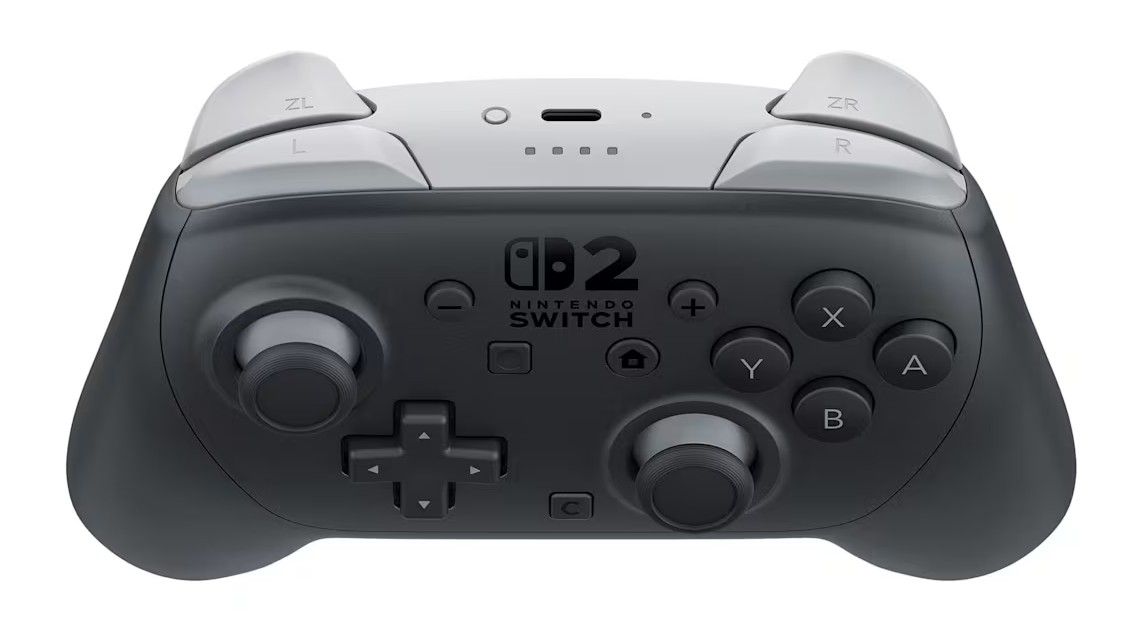
We may not (officially) be able to play Nintendo's games on PC, but nothing's stopping us from using Nintendo Switch controllers to play our PC games! I love the sturdy, premium-feeling Switch Pro controller and its seemingly eternal battery life, and if you've recently become the owner of a Switch 2, you're probably looking for something to do with that Pro controller in between big Nintendo releases.
It's easy to plug either of them in via USB and be up and gaming in just a couple minutes. And if you prefer gaming wirelessly over Bluetooth, I can guide you through setting that up, too (though for now, only for the Switch 1 Pro controller).

I recommend using Steam's built-in controller support to set up the Switch Pro controller on PC. It takes away any fussy setup and works practically instantly; if all the games you play are on Steam, there's no point in even thinking about other solutions. If you do want to play some non-Steam games, that's where the further instructions in this guide come in. I'll go over how to get Windows to recognize your Switch Pro controller's inputs with a third-party tool. It may not make our list of the best PC controllers in 2025, but if you already own one, you should absolutely put it to use.
As of November 2025, Steam Input now supports the newer Switch 2 Pro controller via USB, so it's just as easy to plug-and-play as the older model. Bluetooth doesn't work in Steam for the Switch 2 Pro Controller, however.
First I'll quickly go over the basics for both the Switch and Switch 2 Pro controllers in Steam via wired USB (or Bluetooth for the Switch 1 model only).
Switch and Switch 2 Pro controller on PC: Steam setup
Steam's built-in controller configurator recognizes the Switch and Switch 2 controllers as soon as you plug them in, which makes using the controller dead easy in any game in your Steam library (that has controller support, obviously).
Enabling it is extremely simple. Start by *deep breath* plugging the controller into your PC. You've got this!

Plugged in? Okay, next:
1. Open Steam and the settings menu. Find the Controller tab and verify that it recognizes your controller. Scroll down to the setting for "Enable Steam Input for Switch Pro controllers" and tick it on. This will ensure the controller works even in games that don't natively support it.
2. If you like your Pro controller with flip-flopped X/Y and A/B buttons, you can also enable Use Nintendo Button Layout so games default to it (Microsoft had to go and reverse them on the original Xbox, for some reason, and it's still confusing). If this option is not enabled, your Pro controller button presses will be treated like an Xbox controller.
You can also change your controls game-by-game by right-clicking that game in your library, selecting Manage > Controller layout, and remapping each button.
3. While you're in the Controller menu, take the time to personalize your Switch controller by clicking Calibration & Advanced Settings. You can calibrate the joysticks, gyro, and tweak the brightness of the LED. If you ever feel the need to calibrate your controller, click Calibrate, set it on a flat surface, and follow the button prompts.
Switch and Switch 2 Pro controller on PC: Non-Steam games

Using Steam is the really easy way to get this controller working. If you aren't playing games via Steam, using a Switch or Switch 2 Pro controller is still an option but it requires a little extra work, particularly for a Bluetooth connection. But the good news is that it's natively recognized in modern Windows 10/11, which helps speed things up.
The easiest solution for non-Steam games is to actually bring Steam back into the picture. Steam has an "Add to library" feature for Windows executables that allows you to add other programs to your Steam library, and then make use of the Steam overlay. This even works for the Nintendo GameCube/Wii emulator Dolphin!
As you can see in the image above, click the "Games" menu in Steam, then choose the "Add a Non-Steam game to my library..." option to pull up a list of programs on your PC. In most cases, this should allow you to add a game and use a controller with Steam as an intermediary. Hooray!
Switch 1 Pro controller on PC: Bluetooth connectivity
Right now, there's no good way to get the Switch 2 Pro controller working well via Bluetooth, but folks are working on it. I'll update this guide when a reliable method becomes available.
Here's what you'll need on-hand to get your Switch 1 connected via Bluetooth:
Hardware
- Nintendo Switch Pro controller
- Ideal: 8Bitdo wireless Bluetooth adapter (optional)
- Otherweise: Bluetooth dongle (or Bluetooth built into your PC)
Software
- 8Bitdo USB Adapter 2 software
- BetterJoy (if you don't use the 8Bitdo dongle)

8Bitdo adapter: Easy Bluetooth and XInput support
The $20 8Bitdo Bluetooth adapter helps you bypass most of the finicky setup below by handling the Bluetooth connection and making Windows play nice with the controller without any extra software. It'll make Windows see the Switch Pro controller like it would an Xbox gamepad, and supports the button/joystick inputs and motion controls (but not vibration).
To get it working, just put your controller in pairing mode with the sync button, then use 8bitdo's software to pair and configure it.
As a bonus, the adapter work on multiple consoles and with tons of other controllers, too, including the Switch Joy Cons, PS4 controller, Wii remotes, and more. Note that while the 8Bitdo wireless adapter is compatible with the Switch 2 console, it can't sync the Nintendo Switch 2 Pro controller to PC.
If you don't want to spend the $20, follow the guide below.
The (slightly) harder way: Windows installation guide
Note: You only need to follow these steps if you're not using the Switch Pro Controller through Steam.
1. Plug your Switch Pro controller into the PC with a USB cable. You should be able to use the USB-A to USB-C cable that came with the controller, or you can use a USB-C to USB-C cable, if your PC has the appropriate port. Within a few seconds, Windows 10 should pop up with a new connected device: Pro Controller.
You're most of the way there! But because this is a DirectInput controller (like most gamepads other than the Xbox's), if you aren't using Steam's built-in controller interface, some games won't recognize the controller without some extra software.
2. Download BetterJoy and install it.
BetterJoy is a piece of open source software specifically built to use the Switch Pro controller and joy-cons as generic XInput devices (and to make them easier to use with emulators).
Unzip BetterJoy, open the folder it created when you unzipped it, and head to the drivers folder within. Install its drivers and reboot as it instructs you to. That's pretty much the install process. Now it's time to connect that controller.
The (slightly) harder way: Windows Bluetooth setup

You only need to follow these steps if you want to play wirelessly and chose not to buy the 8Bitdo adapter for Bluetooth connectivity.
Note that if you decide to connect via Bluetooth, without using the 8Bitdo adapter method above, you cannot charge the controller while it's connected, so make sure its battery is topped off before you start.
First, disconnect it from your Switch by holding the small circular button on the top of the controller to the left of the USB-C port. (If your Switch is in the same room as your PC, I recommend turning it off, just to keep your Bluetooth environment clear. We also don't want it to know we're two-timin' it. You can easily reconnect your Pro controller to your Switch via cable.)
Pull up your Windows Bluetooth settings and start a search for new devices, then press the same small button on the top of your controller one more time. It should automatically pair after 30 seconds to a minute.
Using your Switch Pro controller via Bluetooth in PC games
BetterJoy works by reading DirectInput commands as XInput commands, which is what most modern games support. Now that it's installed, your Switch Pro controller should behave like an Xbox 360 controller in most games. But first you have to launch BetterJoy for Cemu (the name of the executable) from its install folder.
Once it's open, click the "Locate" button and it should find your Switch controller if it's paired via Bluetooth. Once connected, you can click Map buttons to change as desired.
And with that you're ready to game: your controller should show up and work in any game that an Xbox controller would.
Not a controller person? Here's a round-up of the best gaming keyboards, and best gaming mouse.







