
Get all your news in one place.
100’s of premium titles.
One app.
Start reading
LiveScience
LiveScience
Jamie Carter

See a rare conjunction of Mercury and Venus late tonight

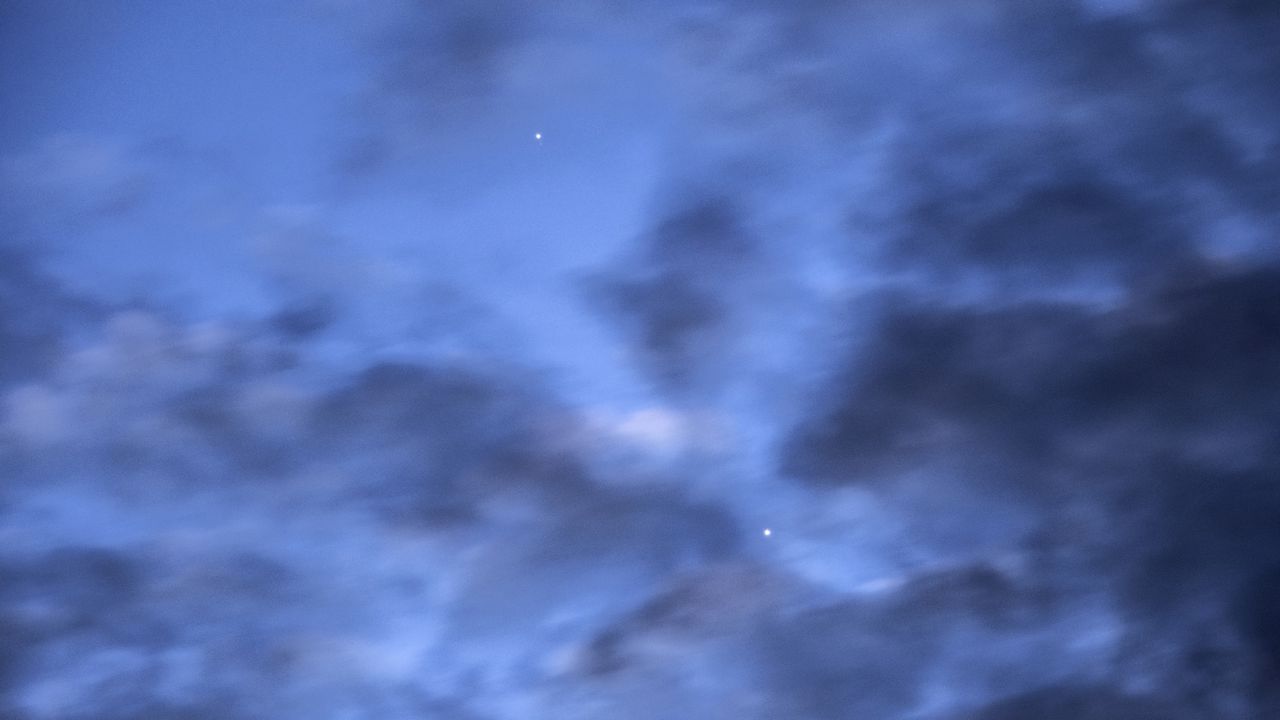
A photo of the sky at dawn with Mercury and Venus visible behind dark clouds.

Venus, Jupiter and Saturn are easy to see in the night sky, but few skywatchers have ticked Mercury off their planetary bucket list. That may change on Tuesday, Nov. 25, when early risers (or late sleepers) will get a rare chance to see the closest planet to the sun together with its bright neighbor, Venus.

Mercury is notoriously difficult to spot due to its close orbit, which often causes the small planet to be lost in the sun's glare. However, Mercury occasionally makes a brief appearance before sunrise.

A particularly good window for Mercury watching opens on Nov. 25 and continues until around Dec. 25. It begins with a close conjunction, when Mercury will appear just above the brighter Venus in the east-southeast sky. You'll need a clear view of the southeast horizon to see the duo rise together and a pair of good binoculars to see the planets clearly (though be sure to put the binoculars away before sunrise where you are). Mercury appears in binoculars as a faint, steady light.

During the conjunction, Mercury will shine at magnitude -2 and Venus will be at magnitude -3.8, making the "Swift Planet" about five times dimmer than the "Morning Star." (In astronomy, lower magnitudes indicate brighter objects.)

Mercury is visible from Earth only occasionally because of the tiny planet's short, swift orbit; it takes just 88 days to complete one lap of the sun. That's why Mercury almost always appears to be lost in the sun's glare. However, when it moves to the western side of the sun as seen from Earth, it appears in the predawn sky, rising shortly before the sun. This brief morning apparition will occur around Mercury's greatest western elongation on Dec. 7, which will be when it's farthest from the sun from Earth's point of view and thus highest in the predawn sky.

This conjunction has a bigger significance, because as Mercury rises, Venus sinks. Having been bright in evening skies in early 2025, Venus is approaching the end of its bright morning apparition. It's rising later each morning and will soon fade from view as it retreats into the sun's glare.

On Jan. 6, 2026, Venus will pass between Earth and the sun — what astronomers call superior conjunction.In the weeks after, Venus will reemerge in the evening sky and reach peak brightness on Sept. 22, 2026, according to EarthSky.

Editor's note: This story was updated on Nov. 24 to indicate the conjunction is happening overnight tonight.

Sign up to read this article
Read news from 100’s of titles, curated specifically for you.
Already a member? Sign in here
Related Stories
Top stories on inkl right now
One subscription that gives you access to news from hundreds of sites
Already a member? Sign in here
Our Picks
Fourteen days free
Download the app
One app. One membership.
100+ trusted global sources.