Get all your news in one place.
100's of premium titles.
One app.
Start reading
Space
Space
Science
Jamie Carter

How to observe the sun safely (and what to look for)

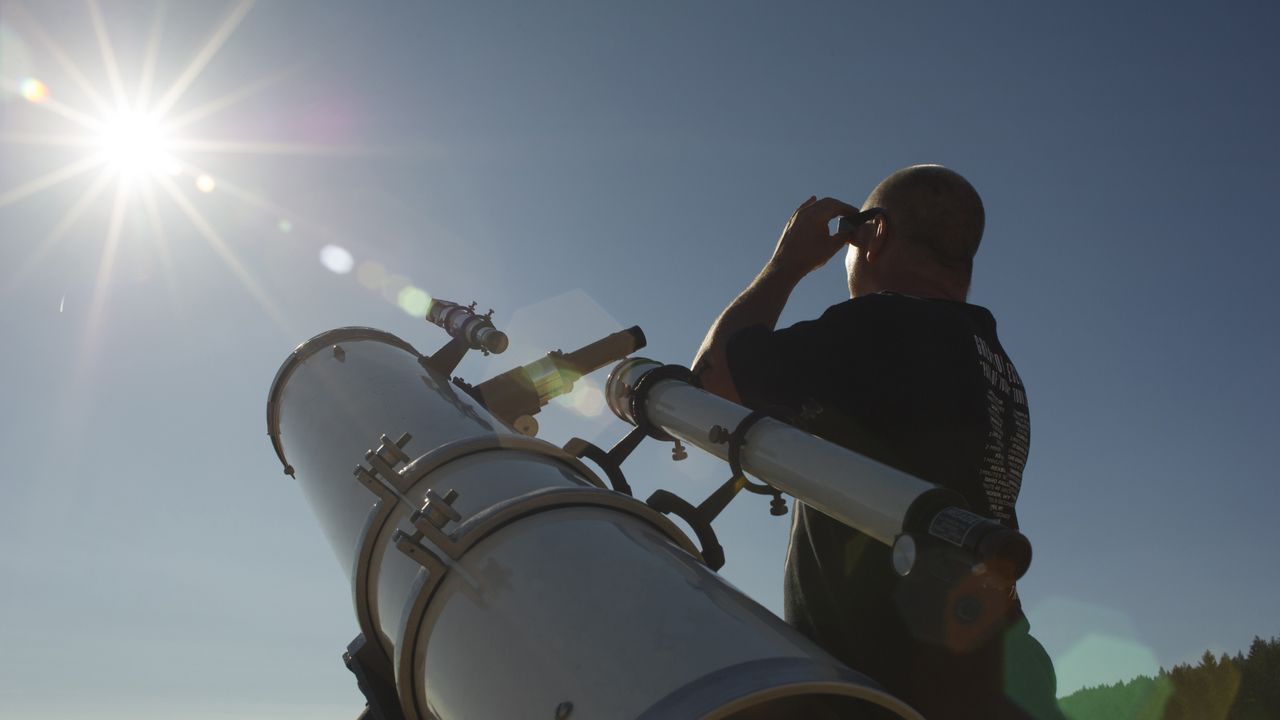
A person looking at the sun while standing next to a telescope.

You don't need to wait until nightfall to go stargazing.

Each day the sun — our yellow dwarf star– rises in the east and sets in the west, but have you ever looked at it up close? About 93 million miles from Earth, the sun is a 4.5 billion-year-old ball of hydrogen and helium that demands a closer look.

From sunspots on its ever-changing surface to incredible phenomena visible only during a total solar eclipse, the sun is a skywatching target like no other, yet solar observing demands great care.

Related: Night sky guide (what you can see and when)

Why it's important to observe the sun safely

Except during the brief total phase of a total solar eclipse, when the moon obscures the sun, never look at the sun without proper eye protection. It is never safe to look directly at the sun's rays even if the sun is partly obscured, because they contain harmful ultraviolet (UV) and infrared (IR) rays that can damage your eye's retina and even cause blindness.

Never use regular sunglasses to observe the sun. The only safe way to look directly at the sun is through specifically designed solar filters, using solar eclipse glasses for direct viewing and solar filters for telescopes and binoculars.

Solar viewing FAQs

Can I look at the sun through clouds?

No. Clouds do not make it safe to look directly at the sun. Even when the sun appears dimmed by cloud cover, harmful ultraviolet and infrared radiation can still reach your eyes and cause damage. Always use certified solar viewing glasses or approved solar filters when observing the sun.

Are sunglasses safe for looking at the sun?

No. Sunglasses, even very dark ones, do not provide enough protection for direct solar viewing. To observe the sun safely, use eclipse glasses or handheld solar viewers that meet the international ISO 12312-2 safety standard.

Can I photograph the sun with my phone?

Yes, but you should use a certified solar filter whenever your camera is pointed directly at the sun. Without proper filtration, intense sunlight can damage camera sensors and produce poor-quality images.

You can carefully hold eclipse glasses over a smartphone camera lens to capture simple solar photos.

How to observe the sun with eclipse glasses

When used correctly, solar eclipse glasses are a great way to view the sun safely. (Image credit: Daniel MacDonald / www.dmacphoto.com via Getty Images)

According to the American Astronomical Society (AAS), here's how to use solar eclipse glasses:

  • Inspect your solar filter before use. If they're scratched, discard them.
  • Always supervise children using solar filters.
  • If you wear glasses then put solar eclipse glasses over them.
  • Cover your eyes with your eclipse glasses before looking at the sun and look away from the sun before removing them.

The most common mistake people make when using solar eclipse glasses is to wear them like glasses. Despite their design, the thin cardboard arms on eclipse glasses make them prone to falling off. That can be dangerous if you're looking at the sun at the time. So the best way is to wear them like glasses but while doing so keep the temples pressed against the side of your head using both hands.

However, you should never observe the sun through a telescope or binoculars while wearing eclipse glasses. Optical equipment magnifies the sun's harmful rays unless there's a solar filter in the way at the sun-facing end of the instrument.

How to observe the sun with a telescope

The best way to get a close-up view of the sun is to use a telescope equipped with a solar filter. Never look at the sun with a telescope that doesn't have a solar filter. (Image credit: m-gucci via Getty Images)

If you want a close-up of the sun the best way is to use a telescope. However, never look through a telescope without a solar filter on the large end (the objective lens). One way is to purchase a white light solar filter, which blocks 99.999% of sunlight — including dangerous UV and IR light — and is designed to view sunspots as dark regions of the surface of the sun as well as the solar photosphere. The view is typically either bluish-white or yellow, depending on the materials used.

Another way is Hydrogen-alpha (Hα) filters, which, instead of sunspots, show prominences and other details on the sun's surface. Hα filters do that by only allowing light from hydrogen atoms. Both white light and Hα solar filters for telescopes come in all shapes and sizes to fit all kinds of telescopes. It's even possible to buy Hα telescopes with integrated filters for 100% solar viewing.

If you're looking for a telescope to view the sun, our best telescopes guide can help point you in the right direction. We also have a guide to the best budget telescopes under $500 for those wanting to invest in new equipment without breaking the bank.

How to observe the sun with binoculars

There are two ways of observing the sun when using binoculars. As with a telescope, you must put solar filters on the objective lenses on the front of binoculars (and never the eyepieces). The most common way to do this is to purchase solar filter film from reputable brands. The other way of observing the sun with binoculars is to buy some special sunoculars, which have solar filters built in. You get a magnified view of the entire solar disk, though, since the solar filters are built-in, they're safe, but lack versatility. Well-known models include Lunt SUNoculars and Celestron EclipSmart.

Our best binoculars guide will help you scope out the best astronomy binoculars available for stargazing and what you should be looking for when choosing the right pair for you.

How to buy safe solar eclipse glasses and solar filters

These manufacturers sell reliable solar eclipse glasses and solar filters that comply with the transmission requirements of the ISO 12312-2 international standard. Some also sell solar film for DIY projects, such as making custom-fit solar filters for telescopes and binoculars.

Other ways to observe the sun

Before solar eclipse glasses and solar filters were common, the safest way to observe the sun — particularly during an eclipse — was indirectly by using a pinhole camera that you can make easily at home.

For a larger projection, you can use a pair of (cheap, expendable) binoculars and a tripod to make a sun projector.

Another completely safe way to observe a partial solar eclipse safely is to look at the ground beneath trees. A partially eclipsed sun's light filtered through the leaves of a tree or other foliage projects tiny crescent suns onto the ground. For a similar effect, you can hold a kitchen colander or slotted spoon. Anything with small, well-defined holes will project crescent suns.

However, the safest way to observe the sun is online, with the Virtual Telescope Project and Time and Date frequently livestreaming solar eclipses. You can also observe (almost) real-time images of the sun from NASA's orbiting Solar Dynamic Observatory.

What to look for when observing the sun

Sunspots are cooler regions on the surface of the sun that can spawn eruptive disturbances, such as solar flares and coronal mass ejections. (Image credit: NASA/SDO)

Sunspots

The most common reason for studying the sun is to look for sunspots. Best seen through white light solar filters, sunspots are darkened patches on the sun caused by its magnetic field. Counting them is how astronomers monitor the sun's activity, which waxes and wanes across the solar cycle, which lasts roughly 11 years. They can appear quickly and evolve over a few hours or many days. Sunspots can be seen at any time of day and are also worth looking for during a partial solar eclipse.

Photosphere, chromosphere and solar prominences

The lowest layer of the sun's atmosphere, the photosphere is the innermost that can be observed outside of a total solar eclipse. Best seen through Hα solar filters as a red halo, it's where most of the sun's energy is emitted, including solar flares.

Also visible through Hα solar filters is the chromosphere, the region of the sun's atmosphere between the photosphere and corona. It's from here that you may see spot solar prominences (also called filaments), plasma and magnetic field structure that is visible as red arcs.

Transits of planets and satellites

ISS transit captured by astrophotographer Miguel Claro on June 14, 2017. (Image credit: Miguel Claro)

The inner planets Venus and Mercury occasionally cross the sun as viewed from Earth. When that happens, it's possible to observe a black dot appearing to cross the sun's disk. A good view demands a telescope with a solar filter, though it's a rare event to witness. Transits of Venus occur twice every seven years, but with a gap of 105 years until the next pair. They will occur in December 2117 and 2125.

Transits of Mercury are more common with the next one on November 12/13, 2032 then November 7, 2039. The most recent transit of Mercury was on November 11, 2019.

Your best chance of catching a transit is actually by watching the International Space Station (ISS) cross its disk. It can be calculated in advance using the ISS Transit Finder, but since it lasts less than a second, you do need to have a camera using solar filters, ideally mounted on a star-tracker.

Related: How to see and track the International Space Station (ISS)

What to look for when observing the sun during a total solar eclipse

When light begins to pass through the mountains of the moon, "beads" of light form on the edge of the moon's shadow, this is known as "Bailey's beads". (Image credit: Michael Allen Siebold via Getty Images)

The golden rule for all solar observing is to never look at the sun without proper eye protection except during the total phase of a total solar eclipse. Though care is required, during these rare and spectacular events is the only time you can see — with the naked eye — these phenomena. However, do remember that they are only visible during the brief minutes of totality, and not at all visible during partial or annular solar eclipses, for which you must wear solar eclipse glasses and use solar filters on optical equipment.

Related: Solar eclipses: When, where & how to see them

Solar corona

The naked eye target everyone is waiting for during a total solar eclipse is the solar corona, the sun's hotter, outer atmosphere. Only visible during the brief minutes of totality during a total solar eclipse, it's an incredible sight, appearing as a tenuous, wispy, spiky, flower-like halo of white diffuse light around the moon. Incredibly, the corona is much hotter than the surface of the sun.

Eclipse-chaser Bill Kramer took this amazing photo of the sun's corona during totality of the total solar eclipse on July 11, 2010 from the deck of the cruise ship Paul Gaugin, which was sailing near Tahiti at the time (Image credit: Bill Kramer)

Baily's beads and the 'diamond ring'

As the first beads of sunlight glisten through the valleys of the moon, totality ceases. They coalesce into a fabulous 'diamond ring' as a burst of light appears. It's time to look away from the eclipsed sun and put your solar eclipse glasses back on. A few minutes earlier, before totality, a 'diamond ring' reduces down to Baily's beads, though since that happens at the moment a partial solar eclipse (which requires solar eclipse glasses) ends it's easy to miss.

Chromosphere and solar prominences

Visible during the first and last few moments of totality on opposite sides of the moon, the chromosphere looks a deep pink to the naked eye. It's worth studying through binoculars (with solar filters briefly removed during totality), not least because you may well spot solar prominences (also called filaments) visible to the naked eye as deep pinky-red arcs.

Solar prominence captured by astrophotographer Mark Johnston. (Image credit: Mark Johnston)

Additional resources

Want to look further ahead? You can find a concise summary of solar eclipses through 2030 on NASA's eclipse website or find the next eclipse for any location on Time and Date.

Bibliography

The Ultimate Guide to Observing the Sun. Celestron. Retrieved October 20, 2022, from https://www.celestron.com/blogs/knowledgebase/the-ultimate-guide-to-observing-the-sun

How to View a Solar Eclipse Safely. American Astronomical Society. Retrieved October 20, 2022, from https://eclipse.aas.org/eye-safety

What to look for & when during a total solar eclipse. Sky & Telescope. Retrieved October 20, 2022, from https://skyandtelescope.org/2017-total-solar-eclipse/what-to-look-for-when-total-solar-eclipse/

Reputable Vendors of Solar Filters & Viewers. American Astronomical Society. Retrieved October 20, 2022, from https://eclipse.aas.org/resources/solar-filters

How to View the 2017 Solar Eclipse Safely. NASA. Retrieved October 20, 2022, from https://eclipse2017.nasa.gov/safety

Sign up to read this article
Read news from 100's of titles, curated specifically for you.
Already a member? Sign in here
Related Stories
Top stories on inkl right now
One subscription that gives you access to news from hundreds of sites
Already a member? Sign in here
Our Picks
Fourteen days free
Download the app
One app. One membership.
100+ trusted global sources.