Get all your news in one place.
100’s of premium titles.
One app.
Start reading
The Independent UK
The Independent UK
Lifestyle
Hannah Twiggs

How the UK forgot to teach its children to cook – and has lost out because of it

Cookery lessons in schools have declined, leaving many young people without basic skills - (Getty/iStock)

Years ago, during Ainsley Harriott’s Ready Steady Cook heyday, a viewer wrote in about a jacket potato he’d made on the show – topped with a little leek and cream cheese. The man explained he didn’t normally cook but had tried the recipe and loved it.

Twenty years later, Harriott ran into him again. “He said, ‘I wrote to you,’ and I said, ‘Yes! I remember!’” Harriott recalls. “Now he’s a chef. I thought, bloody hell…”

For Harriott, it was a reminder of how small moments in the kitchen can spark something bigger. And it’s exactly the kind of spark he hopes to ignite again through a new initiative aimed at young cooks.

New research suggests that more than half of young people are not confident cooking a meal for themselves or others. According to the survey, many say they cannot prepare everyday dishes such as soup or curry, while many struggle to identify appropriate portion sizes.

In response, and with Harriott’s support, the Scouts have relaunched their chef’s badge for 10-14-year-olds to be more relevant to young people today, including a new focus on reducing food waste, food storage and meal planning.

The scheme arrives at a time when confidence in the kitchen appears to be fading.

“There are loads of kids out there – one in two! – who are a bit embarrassed, a bit frightened. They find it difficult to cook for others,” says Harriott. But cooking, he argues, is about far more than simply feeding yourself. “It’s a social skill that just brings people together.”

He’s seen that play out in his own family. “My daughter left home about a year ago, but she’s perfectly independent, perfectly able to get in the kitchen,” he says. “The biggest thrill I get is when she says, ‘I’ve got a couple of girls coming around tonight because I’m cooking them a meal.’”

But cooking’s importance extends beyond the social side of food. Experts say the ability to prepare meals from scratch also plays a key role in long-term health and diet quality.

“Basic cooking skills are fundamental for being able to follow a healthy dietary pattern as they allow you to incorporate plenty of vegetables, wholegrains, pulses and lean protein foods into a balanced diet that supports long-term health,” says Bridget Benelam, nutrition scientist at the British Nutrition Foundation.

Harriott showing Scouts how simple cooking skills can build confidence in the kitchen (Marty Milner Photography)

Cooking skills also matter when money is tight. “It’s also important for being able to eat healthily on a budget as basic cooking skills mean that you can prepare inexpensive meals with healthy ingredients,” she adds.

Yet despite near universal agreement about its importance, many young people are growing up without the skills previous generations learned almost by default.

Part of the explanation lies in a broader cultural shift.

For generations, cooking was simply woven into daily life. Children watched parents and grandparents prepare meals, absorbing the rhythms of chopping, seasoning and simmering almost by osmosis. Today, those informal lessons in the UK are far less common.

Charlotte Stirling-Reed, a baby and child nutritionist, says cooking skills are still vital – but they begin with something even more fundamental: a child’s relationship with food.

Before a child will ever want to cook, they first have to learn a love for food

Charlotte Stirling-Reed, baby and child nutritionist

“Cooking skills are absolutely essential, but in my experience, before a child will ever want to cook, they first have to learn a love for food,” she says. “If a child hasn’t developed a real enjoyment of eating, such as a curiosity about flavours, a willingness to try things, a sense that food is something exciting rather than something to be endured – then teaching them to chop an onion may be rather missing the point.”

That relationship with food used to form naturally in households where cooking was routine. But that environment has changed in many British households.

“Kids naturally picked things up by watching parents or grandparents cook… that’s how most skills are learned, through seeing them happen again and again.”

Harriott remembers a similar upbringing.

“I was fortunate growing up to be able to get home, my mum was there, there was a meal, there was something being cooked,” he says. “We don’t have that perfect situation any more.”

A combination of longer working hours, busy family schedules, for mums and dads, and the convenience of ready meals and takeaway apps, has reshaped how many households eat.

None of this is inherently negative – convenience has its place – but it can mean fewer opportunities for children to see cooking in action.

At the same time, Stirling-Reed says, many parents feel unsure about cooking themselves. “Many parents feel anxious or unsure about cooking themselves – and that lack of confidence is also so easily passed down.

“Even very small moments such as laughing over a mealtime, stirring ingredients, washing vegetables or laying the table can build familiarity and confidence around food and eating.”

Simple meals can provide valuable opportunities for children to develop basic skills.

Many children learn cooking skills first by watching and helping parents at home (Getty/iStock)

“It’s not about teaching them to be a perfect cook,” Stirling-Reed adds. “It’s about creating an environment where a wide variety of food is normal, and where cooking is a part of eating.”

Harriott says even learning a few simple dishes can make a difference. “I think everyone should learn how to make a pasta dish,” he says. “I love the idea of kids doing a pork or chicken stir fry… it’s very, very basic, but it’s full of nutrition.”

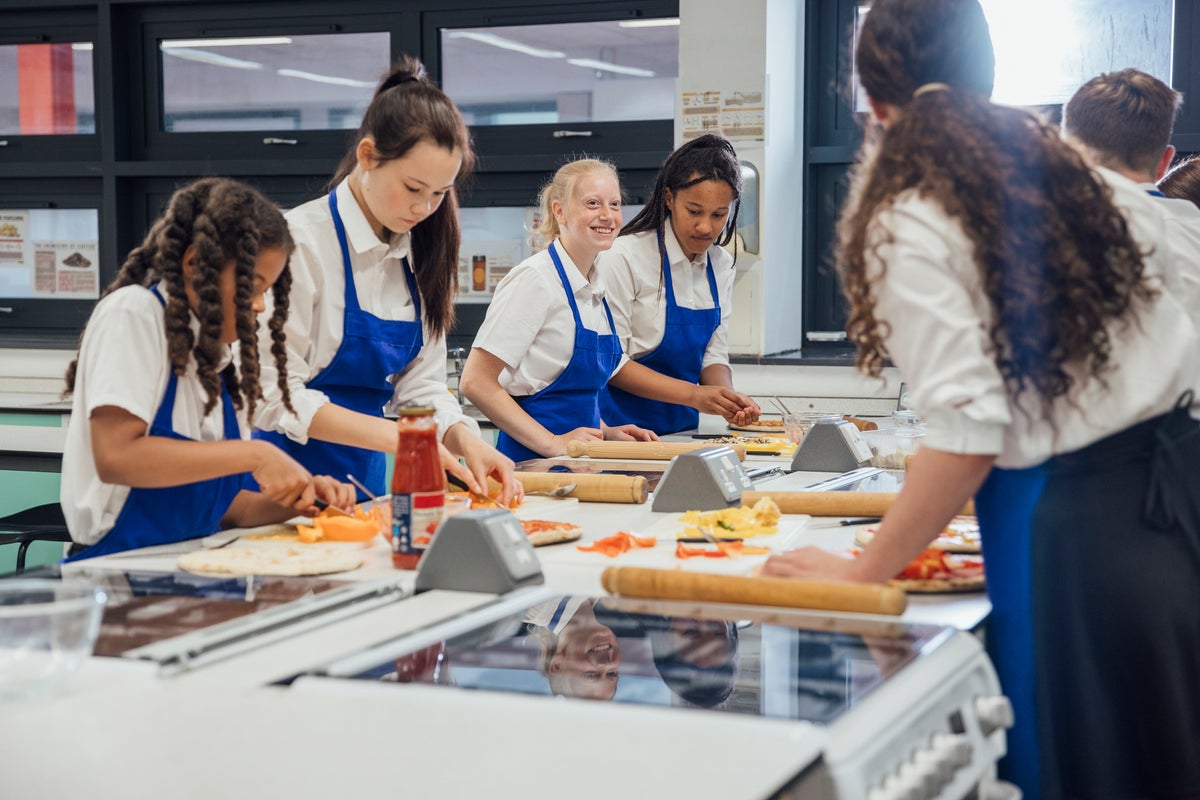
If cooking skills are no longer routinely learned at home, the obvious place to teach them might be school. But here, too, provision is uneven. “Food education in England is patchy and highly variable,” says Caroline Harrison, director of the Food Education Network.

In primary schools, opportunities can be especially limited. Reporting cited by the network suggests that around 75 per cent of primary schools do not offer regular cookery lessons. By secondary school, only 48 per cent of young people aged 11 to 18 say they receive any dedicated class time for food education.

55%

of young people are too afraid to cook

The disparities run deeper than age. Children from households earning under £45,000 are less likely to receive food education than those from higher-income homes. Geography also plays a role: around 58 per cent of young people in London receive dedicated food education, compared with 40 per cent in Yorkshire and the Humber.

Schools often face practical barriers too. “Limited facilities, equipment and ingredients, as well as a shortage of trained food education teachers, particularly at secondary level,” Harrison explains, can make practical cookery lessons difficult to deliver.

The result is that many pupils leave school without the practical skills once taught in traditional home economics classes.

Harriott believes those skills deserve a place in the classroom. “When you think about the skill that cooking gives you in life, it’s something that should be there,” he says. “Just to be able to pass on a little bit of cooking now, early in life, to those young kids… that spongy age, where the brain is still soaking up loads of information.”

Cooking confidence can also influence what people eat for years to come.

“There are studies that show that cooking skills in young people translate into healthier habits and eating patterns later in life,” says Benelam. One study, she notes, found that better cooking skills between the ages of 18 and 23 were associated with improved diet outcomes a decade later, including higher vegetable consumption and less reliance on fast food.

Too many cooks: Brooklyn Beckham enlisted brother Cruz as sous chef to impress Gordon Ramsay with beef wellington. (Brooklyn Beckham)

The link between cooking and diet quality is particularly relevant at a time when ultra-processed foods make up a significant portion of the UK diet. While convenience foods can certainly form part of a balanced diet, experts say the ability to prepare meals from basic ingredients provides more flexibility and control over what goes onto the plate.

Cooking from scratch can also make it easier to incorporate ingredients such as vegetables, pulses and whole grains – foods widely recommended in dietary guidelines.

Against this backdrop, initiatives like the Scouts’ updated chef’s badge, designed to rebuild cooking confidence, are gaining attention.

For Stirling-Reed, the wider question is why such initiatives are necessary in the first place. She agrees with Harriott that the gap visible in today’s teenagers did not appear overnight. “My generation grew up right as cooking lessons were being stripped out of schools, and I genuinely think that’s had a huge impact on the skills we’re seeing now.”

In other words, it may not be today’s young people who forgot how to cook, but the systems around them – schools that deprioritised practical food education, households stretched for time, and a culture increasingly built around convenience.

In a moment when conversations about food increasingly revolve around ultra-processed diets and healthy longevity, the solution may start with something simpler: knowing how to cook dinner.

And if Harriott’s jacket-potato story is anything to go by, sometimes all it takes is one small spark.

Sign up to read this article
Read news from 100’s of titles, curated specifically for you.
Already a member? Sign in here
Related Stories
Top stories on inkl right now
One subscription that gives you access to news from hundreds of sites
Already a member? Sign in here
Our Picks
Fourteen days free
Download the app
One app. One membership.
100+ trusted global sources.