Get all your news in one place.
100's of premium titles.
One app.
Start reading
The Times of India
The Times of India
World
TOI World Desk

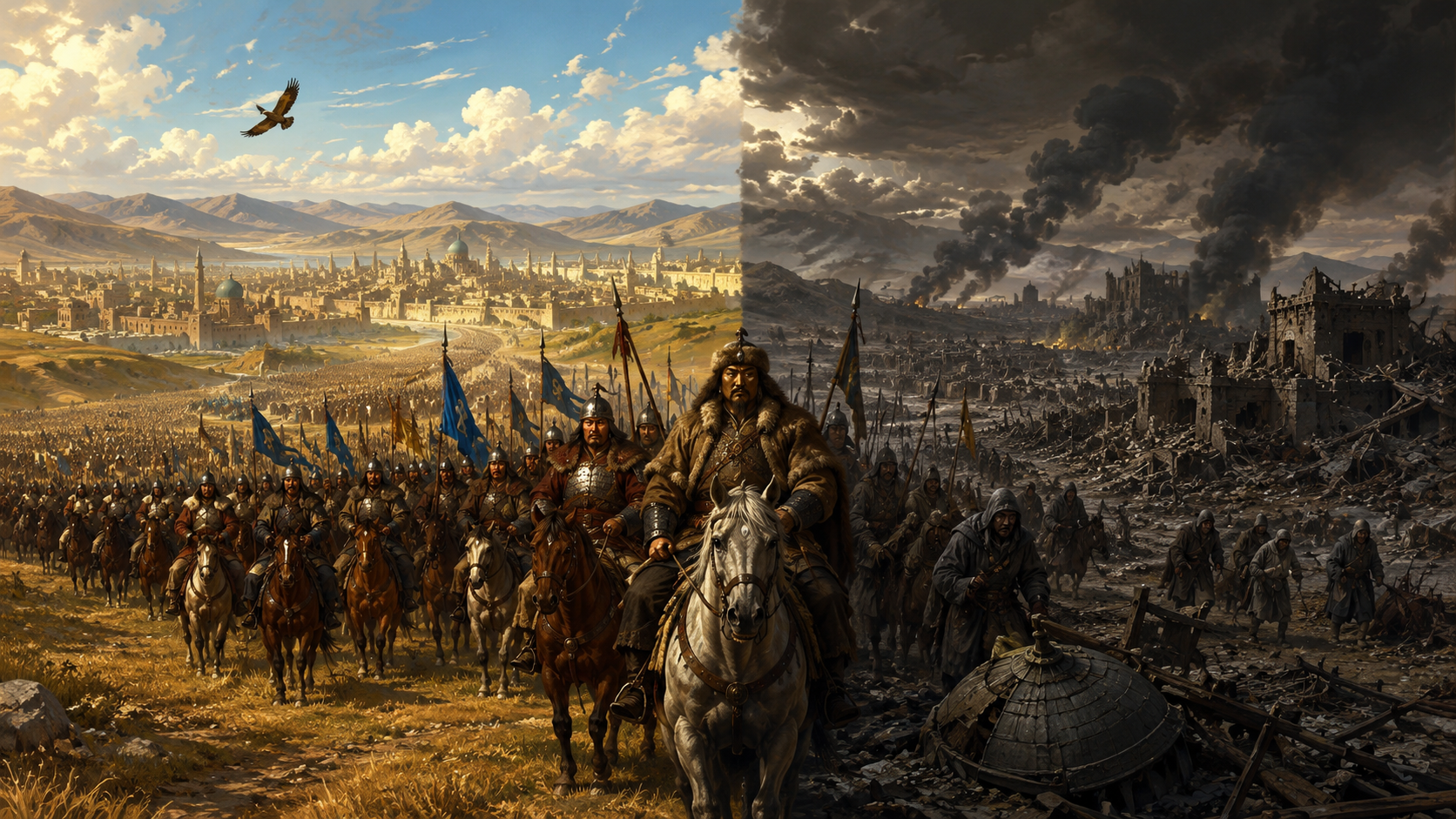
How the Mongol Empire became the largest land empire in history and why it eventually collapsed

The Mongol Empire covered a continuous stretch of land unlike anything that had existed before. From the Pacific coastline to the plains of Eastern Europe, a single ruling dynasty controlled an immense territory that linked peoples speaking different languages, following different religions and living under very different traditions. Such a vast empire could never be governed by conquest alone. Roads, couriers, administrators and local officials all became part of a system that allowed orders to travel across extraordinary distances. Trade flourished along routes that had once been uncertain, while merchants, craftsmen and scholars moved between regions more freely than they had for generations.

Get breaking news anytime, anywhere. Download the TOI app now!

Yet the same size that made the empire remarkable also created lasting problems. As power spread across thousands of miles, rival branches of the ruling family increasingly acted in their own interests. Within little more than a century, the political unity that had transformed Eurasia gradually dissolved into separate kingdoms that no longer answered to a single ruler.

How the Mongol Empire became the largest land empire in history

The rise of the Mongol Empire began on the open grasslands of what is now Mongolia, where Genghis Khan united tribes that had spent generations competing with one another. Once that internal struggle ended, expansion followed at remarkable speed. Campaigns carried Mongol armies across deserts, mountain ranges and fertile river valleys, bringing territories in northern China, Central Asia, Persia and parts of Eastern Europe under their control within only a few decades.

By the closing years of the 13th century, the empire covered roughly nine million square miles, making it the largest continuous land empire in recorded history. Modern national borders divide this area among almost 30 countries, yet for a period those distant regions formed part of a single political system. Maintaining authority across such distances demanded more than military strength. Governors managed local administration, taxation supported the state, and a network of communication routes allowed instructions to reach provincial centres far from the imperial court.

What Marco Polo witnessed across the Mongol Empire

Few European travellers left such a detailed description of the Mongol world as Marco Polo. After departing Venice in 1271, he travelled east and eventually entered the service of Kublai Khan, remaining within his court for many years. His later account introduced readers across Europe to places and customs that had previously been little known outside Asia.

Among the places that impressed him most was Khanbaliq, the imperial capital that later became part of present-day Beijing. He described grand halls, richly decorated buildings and an imperial residence on a scale unlike anything he had encountered in Europe. Yet it was not only architecture that caught his attention. Polo also recorded the efficient courier network that allowed official messages to travel rapidly across enormous distances, together with the widespread use of paper money issued by the government. These observations revealed an administration capable of managing an empire that stretched across much of Eurasia.

The policies that helped the empire endure

Victory brought about the creation of the empire, but its existence would rely on an overall structure of governance. The way Genghis Khan transformed the conventional conception of leaders was that he appointed those who proved themselves competent irrespective of their lineage. Loyalty, discipline, and competence mattered more than nobility for these people to be promoted to positions of power.

The Mongols also administered the lives of various religious groups. In the place of forcing their religion upon all conquered peoples, they simply allowed these religions to exist as long as the subjects recognized their rule and paid their taxes.

Movement across the empire also became far easier than it had been before. Skilled craftsmen, engineers, physicians and administrators were relocated where their knowledge was needed, while commercial routes connected eastern and western Eurasia more closely than at almost any earlier point in history. Technologies such as gunpowder, papermaking techniques and military innovations spread between regions through these growing exchanges, leaving a lasting influence long after Mongol political rule had ended.

Growing divisions beneath a powerful empire

The foundations of unity began to weaken after Genghis Khan died in 1227. His descendants inherited different parts of the empire, and although they remained connected by family ties, disagreements over succession repeatedly disrupted relations between competing branches of the dynasty.

By the time Kublai Khan secured victory over his brother Ariq Böke during the 1260s, the empire had already started separating into regional centres of power. The Yuan dynasty governed China and Mongolia, while the Golden Horde controlled much of Eastern Europe. Further west, the Ilkhanate ruled Persia, and the Chagatai Khanate dominated large parts of Central Asia. Although these states shared common origins, each increasingly followed its own political priorities, reducing cooperation between them.

Why the empire eventually disappeared

The end of the Mongol Empire unfolded gradually rather than through a single decisive collapse. Each khanate faced its own difficulties, shaped by local politics, economic pressures and disputes over leadership. In Persia, the Ilkhanate fragmented during the 1330s after succession crises and the wider disruption caused by the Black Death.

China followed a different path. Growing unrest weakened the Yuan dynasty until it was replaced by the Ming dynasty in 1368, an event commonly regarded as marking the end of the unified Mongol Empire. Some successor states remained influential for many decades afterwards, particularly the Golden Horde and the Chagatai Khanate, but they no longer formed parts of a single political structure. The vast empire that had once linked much of Eurasia survived only through the legacy it left behind in trade, administration and the exchange of ideas across continents.

Sign up to read this article
Read news from 100's of titles, curated specifically for you.
Already a member? Sign in here
Related Stories
Top stories on inkl right now
One subscription that gives you access to news from hundreds of sites
Already a member? Sign in here
Our Picks
Fourteen days free
Download the app
One app. One membership.
100+ trusted global sources.