Get all your news in one place.
100's of premium titles.
One app.
Start reading
Creative Bloq
Creative Bloq
Technology
Joe Foley

How The Dinosaurs' VFX helped audiences travel across vast spans of time

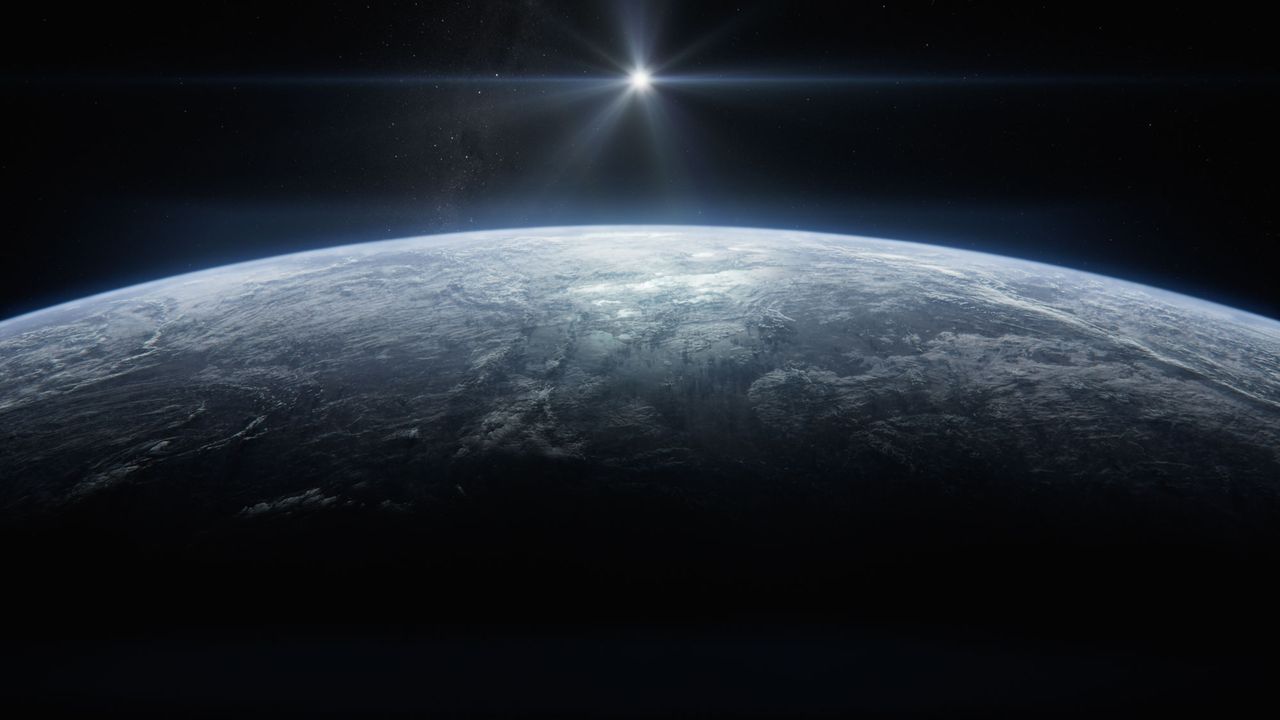
Cinematic image of a planet .

For natural history filmmakers, conveying millions of years of planetary change without losing audience comprehension remains one of the genre’s biggest storytelling challenges. Continents drift apart, climates transform, and ecosystems rise and collapse over immense stretches of time. Helping viewers remain oriented within that scale of change requires more than scientific accuracy. It requires a cinematic language capable of guiding audiences through deep time.

Netflix’s four-part documentary series The Dinosaurs, produced by Silverback Films in association with Amblin Entertainment and narrated by Morgan Freeman, embraces that challenge directly. The series transports viewers across dramatically different eras and landscapes, from dense forests to volcanic terrain to newly forming coastlines.

To structure those shifts, VFX studio Lux Aeterna developed sweeping transitions that treat the Earth as part of the storytelling, providing connective tissue between the series’ different prehistoric periods.

Making geological time readable

“The big narrative challenge was comprehension,” says showrunner Dan Tapster of Silverback Films. “We were asking audiences to travel across vast spans of time, through completely different worlds, and still feel oriented. It wasn’t enough to simply say we’d moved from the Triassic to the Cretaceous – we wanted viewers to understand what had changed and why it mattered.”

The solution was to treat time not as something explained through narration, but as something audiences could experience visually. Large-scale transitions reveal continents drifting apart, coastlines shifting, and climates evolving before the narrative returns to the dinosaurs inhabiting those worlds.

The sequences went beyond decorative interstitials; they became narrative engines, orienting the audience before each return to creature-level storytelling. “Lux Aeterna not only created beautiful planetary visuals,” says Dan. “They delivered a clear visual language for moving through deep time, and that became part of the show’s identity.”

Designing a cinematic language for the planet

(Image credit: Lux Aeterna)

Many of the sequences begin from a global perspective before descending toward Earth's surface. Environments transform as vegetation appears or disappears, volcanic activity reshapes terrain, and atmospheric conditions shift.

Above the planet, accelerated skies and evolving cloud systems reinforce the sense that time is passing on a geological scale. Together, these visual cues create a repeatable grammar for navigating the prehistoric world. Each transition prepares the audience for the era they are about to enter, allowing the story to move fluidly between extensive periods.

The effect is subtle but essential: viewers remain oriented even as the series spans immense stretches of history.

A camera language for deep time

Part of what makes the sequences feel cinematic is the way the camera moves through them. Rather than presenting a static map, the shots often behave like large-scale establishing shots from a feature film.

The camera begins in orbit, revealing the shape of continents and oceans before diving toward the surface. As the shot descends, environments transform beneath it: forests appear, volcanic terrain fractures open, and coastlines gradually reshape themselves.

“Over half of the 62 shots we produced were dealing with the time travel element,” says Paul Greer, senior CGI artist at Lux Aeterna. “We were taking the narrative from one geological era to another, and that meant inventing creative solutions such as spinning time-lapse star fields, landscapes that morph and change as we go back in time, and Low Earth Orbit satellite-style shots that show continents physically moving as the camera dives millions of years into the past.”

The result is a visual experience closer to cinematic world-building than traditional documentary illustration.

Transitions that guide the story

The sequences also serve a practical storytelling function within the series' structure. Instead of abruptly cutting between periods, the camera often travels across the planet before descending into the next environment.

These transitions give the audience a moment to recalibrate before the story settles into the next ecosystem and its inhabitants. What might otherwise be simple scene changes instead become narrative bridges across deep time.

Bridging documentary and cinematic storytelling

With executive production from Steven Spielberg and Amblin Entertainment, The Dinosaurs was conceived with production values more commonly associated with scripted features.

For Dan, achieving that scale required close collaboration between filmmakers and visual effects artists from the earliest stages of production.

“Lux Aeterna felt like the perfect partner because they could take an information-led brief and turn it into storytelling,” he says. “They understood the ambition for the series to feel cinematic, and they had the taste and craft to create shots that were genuinely exciting to watch.”

The planetary sequences were designed to transition seamlessly into the creature animation created by Industrial Light & Magic. Maintaining that continuity was essential for preserving the illusion of a single cinematic world. “So you could move from a Lux sequence into an ILM sequence and feel like you’re still in the same film,” says Dan.

“We took great care to use very high-resolution data to provide as realistic a view of the Earth as possible,” says Paul. “The cinematic nature of the shots brings the audience closer to the science and narrative.”

Expanding the visual language of natural history

In The Dinosaurs, transitions often operate quietly beneath the surface of the narrative. Yet they provide the structural framework that allows the series to move confidently across millions of years of planetary history.

Continents fracture, climates shift, and ecosystems emerge and collapse – and through those transformations, the audience remains oriented.

By turning geological change into cinematic storytelling, the series pushes natural history filmmaking toward a visual language more often associated with feature cinema.

Creative Bloq is now easier to access than ever before with our on-the-go app, which brings you all the content you know and love from our website, but in a super-streamlined design.

Sign up to read this article
Read news from 100's of titles, curated specifically for you.
Already a member? Sign in here
Related Stories
Top stories on inkl right now
One subscription that gives you access to news from hundreds of sites
Already a member? Sign in here
Our Picks
Fourteen days free
Download the app
One app. One membership.
100+ trusted global sources.