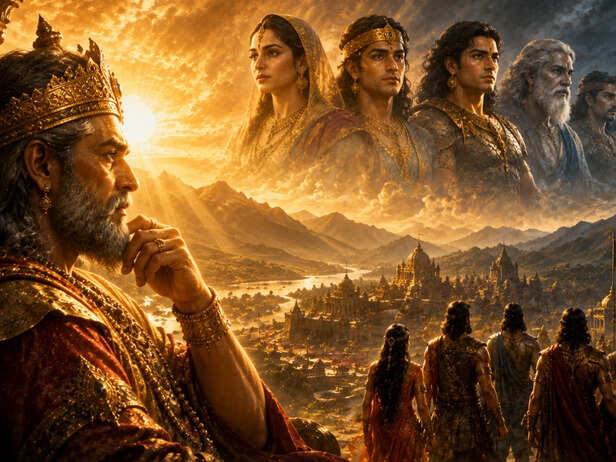
What if one man’s uncontrolled desire could change the destiny of generations?
The story of King Yayati is not simply about a king, a curse, or a family dispute. It is a story about desire, betrayal, sacrifice and destiny. One decision brought a terrible curse upon Yayati. Then came an even bigger surprise: when the aging king asked his sons to give him their youth, only one son was willing to sacrifice everything for him.

That son was Puru.
His sacrifice changed the future of his family and became deeply connected with the royal lineages remembered in Indian Itihasa.
A Marriage Filled With Tension
After her difficult past, Devyani eventually married King Yayati. But her new life was far from simple. Sharmishtha, who was a princess, also became part of Yayati’s household in the traditional story. What began as a royal marriage soon became complicated by emotions, promises and hidden relationships. Yayati was powerful and surrounded by luxury, but his greatest challenge was not outside his kingdom. It was within himself. His attachment to Sharmishtha eventually damaged his relationship with Devyani and brought the anger of her father, Shukracharya. One emotional decision was about to change everything.
Shukra’s Curse Struck Suddenly
When Shukracharya learned what had happened, he became furious and cursed Yayati with old age. The punishment was devastating. Yayati was still filled with youthful desires, but his body suddenly became weak and aged. Imagine having the heart and wishes of a young man while living inside an old body. That was Yayati’s suffering. Yet Shukracharya later gave him one possible solution. Yayati could exchange his old age with the youth of one of his sons. Suddenly, the king faced a new question. Would any son willingly give away the most precious thing he had—his youth?
None of His Sons Said Yes
Yayati went to his sons one by one and asked them to accept his old age. The request was enormous. Youth means strength, freedom and the chance to enjoy life. Giving it away meant accepting weakness before one’s time. His sons refused. They could understand their father’s suffering, but they were not ready to surrender their own youth. Then came the youngest son, Puru, born to Yayati and Sharmishtha. Unlike his brothers, Puru agreed to help his father. His decision was not easy. He willingly accepted old age so that Yayati could regain his youth.
Puru Made the Greatest Sacrifice
Puru’s decision changed everything. He did not ask what he would receive in return. He simply accepted the burden his father had placed before him. Yayati regained his youth, while Puru became old. This moment became one of the most memorable parts of the story because it raises a difficult question: How much should a child sacrifice for a parent? Puru’s act showed loyalty, but it also came with a major consequence. Yayati eventually recognised the depth of his son’s sacrifice. Because of Puru’s devotion, he chose him as his successor, changing the future of the royal family.
Desire Finally Taught Yayati
Yayati eventually learned the lesson hidden inside his curse. Even after receiving youth again, he discovered that desire does not simply disappear when we satisfy it. The more the mind chases pleasure, the more it may want. This became the deeper meaning of the story. Desire without control can become a trap. Yayati had wealth, power, youth and pleasure, yet none of these could give him permanent satisfaction. His experience teaches a simple lesson that still feels relevant today: having more does not always mean wanting less. Sometimes, the real victory is learning when enough is enough.
Two Great Lines Came From Yayati
Yayati’s family later became connected with two major branches. Puru became the ancestor of the Puru lineage, which later included the Kuru dynasty associated with the Kauravas and Pandavas. Another son, Yadu, became the ancestor of the Yadu dynasty, or Yaduvansh. These two branches became important in the traditions surrounding Indian Itihasa. The Yadu lineage is especially significant because Lord Krishna, regarded in Vaishnava tradition as an avatar of Lord Vishnu, was born in the Yadu line. This makes Yayati’s family story remarkably important in the larger genealogical traditions of ancient India.
The Real Battle Was Inside
The deepest lesson of Yayati’s story is not about kingdoms or royal bloodlines. It is about desire and self-control. Shukracharya’s role in the story makes this lesson even more meaningful because Shukra is traditionally associated with beauty, pleasure, attraction, wealth and worldly enjoyment. But these qualities can become tests when they are not balanced by wisdom. Yayati had everything he wanted, yet his desires continued. His curse forced him to face what he could not see before. The story asks us a powerful question: Are we controlling our desires, or are our desires quietly controlling us?
Unlock insightful tips and inspiration on personal growth, productivity, and well-being. Stay motivated and updated with the latest at My Life XP.