Get all your news in one place.
100's of premium titles.
One app.
Start reading
The Conversation
The Conversation
Vera Moerbeek, Doctorante en physique, Centre national de la recherche scientifique (CNRS); Université de Perpignan Via Domitia

How next-generation photovoltaics could contribute to electricity storage

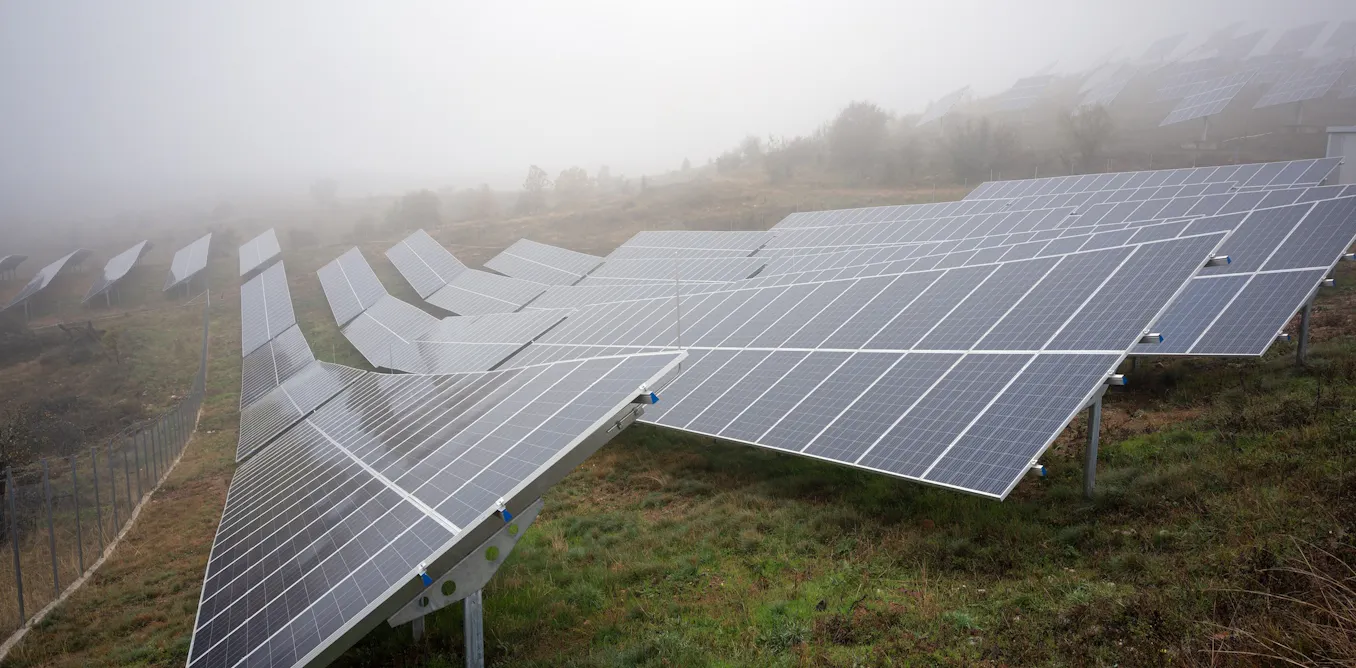
Due to the falling price of silicon solar cells, as well as their manageable size, the sight of solar panels on household rooftops has become a familiar one. However, solar energy, as many other sustainable forms of energy, is intermittent. At peak moments, such as on sunny summer days, the grid is flooded with solar energy, while during the evening and in winter, when energy tends to be most in demand, supply is less. In order to secure energy availability on demand, storage needs to be integrated into the grid.

The pumped hydroelectric storage plant is one example of widespread technology for storing energy by pumping water from a lower reservoir to a higher one, and electricity is generated on demand by letting the water flow back through turbines. The expansion of these plants, however, is limited by the amount of suitable geographical sites. A technology that does not bear these constraints is the electrochemical battery. Lithium-ion batteries present in everyday electronics are examples of these. On a larger scale, companies are starting to invest in large batteries supporting the grid. The dominant technology for such large batteries is currently lithium iron phosphate (LFP). A report by the International Energy Agency (IEA) predicts lithium demand to multiply by more than 40 times in 2040 compared to 2020, largely caused by this need. Lithium mining, however, comes with considerable geopolitical and humanitarian concerns. If lithium mining has a significantly negative impact on local health, water supply, biodiversity and soil, can we maintain that it’s helping us to move towards a sustainable future?

Thermal storage as an alternative for electrochemical batteries

Another alternative is thermal energy storage, in which energy is stored in the form of heat.

Due to the high energy density, abundance and low cost of storage materials, thermal storage seems very promising for longer duration storage. This is the principle behind solar water heaters. On a bigger scale, it is mainly used in combination with concentrated solar power plants (CSP), such as the Crescent Dunes Solar Energy Project in the USA or Andasol Solar Power Station in Spain, for example. In these installations, the first step is to convert solar energy to heat using large mirrors, either parabolic or smaller flat ones tracking the Sun, which concentrate sunlight and heat a large reservoir of molten salt. The second step consists of converting heat into electricity: the heat stored in the salt powers a turbine.

Thermal storage implemented in this way has remained marginal, because the turbines used in CSP become more efficient as they become larger, meaning that the concept is generally not cost-effective at lower scales and therefore requires very large plants, involving big startup investment and maintenance costs. Even though smaller CSP plants with integrated thermal storage exist, such as the linear Fresnel plant at Llo in southern France, they remain even more uncommon.

The efficiency of thermal storage poses a challenge, since heat is notoriously difficult to convert to “useful” energy, including electricity: the efficiency of this process is fundamentally limited by what is known as Carnot’s law. For example, at 300°C, the theoretical maximum conversion efficiency is about 50%, meaning the actual efficiency is going to be even lower. In comparison, lithium-ion batteries, which are not limited by the same physical law and have been optimised for decades, surpass 90%.

While the efficiency of heat to electricity conversion would be improved at higher temperatures, turbines hardly withstand such elevated temperatures.

Using photovoltaics for conversion of heat radiation to electricity

However, there is another way to turn heat into electricity, namely via radiation: this is the principle behind the solar cells you see on rooftops and solar farms. Typical solar cells convert energy from the Sun. In contrast, the idea behind so-called thermophotovoltaic devices (TPV for short) is to harvest the (mostly infrared) radiation from a very hot object, where energy is stored, and turn it into electricity. For example, silicon melts at 1414°C and graphite can be heated up to more than 2000°C. At these high temperatures, the Carnot limit is pushed up to 83% and 87% respectively. In practice, experiments at MIT and the University of Michigan have now pushed conversion efficiency to beyond 40%.

Different device designs

The most recently developed device, which is now being introduced on the market, feature a storage medium in the form of a block of graphite or silicon, for example, heated by electricity. It is therefore similar to a lithium-ion battery but it operates by doing successive energy conversions from “electricity to heat to electricity” instead of from “electricity to chemical energy to electricity”.

However, it would be interesting to heat up our storage medium directly by the Sun, so that the device becomes a direct source of renewable energy.

In our setup at PROMES laboratory, conveniently located in the sunny south of France, the storage medium (graphite during our first tests) was heated with concentrated radiation from the Sun, using a parabolic mirror and a tracking mirror, and can be dubbed “solar to heat to electricity” or storage-integrated solar TPV (SISTPV). It’s the first prototype of a SISTPV system. An important advantage compared to CSP with molten salt storage is that the TPV battery could be cost-effective at a much smaller scale.

Although substantial work remains to improve both the efficiency of TPV cells in themselves and thermal batteries’ overall efficiency, SISTPV offers a promising avenue for supporting the transition to renewable energy. By combining energy collection, storage and electricity generation in a single, compact and potentially cost-effective device, it transforms an intermittent energy source - the Sun - into a firm one, making solar energy available on demand.

This article was originally published on The Conversation. Read the original article.

Sign up to read this article
Read news from 100's of titles, curated specifically for you.
Already a member? Sign in here
Related Stories
Top stories on inkl right now
One subscription that gives you access to news from hundreds of sites
Already a member? Sign in here
Our Picks
Fourteen days free
Download the app
One app. One membership.
100+ trusted global sources.