Get all your news in one place.
100's of premium titles.
One app.
Start reading
Sports Illustrated
Sports Illustrated
Sport
Tom Verducci

How MLB’s Unprecedented Youth Movement Came to Pass

Welcome to Verducci’s View, a new weekly baseball newsletter from Sports Illustrated senior writer Tom Verducci. Every Monday, Tom will empty out his notebook and cover MLB’s hottest topics, provide in-depth analysis through both text and video breakdowns, look forward to what’s worth watching during the week and more. This week, we’re focusing on the MLB’s youth movement, a downside of ABS and more.

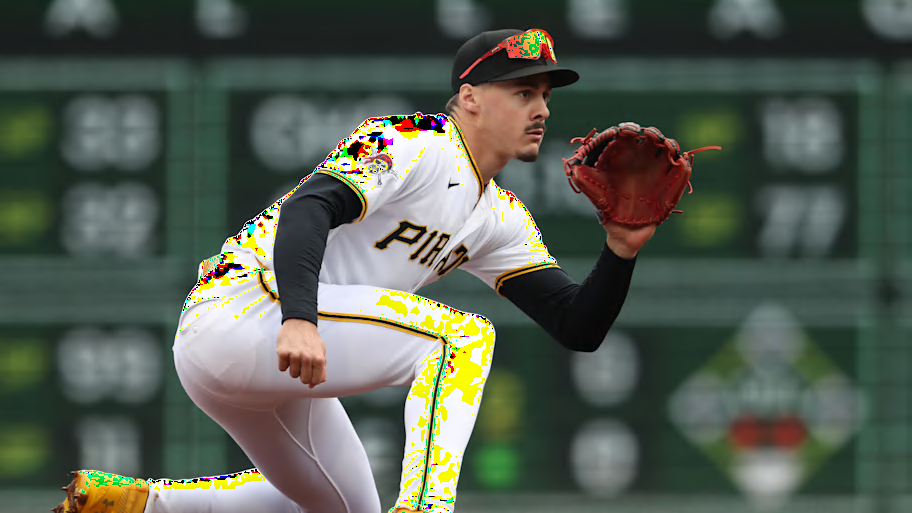
MLB increasingly is becoming a young man’s game. Konnor Griffin of the Pirates is the latest and the best of a deep crop of under-25 players who are changing the game. Yes, it’s early, but here’s a trend to watch: U-25 hitters are outperforming all other hitters by the greatest margin in at least the past 66 seasons.

Historically, teams were hesitant to play young players—and rightly so. From 1961-2015, U-25 players produced at a below-average rate as measured by adjusted OPS in 52 of the 55 years. Teams kept players in the minors longer.

Travel ball, better international training facilities, private academies for fitness, throwing and hitting, better team training facilities and improved infrastructure and coaching in collegiate baseball are shortening the learning curve to the majors.

The result: teams are trusting young hitters like never before. They are giving more at-bats to U-25 hitters and getting more production from them:

Years Seasons with 100+ OPS+ by U-25 Hitters
1961–2015 3 of 55
2016–25 7 of 11

The U-25 hitters have had a remarkable early start to this season. They have outperformed the traditional sweet-spot demographic, 26–30, as well as the young veterans aged 31–35. You must go back to 2018 to find the last time the youngest hitters ruled. That 2018 U-25 class included Bryce Harper, Shohei Ohtani, Juan Soto, Mookie Betts, Jose Ramirez, Manny Machado and Francisco Lindor.

This U-25 class has an OPS+ of 105, outperforming the major league average by the biggest margin since at least 1961, when the expansion era began.

In five-year increments, here is how the U-25 players have risen to the top, ranked against the 26–30 and 31–35 groups:

Year Pct. of PAs Rank tOPS+
2026 24.4% 1 105
2021 19.7% 3 98
2016 25.9% 2 100
2011 23.8% 2 97
2006 21.7% 3 95
2001 21.3% 3 91
1996 19.8% 3 89

And here’s the trend line in which you can see the growth in U-25 production, with the orange line set at 100, representing league average:

tOPS+by 25U Hitters, 1961–2026
tOPS+by U-25 Hitters, 1961–2026

And Another Reason ...

Young players are getting bigger and stronger. Griffin is only the third teenager to make his MLB debut while listed as at least 6-foot-3 and 220 pounds. The first, Larry McLean, played 13 years while battling problems involving alcohol. He died at 39, six years after his last game, when he was shot by a bartender in a Boston speakeasy.

Biggest Players to Debut as Teenagers

Player Year Height/Weight
Konnor Griffin, Pirates 2026 6’3", 222
Alex Rodriguez, Mariners 1994 6’3", 230
Larry McLean, Americans 1901 6’5”, 228

New School vs. Old School

Let’s compare this generation of U-25 players with the most recent U-25 class that outperformed all older players. Note that only one player from the 2018 group remains with the same organization, Jose Ramirez.

Position 2026 2018
Catcher Drake Baldwin, Braves Gary Sanchez, Yankees
First base Nick Kurtz, A’s Cody Bellinger, Dodgers
Second base Jackson Holliday, Orioles Javier Báez, Cubs
Shortstop Gunnar Henderson, Orioles Francisco Lindor, Cleveland
Third base Junior Caminero, Rays José Ramirez, Cleveland
Outfielder Corbin Carroll, D-Backs Mookie Betts, Red Sox
Outfielder Roman Anthony, Red Sox Bryce Harper, Nationals
Outfielder Julio Rodriguez, Mariners Juan Soto, Nationals
Designated hitter Chase DeLauter, Guardians Shohei Ohtani, Angels
Pitcher Paul Skenes, Pirates Blake Snell, Rays

List of the Week

Arizona Diamondbacks right fielder Corbin Carroll
Corbin Carroll is slashing .313/.410/.656 with two triples and two home runs in 10 games. | Rick Scuteri-Imagn Images

Diamondbacks outfielder Corbin Carroll will play career game No. 500 on Wednesday in New York against the Mets. An extra-base machine, he is only the fourth player with 80 homers and 40 triples in his first 500 games. The company he joins is epic.

Players with 80 HR & 40 Triples in First 500 Games

Player Home Runs Triples
Joe DiMaggio 120 46
Willie Mays 120 41
Lou Gehrig 94 52
Corbin Carroll 83 44

The Biggest ABS Adjustment

Have some empathy for veteran umpires who did not come up through the minors under ABS use and must adjust how they call a game in what amounts to on-the-job re-training.

For years they visualized the strike zone with the help of how a batter stood in the box. Now the player’s normal hitting stance does not matter. All that matters is the player’s height. The top is set at 53.5% of the player’s height and the bottom at 27%.

Let me show you how drastic of a visual change it has become. Cody Bellinger and Brenton Doyle are both 6’3”. Bellinger hits from an upright stance. Doyle hits with a deep bend in his knees. Because they are the same height, Bellinger and Doyle have the same strike zone. As they prepare to hit, the top of the strike zone to Bellinger falls well below his belt. To Doyle, it runs well above the belt. 

Cody Bellinger and Brenton Doyle strike zones
Bellinger and Doyle are the same height, yet their strike zones look different to the naked eye.

When a hitter steps in the box, the umpire must disregard how he stands at the plate. But he better know his height—and the same applies to the catcher if he wants to challenge a call.

The One Downside of ABS

Walks are up—and are likely to stay up. ABS increased the walk rate slightly in the minors so it should not be a surprise it’s happening in MLB. Umpires are tightening their strike zone, there is much less of the “scorecasting,” in which umpires widen their zone on 3–0 counts and one-sided games and hitters are more focused than ever on the edges of the zone.

Walks are up to 3.68 per team game. That’s the highest rate in 26 years. 

Based on minor league testing, MLB expected walks to increase slightly and strikeouts to decrease slightly. Surprise! Strikeouts, too, are up—way up. The rate of 9.04 strikeouts per team game would be a record, and up sharply from 8.5 last year. That’s not sustainable. The sample is too small to draw a hard conclusion but keep an eye on the more-walks-and-strikeouts effect of ABS.

Breakdown of the Week

Mike Soroka once was an All-Star at 21 years old for the Braves. Then he tore his Achilles—and tore it a second time. He was demoted to the minors. Went 0–10 for a 121-loss White Sox team. Settled for a one-year, $7.5 million free agent contract with Arizona. Along the way he reinvented himself with a deep dive into biomechanics, a new arsenal of pitches, a new delivery and the nastiest breaking pitch since Corey Kluber’s slurve. I’ll have more on how Soroka, like Charlie Morton, Roy Halladay and Jake Arrieta, taught himself how to pitch anew in a mid-career overhaul.

“There were a lot of people that helped me along the way,” he says. “A training group, lots of medical people ... it’s a group effort really. And I’m not done making progress. And that’s part of the thing that I learned to love—that I’m always going to be addicted to making progress one way or another.”

Soroka is 2–0 with a 0.90 ERA in two starts, already looking like one of best ROI signings of the winter. Over the past two years he has thrown 598 slurves (a turbo-boosted version of his old slider) and given up 14 hits for a .113 batting average. Right-handed hitters against Soroka this year are 1-for-15 with eight strikeouts.

Though it seems he’s been around forever, he is only 28 and built to be a workhorse (6’5”, 250 with much cleaner mechanics). For a quick version of how he became a new pitcher, check out the breakdown here.

Seen and Heard

Are injuries catching up to Ronald Acuna Jr.? He was ranked in the 98th percentile in baserunning when he won the MVP in 2023. He is down to the 26th percentile this year. His sprint speed has declined to the 30th percentile ... Arizona pitcher Zac Gallen has freshened his arsenal. He’s throwing his changeup with more depth and on the plate, rather than just fading it, as well as having more confidence in his two-seamer. Giants third baseman Matt Chapman told Gallen the sinker was a game changer once it registered as even a five percent option. Right-handed hitters could no longer lean over the plate hunting pitches away ... It will be interesting to see how long the Marlins remain committed to using Agustin Ramirez as a catcher. As well as Ramirez hits, he is a liability behind the plate with his troubles blocking pitches and receiving ... What’s up with the Minnesota-Miami connection? The Twins and Marlins made their eighth trade in the past three years. This time was a swap of relievers. The Marlins sent Garrett Acton, who had been DFA’d, to the Twins for Logan Whitaker ... White Sox slugger Munetaka Murakami has hit four home runs—all on fastballs in the middle of the plate at less than 94 mph ... Yes, it’s too early to draw conclusions, but more pitchers keep pushing up against the human limit of torque. Four-seam fastball velocity is up again—even as pitchers are still building arm strength. It’s up from 94.5 mph last year to 94.7 this year, which would be a record. (Velocity typically increases after the first month. Last year it was 94.2 in April and 94.6 after.) Ten years ago, it was 93.2. But its use is down (again) to 30.2%, which would be a record low since tracking began ... Don’t know how the Mets’ staff has done it, but Luis Robert Jr. looks like a different, much calmer hitter. With a career chase rate entering this year of 38%, wildly worse than the MLB average of 28%, Robert is hacking at just 26% of the pitches he sees out of the zone. This will never last, but Robert is chasing less than Juan Soto (31%). In 2022, Robert was in the 1st percentile of chase rate (meaning the worst). Now he’s in the 72nd percentile. It’s rare to see a hitter improve his chase rate so dramatically. The most famous outlier was Sammy Sosa.

Tom’s TV Desk

• Wednesday, April 8: Tigers @ Twins, 7:30 p.m. (FS1)
• Thursday, April 9: Diamondbacks @ Mets, 7 p.m. (MLB Network)

Remember those unfounded complaints of “the WBC is dangerous for pitchers?” No? Good. Two pitchers off to sizzling starts, Eduardo Rodriguez and Nolan McLean, provide a reprise of the WBC championship game matchup between Venezuela and the USA. Rodriguez has never moved the ball and mixed his arsenal more than he is now for Arizona. He has been dominant without cracking 95 mph.


More MLB from Sports Illustrated


This article was originally published on www.si.com as How MLB’s Unprecedented Youth Movement Came to Pass.

Sign up to read this article
Read news from 100's of titles, curated specifically for you.
Already a member? Sign in here
Related Stories
Top stories on inkl right now
One subscription that gives you access to news from hundreds of sites
Already a member? Sign in here
Our Picks
Fourteen days free
Download the app
One app. One membership.
100+ trusted global sources.