On the afternoon of July 11, 1964, the air in the bowl-shaped amphitheatre at the Indian Institute of Technology-Madras (IIT-M) crackled with nervous energy. The institute had successfully produced its first batch of qualified scientists and engineers. After delivering the convocation address, President S. Radhakrishnan awarded degrees to 92 graduates and 15 postgraduates. This is how a report in The Hindu, published on July 17, 2014, marking the Golden Jubilee of the IIT-Madras first batch of graduates, described the occasion. Today, the 65-year-old IIT, standing on a sprawling campus in the heart of Chennai, stands testimony to the efforts of visionary leaders who sowed the seeds of this prestigious higher educational institute nearly a decade after Independence.
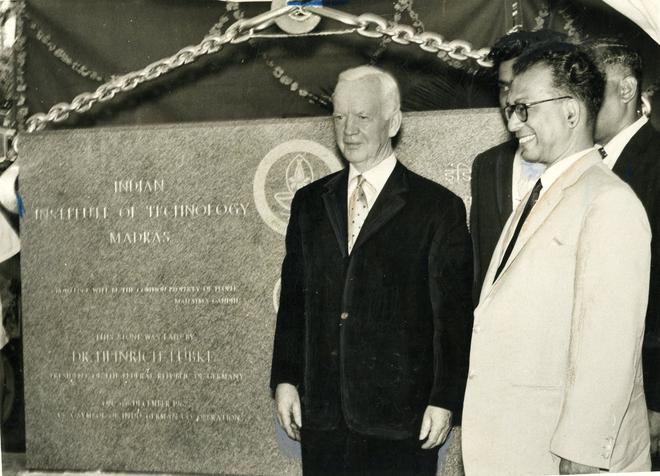
Congress veteran C. Subramaniam, in his memoir, Hand Of Destiny (Volume-I The Turning Point, Chapter 34), published by Bharatiya Vidya Bhavan, said that it was during the 1950s that the Government of India took steps to establish Indian Institutes of Technology, with the first one at Kharagpur. The steps to establish an IIT with foreign collaboration started in 1956, during the four-day official visit of Prime Minister Jawaharlal Nehru to West Germany. A report published in The Hindu on July 18, 1956, based on a communiqué issued at Bonn at the end of talks between Nehru and Chancellor of West Germany Konrad Adenauer, said, “The two Heads of Government agreed that in co-operation between the two countries a technical teaching institution is to be set up in India for which the Federal Government will make available teaching equipment.”