
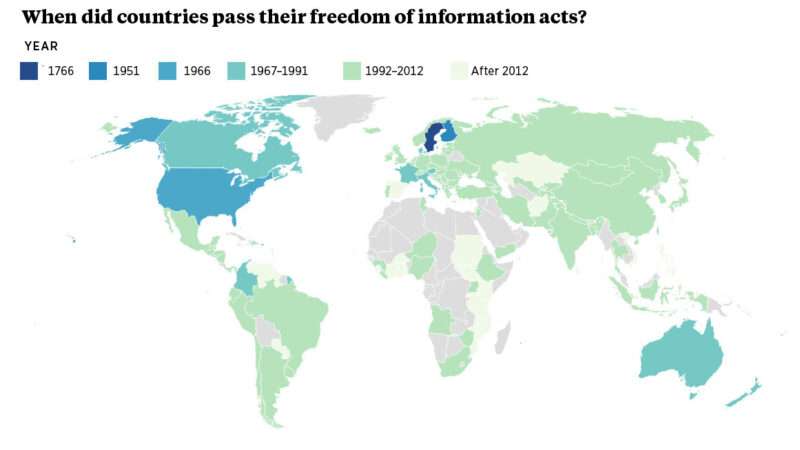
It's well-known that the government heavily censors documents before declassifying them—something humorously captured by The Onion in 2005 with the headline, "CIA Realizes It's Been Using Black Highlighters All These Years." But from a glass-half-full perspective, it's incredible that the U.S. government shares information with the public at all. The original Freedom of Information Act (FOIA) of 1966—the law under which many of those redacted documents are obtained—was the "product of years of slow campaigning by a network of journalists, scientists, and politicians seeking to make the government more transparent," the historian Sam Lebovic writes in State of Silence: The Espionage Act and the Rise of America's Secrecy Regime. FOIA was later strengthened in the wake of the Watergate scandals in the 1970s.
The efforts of those American activists opened the floodgates around the world. Out of 195 countries, 121 now have freedom of information or government transparency laws, according to FreedomInfo, a website run by George Washington University's National Security Archive and Article19, a British free speech nonprofit. All but two of those countries adopted their laws after America's FOIA reforms, and the vast majority came after the Cold War ended.













