Get all your news in one place.
100's of premium titles.
One app.
Start reading
Woman & Home
Woman & Home
Lifestyle
Natasha Brinsmead

How do you make a small patio look bigger with lighting? 'Layering is where the transformation really happens,' say experts

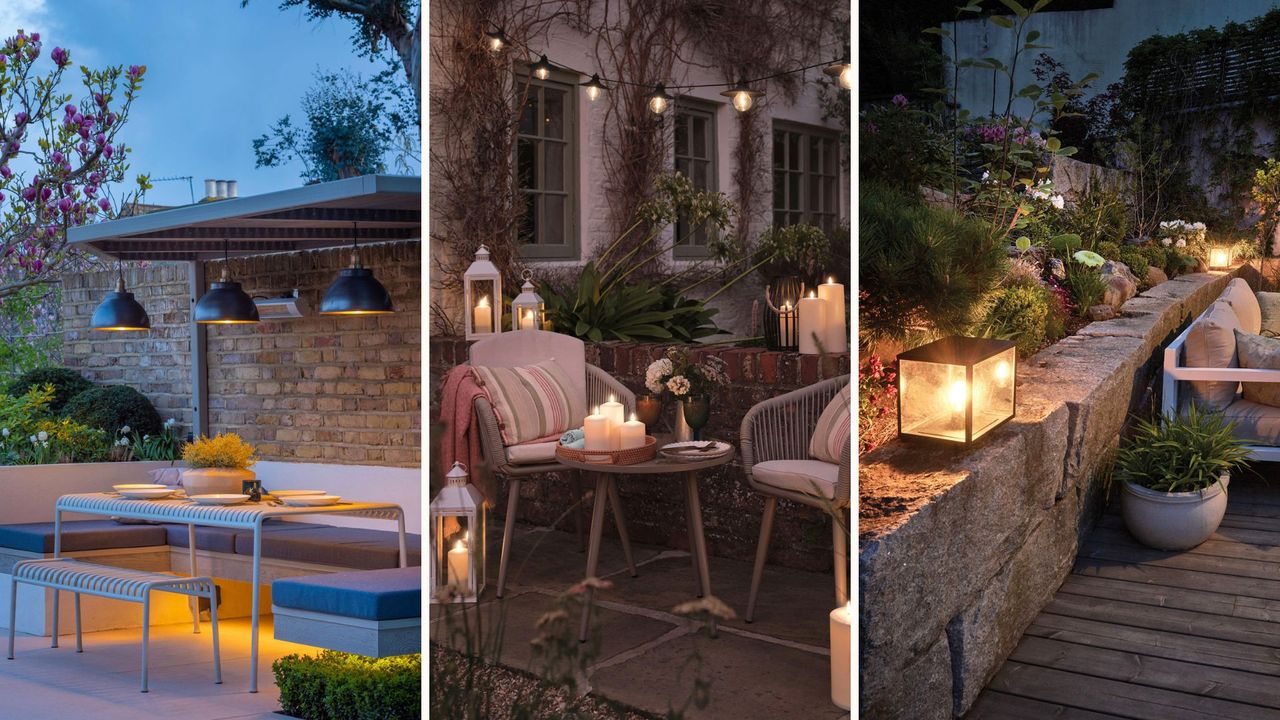
Compilation image of three patios at night to show exterior lighting in use.

You don't need a huge outdoor space to sit and enjoy your garden – I've learnt that even a petite patio, when styled thoughtfully, provides a tranquil spot to kick back and relax.

Taking into account all the clever small garden tips that incorporate lighting, you'll be amazed at how easy it is to enhance the space to maximise potential.

The right lights ensure, from a practical perspective, that your patio is somewhere you can take pleasure in using once night falls, but also adds a sense of space, interest and depth.

How I made my small patio feel bigger with exterior lighting

We reached out to leading experts in exterior lighting trends to get their advice on how to visually expand my small patio using lighting – their advice can make even the tiniest seating spaces gorgeous and glowing.

1. Creating the illusion of depth

(Image credit: KES Lighting & Home)

One of the best ways to make a small patio feel bigger, whether you plan on using it for your outdoor living room ideas or as a secluded spot to sunbathe, is to distract the eye from its proportions and guide it elsewhere.

Lee Lovett, co-founder and creative director of Soho Lighting Company, explains exactly how to do this. "Rather than centring light over a table or seating area, designers often look outwards. Illuminating the boundaries, highlighting walls, planting and fencing, draws the gaze beyond the immediate footprint, creating the illusion that the space continues further than it does.

Discreet spike lights are particularly effective here. Positioned within borders and angled back towards foliage or vertical surfaces, they gently pull focus away from the centre and into the garden beyond."

James Kendall, operations director at KES Lighting & Home, agrees with this approach. "Strategic lighting placement is key to making a small outdoor space feel far larger and more inviting. Rather than placing lights only near the house, try highlighting the far boundary or a tree at the back of the garden. This will help to draw the eye outwards, making the space feel larger after dark."

2. Drawing the eye upwards

(Image credit: Industville)

Whether you are dealing with a small patio or a small kitchen, it really does pay to focus not on the footprint of the space, but on height instead.

"Height plays an important role. In smaller spaces, everything tends to sit on a single plane, which can make the area feel enclosed," picks up Lee Lovett. "Introducing vertical beams of light – through an up-and-down wall fitting, for example – visually stretches the space. The eye follows the upward glow, lending walls a greater sense of scale and adding an architectural rhythm that feels considered rather than confined."

Mara Rypacek Miller, founder of Industville, has another clever way of drawing the gaze upwards, as well as adding a little drama with some of the latest garden trends.

"If your patio is covered, a central pendant can help anchor the space. Choose a size that feels balanced with the proportions of the area – too large and it will overwhelm, too small and it can feel lost. When done right, it draws the eye upward, subtly increasing the sense of height and openness."

3. Layering up light sources

(Image credit: Joanna Kossak; Lighting: Industville)

All kinds of spaces benefit from a layered lighting scheme, whether you are aiming to cosy up a living room or make a compact patio feel more expansive.

"Layering is where the transformation really happens," says Lee Lovett. "A softly lit wall, a cluster of planting picked out with a directional beam, a subtle uplighter catching the texture of brick or timber – each element builds on the next. Together, they create depth and contrast, ensuring the patio feels immersive rather than flat. Uplighters are especially useful for this, bringing quiet drama to overlooked corners and turning even the simplest feature into a focal point."

"Layering lighting prevents the space from feeling flat or enclosed," adds Julian Page, head of design at BHS. "Combining a main wall light with softer, secondary lighting helps to reduce shadows and bring balance to the overall scheme."

"Layering light instantly makes the space feel more considered and finished, while also improving how usable it is from day to night," picks up Mara Rypacek Miller. "Add wall lights to extend illumination into the edges and corners. This is especially effective in compact patios, where harsh shadows can make boundaries feel tighter."

4. Opting for warmer colour temperatures

(Image credit: Joanna Kossak; Lighting: Industville)

Never underestimate the power of light colour temperature – it can totally change the way a space, indoor or out, feels and appears.

"There’s a subtle art to colour temperature," explains Lee Lovett. "Warmer tones – from a sunset 1800k to a clearer 2000K – will both lend intimacy and comfort as well as look after the wildlife. Take care not to wander into cooler/bluer colours as this becomes harmful to our nocturnal friends."

Lee goes on to explain that the materials you choose for your fittings matter here. "Solid brass fittings bring a certain warmth and permanence to a scheme. Their finish ages beautifully over time, while the quality of light they emit tends to feel softer and more nuanced – ideal for creating an inviting, layered glow rather than a harsh wash of illumination. Stainless steel is clean and crisp, making it perfect for a contemporary look that's still classic and refined."

5. Taking care not to 'over-light' the space

(Image credit: Soho Lighting Company)

It is important that, in your quest to light your compact patio, you don't flood it with too much light. "A small patio benefits from pockets of shadow just as much as it does from light," points out Lee Lovett.

"By concealing the source and focusing on the effect – allowing light to graze surfaces, filter through patio container plants or border planting or highlight a single detail – the overall scheme feels effortless and considered. In the end, it’s not about making a small space brighter, but about making it feel deeper, softer and more layered. A place that draws you in, rather than closing you off."

"The key is to think less about adding brightness with exterior lighting and more about shaping how the space is perceived," adds Mara Rypacek Miller.

James Kendall is keen to point out the power of low-level lighting here. "Subtle ground lighting can help by creating a clean and uncluttered look. Low-level lights provide practical illumination, making the space both functional and welcoming, whatever its size."

6. Using wireless lighting for flexibility

(Image credit: Pooky)

Portable, rechargeable lamps are one of the hottest exterior lighting trends around right now. Partly due to the wide range of stylish design options on offer, but also because they make it possible to illuminate spots not served by electrical sockets.

"For maximum flexibility where sockets are limited, rechargeable table lamps are your best friend," says Jo Plant, chief creative officer at Pooky. "Placing one on a bistro table creates an instant, cosy focal point that mimics an indoor living room.

"To add depth, tuck a few wireless lights into planters at the far edges of your space – by illuminating the perimeter, you trick the eye into seeing more distance and a much larger 'room'."

FAQs

What IP rating should patio lighting have?

Remember, not all lights are suitable for use outdoors – while you might love the idea of that oversized pendant for your outdoor kitchen ideas, you'll need to check the IP rating first.

Ideally, you want to stick to IP65-rated waterproof lights to ensure they can withstand the elements and do your patio justice for many years to come. You also need to ensure that all your connectors and extension leads are outdoor-rated.

Once you have your patio lighting sorted, turn your attention to finding the best outdoor furniture for your space – not only does it need to suit the style of your garden, but it also needs to withstand all weathers, be robust and comfortable to use.

Sign up to read this article
Read news from 100's of titles, curated specifically for you.
Already a member? Sign in here
Related Stories
Top stories on inkl right now
One subscription that gives you access to news from hundreds of sites
Already a member? Sign in here
Our Picks
Fourteen days free
Download the app
One app. One membership.
100+ trusted global sources.