
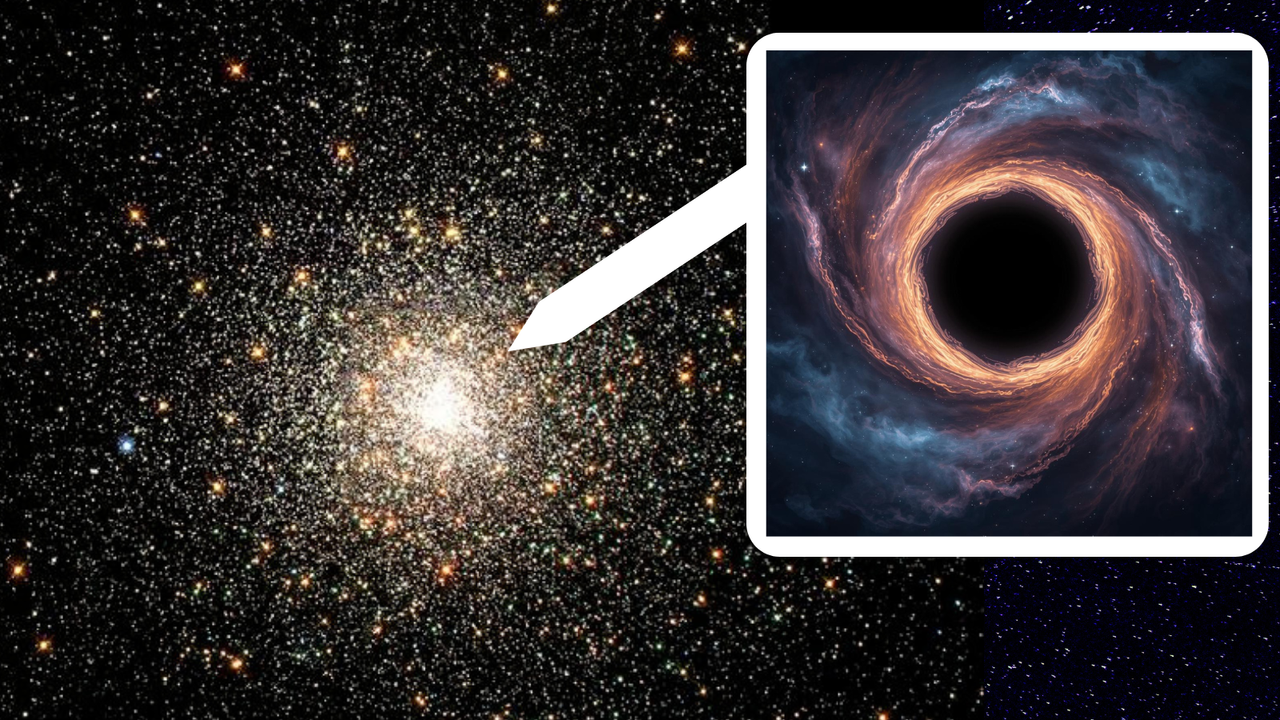
Scientists have discovered that the universe's most massive black holes may form in the densest of stellar environments, or so-called globular clusters. It is in these clusters where violent collisions are common, suggesting a chaotic new origin for these cosmic titans of our cosmos.
Scientists pinpointed this potential birthplace of massive black holes by studying ripples in space and time — unified as a single entity called spacetime — otherwise known as gravitational waves. The waves were heard" on Earth by our highly sensitive gravitational wave detectors, the Laser Interferometer Gravitational-Wave Observatory (LIGO), KAGRA and Virgo. Gravitational waves were first predicted by Albert Einstein back in 1915 as part of his theory of gravity, known as general relativity. They are launched when powerful events such as the collision and merger of black holes set the very fabric of spacetime ringing.














