
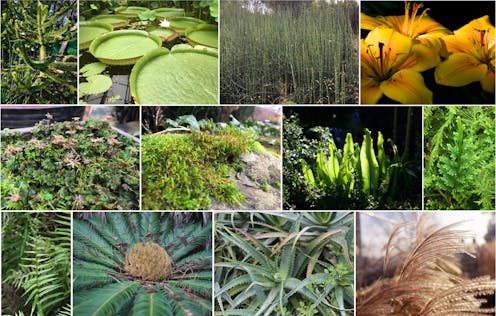
Plants range from simple seaweeds and single-celled pond scum, through to mosses, ferns and huge trees. Palaeontologists like us have long debated exactly how this diverse range of shapes and sizes emerged, and whether plants emerged from algae into multicellular and three-dimensional forms in a gradual flowering or one big bang.
To answer this question, scientists turned to the fossil record. From those best-preserved examples, like trilobites, ammonites and sea urchins, they have invariably concluded that a group’s range of biological designs is achieved during the earliest periods in its evolutionary history. In turn, this has led to hypotheses that evolutionary lineages have a higher capacity for innovation early on and, after this first phase of exuberance, they stick with what they know. This even applies to us: all the different placental mammals evolved from a common ancestor surprisingly quickly. Is the same true of the plant kingdom?














