Get all your news in one place.
100's of premium titles.
One app.
Start reading
The Conversation
The Conversation
Lana Williams, PhD Candidate, School of Physics and Astronomy, Lancaster University

How did Mars get its moons? Japan’s MMX space mission aims to solve the puzzle

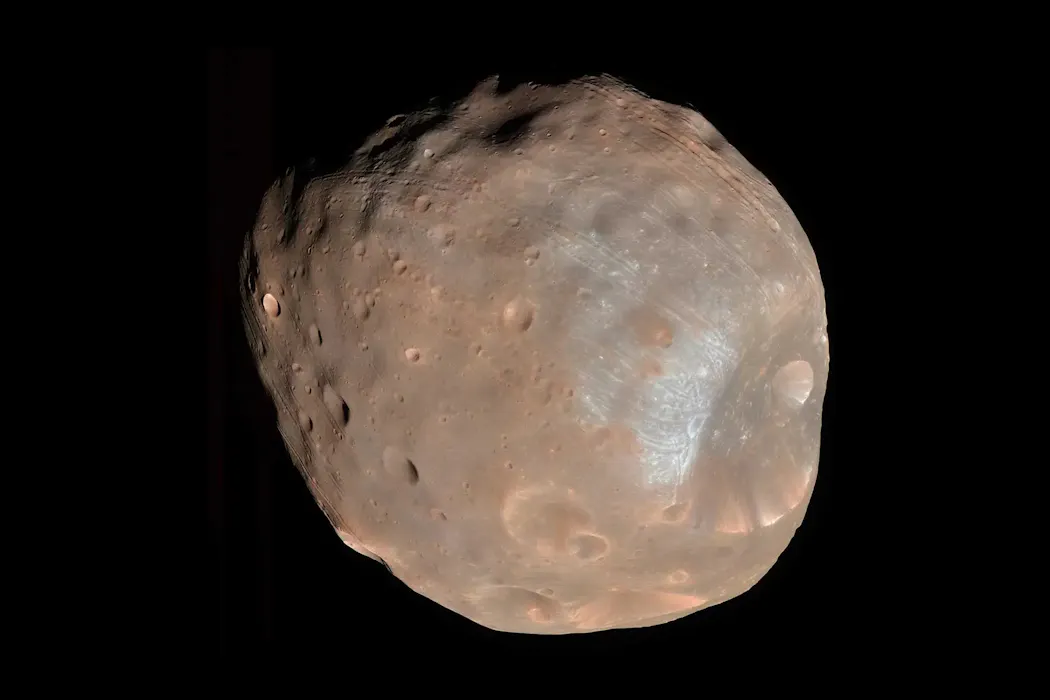
Phobos is dominated by Stickney crater, a 9km (5.6 mile) bowl visible on the right. NASA/JPL-Caltech/University of Arizona

The Earth got its Moon when a celestial object collided with our planet more than four billion years ago. This impact hurled molten rock into space, which eventually coalesced to form the satellite we can see every night from across our planet.

But what of our neighbour, Mars? The red planet has two small, irregularly shaped moons called Phobos and Deimos. There are several theories on how these natural satellites formed, but no clear front-runner. Soon, a Japanese-led space mission called Martian Moons Exploration (MMX) will begin its hunt for the answer.

Sign up to read this article
Read news from 100's of titles, curated specifically for you.
Already a member? Sign in here
Related Stories
Top stories on inkl right now
One subscription that gives you access to news from hundreds of sites
Already a member? Sign in here
Our Picks
Fourteen days free
Download the app
One app. One membership.
100+ trusted global sources.